Comparison

Sharp-tailed Sandpiper vs Red Knot

Sharp-tailed Sandpiper (Calidris acuminata) and Red Knot (Calidris canutus) both belong to the genus Calidris (stints) and part ways below it. Both are recorded in 50 countries.
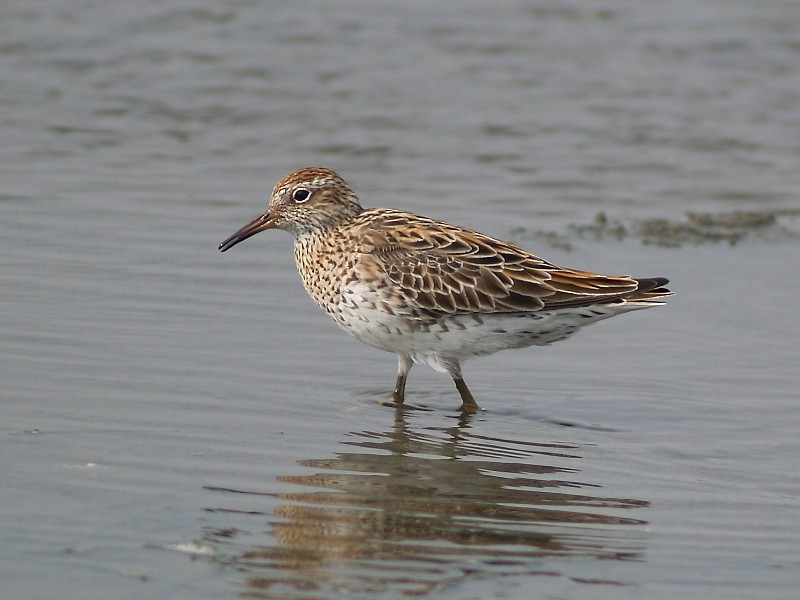
Sharp-tailed Sandpiper

Sharp-tailed Sandpiper

Calidris acuminata

Alnus, CC BY-SA 3.0, via Wikimedia Commons

Red Knot

Red Knot

Calidris canutus

JJ Harrison (https://www.jjharrison.com.au/), CC BY-SA 4.0, via Wikimedia Commons

Side by side

Sharp-tailed SandpiperRed Knot
Scientific nameCalidris acuminata (Horsfield, 1821)Calidris canutus (Linnaeus, 1758)
English nameSharp-tailed SandpiperRed Knot
GroupBirdsBirds
ClassAves BirdAves Bird
OrderCharadriiformes AuksCharadriiformes Auks
FamilyScolopacidae SandpiperScolopacidae Sandpiper
GenusCalidris StintsCalidris Stints
Named in18211758
Red List categoryVulnerableNear Threatened
Environmentmarine, terrestrialmarine, terrestrial
Countries on record62 countries149 countries
GBIF occurrence records177,980 records744,323 records

Rows where the two agree are shown in grey.

Where each is found

Both recorded in 50 countries

Only Sharp-tailed Sandpiper (12)

Only Red Knot (99)

From Catalogue of Life checklists and GBIF occurrence records. A country missing from a list means no record is held, which is not proof of absence.

Checked facts

Sharp-tailed SandpiperRed Knot
Appearance
  • The Sharp-tailed Sandpiper has a pot belly, flat back and elongated rear profile. English Wikipedia
  • Its upper body is mottled chestnut-brown, with dark-centred feathers and a chestnut-coloured crown. English Wikipedia
  • The species has a brown stripe running through each eye. English Wikipedia
  • Its bill is straight and dark grey to black, while its legs are olive to yellow. English Wikipedia
  • Its underparts are white or pale, with mottling across the breast and sides of the belly. English Wikipedia
  • Its plumage is more vivid during the breeding season and duller during winter. English Wikipedia
  • The red knot has a small head and eyes, a short neck, a slightly tapering bill, short dark legs, and a medium-thin dark bill. English Wikipedia
  • During the breeding season, adults develop cinnamon colouring on the face, throat, and breast, with mottled grey upperparts and a light-coloured rear belly. English Wikipedia
  • In winter, the red knot has uniformly pale grey plumage. English Wikipedia
  • Female breeding plumage is slightly lighter than male breeding plumage and has a less distinct eye-line. English Wikipedia
  • The red knot has a white wing bar and a grey rump and tail that are conspicuous in flight. English Wikipedia
  • Juveniles have distinctive submarginal lines and brown coverts during their first year. English Wikipedia
SizeNo checked fact yet
  • The red knot measures approximately 23–26 cm in length and has a wingspan of 47–53 cm. English Wikipedia
  • Adult body weight varies among subspecies from approximately 100 to 200 g. English Wikipedia
  • Red knots can increase their body weight to twice its usual level before migration. English Wikipedia
Habitat
  • Its Siberian breeding habitat consists mainly of tundra with peat hummocks and lichen. English Wikipedia
  • During migration, it favours muddy margins of shallow freshwater or brackish wetlands with low vegetation. English Wikipedia
  • Its migration habitats include swamps, lakes, lagoons and coastal pools. English Wikipedia
  • In Alaska, it uses coastal moist graminoid meadows and riverine mudbanks exposed by tides. English Wikipedia
  • In Australia, it mainly occupies wetlands and prefers inland freshwater wetlands with grassy edges. English Wikipedia
  • After ephemeral terrestrial wetlands dry out in Australia, the species tends to use coastal mudflats, salt marshes and brackish lagoons. English Wikipedia
  • Additional Australian habitats include sewage farms, flooded fields, mangroves, rocky shores and beaches. English Wikipedia
  • The species breeds in moist tundra environments in the Arctic. English Wikipedia
  • Red knots use intertidal mudflats as feeding areas during migration and winter. English Wikipedia
  • The species nests on the ground, usually inland and near water. English Wikipedia
Diet
  • On breeding grounds, red knots consume spiders, arthropods, insect larvae, and some plant material. English Wikipedia
  • During migration and winter, red knots feed on hard-shelled prey including bivalves, gastropods, and small crabs. English Wikipedia
  • Macoma molluscs are a preferred food of red knots on European coasts. English Wikipedia
  • Red knots feed extensively on horseshoe crab eggs in Delaware Bay during spring migration. English Wikipedia
  • Red knots swallow bivalves whole and crush them in their muscular stomachs. English Wikipedia
Behaviour
  • The species is strongly migratory, with its breeding and wintering ranges separated between Siberia and Australasia. English Wikipedia
  • Adults generally leave Siberia in July, while juveniles depart in August. English Wikipedia
  • Most of the population winters in Australasia. English Wikipedia
  • Most post-breeding adults migrate south in flocks containing fewer than 1,000 birds. English Wikipedia
  • Some juveniles and adults migrate east across the Bering Strait into Alaska. English Wikipedia
  • Migrating birds in Alaska remain from mid-August until late October to accumulate fat reserves. English Wikipedia
  • The species forages along wetland edges, intertidal mudflats, sand and bare wet mud. English Wikipedia
  • It sometimes forages in short-grass paddocks well away from water after rainfall. English Wikipedia
  • It generally feeds by picking up food visually, although it sometimes probes the substrate. English Wikipedia
  • At low tide, it forages on intertidal mudflats and moves inland to freshwater wetlands at high tide. English Wikipedia
  • Outside the breeding season, red knots form enormous flocks. English Wikipedia
  • Red knots use tactile feeding techniques to locate prey buried in mud. English Wikipedia
  • When feeding in soft mud, red knots can insert their bills approximately 1 cm below the surface while probing forward. English Wikipedia
  • Red knots can detect molluscs buried beneath wet sand by sensing water-pressure changes with Herbst corpuscles in their bills. English Wikipedia
  • Red knots can change the thickness of their gizzards according to the hardness of their seasonal food. English Wikipedia
  • Seasonal changes in red knot digestive organ size can occur within six days. English Wikipedia
  • Red knots undertake exceptionally long annual migrations between Arctic breeding grounds and southern wintering areas. English Wikipedia
  • Some red knots use the same migratory stopover sites each year to replenish their energy reserves. English Wikipedia
  • Red knots may remain at stopover sites for approximately 10–14 days while increasing their body weight. English Wikipedia
Reproduction
  • Red knots are territorial and seasonally monogamous. English Wikipedia
  • Red knots construct ground nests consisting of shallow scrapes lined with leaves, lichens, and moss. English Wikipedia
  • Females generally lay four eggs, with the clutch laid over approximately six days. English Wikipedia
  • Red knot eggs measure approximately 43 × 30 mm. English Wikipedia
  • Both parents share egg incubation duties equally. English Wikipedia
  • The incubation period lasts approximately 22 days. English Wikipedia
  • Red knot chicks are precocial and covered in downy feathers when they hatch. English Wikipedia
  • Female red knots leave before their offspring fledge, while males remain with the young. English Wikipedia
Distribution
  • The species breeds exclusively in eastern Siberia, from the Taymyr Peninsula to Chaunskaya Bay in Chukotka. English Wikipedia
  • The majority of the population winters in Australasia. English Wikipedia
  • During breeding, red knots have a circumpolar distribution across the high Arctic. English Wikipedia
  • Red knots migrate to coastal wintering areas at latitudes ranging from approximately 60° N to 55° S. English Wikipedia
  • The subspecies C. c. rufa breeds in the Canadian low Arctic and winters in South America. English Wikipedia
Conservation
  • The species was classified as globally vulnerable by the IUCN in 2021. English Wikipedia
  • Its estimated population comprises 60,000 to 120,000 mature individuals. English Wikipedia
  • Its global population trend is decreasing. English Wikipedia
  • Habitat loss caused by land reclamation for aquaculture and degradation from human activities threatens the species at migratory staging areas. English Wikipedia
  • In Australia, wetland clearing, inundation, drainage and infilling reduce the availability of feeding and roosting sites. English Wikipedia
  • Other threats include riparian vegetation loss, invasive species, water pollution and human-induced changes to hydrological regimes. English Wikipedia
  • The species faces mortality risks from hunting, vehicle collisions, aircraft strikes and predation by foxes and cats. English Wikipedia
  • The species was listed as vulnerable in New South Wales under the Biodiversity Conservation Act 2016 following a final determination. environment.nsw.gov.au
  • The estimated global population of red knots is approximately 1.1 million individuals. English Wikipedia
  • Red knot numbers in Tierra del Fuego and Delaware Bay declined by approximately 75 percent between the 1980s and 2000s. English Wikipedia
  • Delaware Bay supports an estimated 50–80 percent of migrating rufa red knots annually. English Wikipedia
Similar species
  • The Broad-billed Sandpiper is identified as the Sharp-tailed Sandpiper's closest relative within the genus Calidris. English Wikipedia
  • The Pectoral Sandpiper is the species most similar in appearance to the Sharp-tailed Sandpiper. English Wikipedia
  • The Sharp-tailed Sandpiper differs from the Pectoral Sandpiper by lacking a strongly demarcated breast band and having chevron-shaped flank markings. English Wikipedia
  • The Sharp-tailed Sandpiper resembles the Long-toed Stint but is substantially larger. English Wikipedia
No checked fact yet
Name originNo checked fact yet
  • The English name knot is thought to derive from the bird's characteristic grunting call. English Wikipedia

In brief

Sharp-tailed Sandpiper

Calidris acuminata breeds in eastern Siberia and most of the population winters in Australasia. It has a pot belly, flat back, chestnut-brown upper body and elongated rear profile. Full profile

Red Knot

Calidris canutus breeds across the high Arctic and migrates to coastal wintering areas between approximately 60° N and 55° S. It is distinguished by seasonal plumage changes, with cinnamon colouring during the breeding season and uniformly pale grey plumage in winter. Full profile

Compare something else

Page built on 28 November 2026 from the data on the two species pages, where every source is listed.

Cite this page

ScientificNames.org. (2026). Sharp-tailed Sandpiper vs Red Knot. Retrieved November 28, 2026, from https://scientificnames.org/compare/sharp-tailed-sandpiper-vs-red-knot