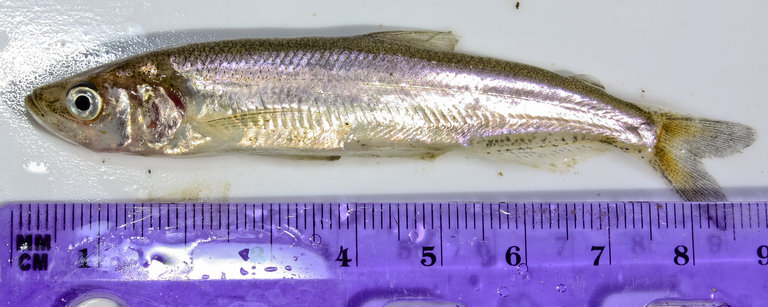
| Appearance | | - The species has an elongated, streamlined body that is compressed laterally. English Wikipedia
- Its sides and underside are generally silver-white, while its back ranges from olive-green or brown to pinkish. English Wikipedia
- Its pectoral fins extend nearly to the bases of its pelvic fins. English Wikipedia
- The species has a forked tail with two equally sized lobes. English Wikipedia
- Its lateral line is incomplete and extends only to just below the dorsal fin. English Wikipedia
- Its dorsal fin has 8–10 rays and its anal fin has 15–19 rays. English Wikipedia
- Its lower jaw projects beyond its upper jaw when compressed. English Wikipedia
- Teeth occur on the tongue and in both jaws. English Wikipedia
- Males generally have a more angular anal fin, sometimes with a small protruding bump, whereas females have a rounder anal fin. English Wikipedia
- Spawning males are generally darker than females and have extensive stippling on their backs and along their scale margins. adfg.alaska.gov
- During spawning, males develop enlarged and stiffened portions of their pectoral, pelvic, anal, and dorsal fins. adfg.alaska.gov
|
|---|
| Size | | |
|---|
| Habitat | - Shishamo is an anadromous fish that migrates between coastal marine waters and rivers. pmc.ncbi.nlm.nih.gov
| - The species generally inhabits bays and estuaries while spawning in coastal rivers. English Wikipedia
- The species can occupy marine, estuarine, and freshwater environments. English Wikipedia
- The species inhabits open water across most of the water column. English Wikipedia
- Marine populations prefer relatively shallow areas. English Wikipedia
- Spawning rivers are typically slow-moving because the fish cannot swim effectively through long stretches of fast-flowing water. adfg.alaska.gov
- Spawning sites are generally located in lower river or stream elevations. adfg.alaska.gov
- The species requires salinity levels between 2 and 18 parts per thousand. English Wikipedia
- Larvae require salinity between 0.4 and 10 parts per thousand and develop best at 5–10 parts per thousand. English Wikipedia
- Successful embryonic development requires water temperatures between 10 and 12 °C. English Wikipedia
|
|---|
| Diet | - Female shishamo viscera contain enriched levels of docosahexaenoic acid (DHA) and eicosapentaenoic acid (EPA). pmc.ncbi.nlm.nih.gov
| - Juveniles younger than one year feed on chironomids, copepods, and cladocerans. English Wikipedia
- Amphipods and cladocerans remain important food sources during winter. English Wikipedia
- Juveniles and adults mainly consume small crustaceans, particularly copepods, cumaceans, and euphausiids. adfg.alaska.gov
- Newly hatched juveniles feed mainly on copepod larvae, other plankton, and insect larvae. adfg.alaska.gov
|
|---|
| Behaviour | - Shishamo migrates upstream between October and December each year to spawn. English Wikipedia
| - The species forms large shoals. English Wikipedia
- Individuals generally remain deeper during daylight and ascend at night to feed. English Wikipedia
- Individuals gather in large groups near river mouths before migrating upstream to spawn. English Wikipedia
- Males generally migrate to spawning grounds before females. English Wikipedia
- The species does not consistently return to one particular spawning stream and instead appears to select suitable streams in its general natal area. adfg.alaska.gov
|
|---|
| Reproduction | - Larger female shishamo produce more eggs than smaller individuals. English Wikipedia
- Shishamo mostly spawns in locations where riverbed flow velocity is below 0.6 meters per second. English Wikipedia
| |
|---|
| Distribution | | No checked fact yet |
|---|
| Conservation | - Shishamo populations have declined markedly and the species is classified as endangered on Japan's Red List. pmc.ncbi.nlm.nih.gov
| - The species is classified as Least Concern on the IUCN Red List. English Wikipedia
- Watershed destruction and freshwater diversion, primarily for agriculture, threaten the species. English Wikipedia
- The San Francisco Bay-Delta population was listed as Endangered by the U.S. Fish and Wildlife Service on July 29, 2024. English Wikipedia
- Potential overharvesting by commercial, personal-use, and subsistence fisheries is identified as the main threat to the Alaskan resource. adfg.alaska.gov
|
|---|
| Uses | - Shishamo is consumed in Japanese cuisine, commonly grilled or fried whole with its roe intact. English Wikipedia
- Shishamo is a culturally and economically important fishery resource in Hokkaido. pmc.ncbi.nlm.nih.gov
- Commercial farming of shishamo has been attempted in Japan in response to declining catches. English Wikipedia
| No checked fact yet |
|---|
| Similar species | - Capelin (Mallotus villosus) is a closely related osmerid that is marketed in Japan under the name karafuto-shishamo. pmc.ncbi.nlm.nih.gov
| No checked fact yet |
|---|
| Name origin | - The Japanese name shishamo is derived from the Ainu name susam. English Wikipedia
- The Ainu name susam is thought to derive from the words susu, meaning willow, and ham, meaning leaf. English Wikipedia
- The Japanese name shishamo reflects the fish's resemblance to a willow leaf. English Wikipedia
| No checked fact yet |
|---|
| Other | - Monounsaturated fatty acids FA 22:1 and FA 20:1 are identified as molecular markers distinguishing shishamo from capelin. pmc.ncbi.nlm.nih.gov
- Shishamo is frequently substituted in markets with imported capelin because the two species are morphologically similar. pmc.ncbi.nlm.nih.gov
- Female shishamo meat is particularly rich in omega-3 polyunsaturated fatty acids. pmc.ncbi.nlm.nih.gov
| No checked fact yet |
|---|