Comparison
Indian Ocean Humpback Dolphin vs False Killer Whale
Indian Ocean Humpback Dolphin (Sousa plumbea) and False Killer Whale (Pseudorca crassidens) both belong to the family Delphinidae (oceanic dolphin) and part ways below it.

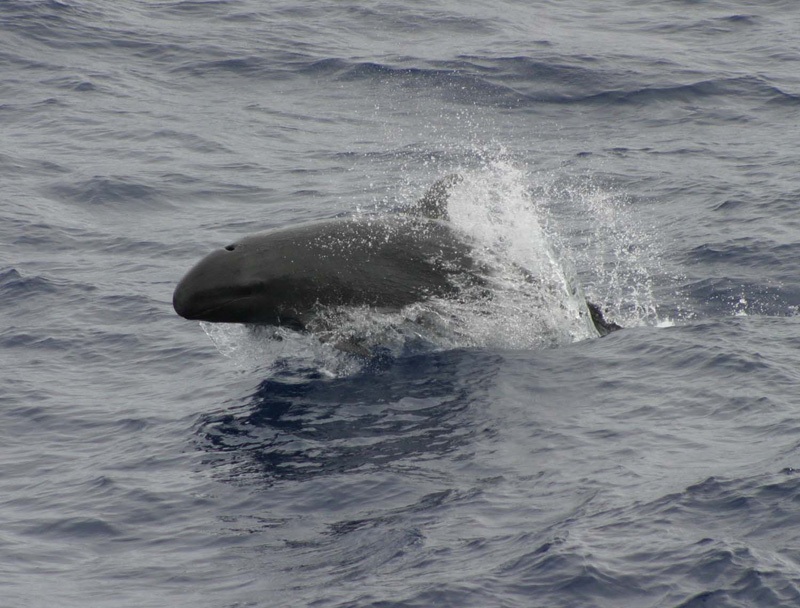


Side by side
| Indian Ocean Humpback Dolphin | False Killer Whale | |
|---|---|---|
| Scientific name | Sousa plumbea (G. Cuvier, 1829) | Pseudorca crassidens (Owen, 1846) |
| English name | Indian Ocean Humpback Dolphin | False Killer Whale |
| Group | Mammals | Mammals |
| Class | Mammalia Mammal | Mammalia Mammal |
| Order | Cetacea Cetacean | Cetacea Cetacean |
| Family | Delphinidae Oceanic Dolphin | Delphinidae Oceanic Dolphin |
| Genus | Sousa Humpbacked Dolphins | Pseudorca False Killer Whales |
| Named in | 1829 | 1846 |
| Red List category | Endangered | Near Threatened |
| Environment | marine | marine |
| Countries on record | 9 countries | 32 countries |
| GBIF occurrence records | 1,048 records | 9,197 records |
Rows where the two agree are shown in grey.
Where each is found
Only Indian Ocean Humpback Dolphin (9)
Only False Killer Whale (32)
- American Samoa
- Australia
- Bahamas
- Canada
- Costa Rica
- Cuba
- Cyprus
- Denmark
- Dominica
- France
- French Polynesia
- Grenada
- Guadeloupe
- Guam
- Ireland
- Italy
- Martinique
- Mexico
- Micronesia
- New Caledonia
- New Zealand
- Northern Mariana Islands
- Panama
- Portugal
- Spain
- Sweden
- The Netherlands
- Timor Leste
- United Kingdom
- United States
- United States Minor Outlying Islands
- Wallis and Futuna
From Catalogue of Life checklists and GBIF occurrence records. A country missing from a list means no record is held, which is not proof of absence.
Checked facts
| Indian Ocean Humpback Dolphin | False Killer Whale | |
|---|---|---|
| Appearance |
|
|
| Size |
| No checked fact yet |
| Habitat | No checked fact yet |
|
| Diet |
|
|
| Behaviour |
|
|
| Reproduction | No checked fact yet |
|
| Distribution |
| No checked fact yet |
| Conservation |
|
|
| Uses | No checked fact yet |
|
| Similar species | No checked fact yet |
|
| Name origin | No checked fact yet |
|
| Other |
| No checked fact yet |
In brief
Indian Ocean Humpback Dolphin
Sousa plumbea occurs from Southern Africa to Western Indochina, including coastal areas of East Africa, the Middle East and India. It has a fatty hump on its back that distinguishes it from Sousa chinensis. Full profile
False Killer Whale
Pseudorca crassidens inhabits tropical and subtropical marine waters, primarily in open-ocean and deep-water environments. It has a slender, dark gray or black body, an elongated tapered head without a distinct beak and a sickle-shaped dorsal fin. Full profile
Compare something else
Page built on 28 November 2026 from the data on the two species pages, where every source is listed.
Cite this page
ScientificNames.org. (2026). Indian Ocean Humpback Dolphin vs False Killer Whale. Retrieved November 28, 2026, from https://scientificnames.org/compare/indian-ocean-humpback-dolphin-vs-false-killer-whale
“Indian Ocean Humpback Dolphin vs False Killer Whale.” ScientificNames.org, 2026, scientificnames.org/compare/indian-ocean-humpback-dolphin-vs-false-killer-whale. Accessed 28 Nov. 2026.
ScientificNames.org. “Indian Ocean Humpback Dolphin vs False Killer Whale.” Accessed November 28, 2026. https://scientificnames.org/compare/indian-ocean-humpback-dolphin-vs-false-killer-whale.
@misc{scientificnames_indian_ocean_humpback_dolphin_vs_false_killer_whale,
  author = {{ScientificNames.org}},
  title = {Indian Ocean Humpback Dolphin vs False Killer Whale},
  year = {2026},
  url = {https://scientificnames.org/compare/indian-ocean-humpback-dolphin-vs-false-killer-whale},
  note = {Accessed 2026-11-28}
}