Comparison
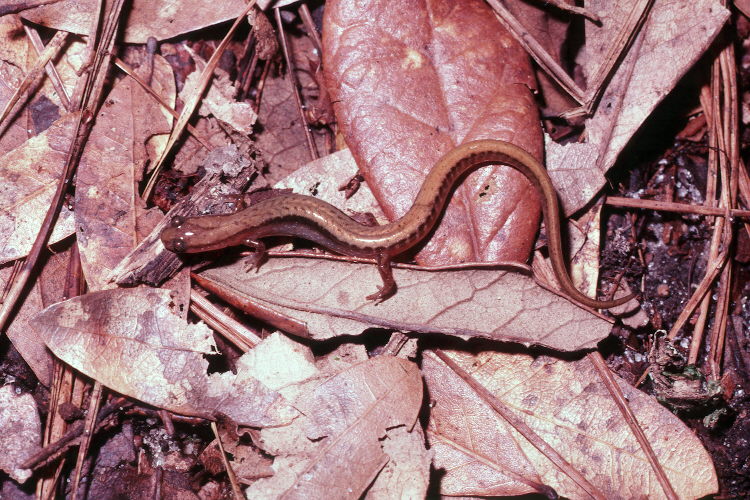
Southeastern Dwarf Salamander vs Blanco Blind Salamander
Southeastern Dwarf Salamander (Eurycea quadridigitata) and Blanco Blind Salamander (Eurycea robusta) both belong to the genus Eurycea (brook salamander) and part ways below it.

Blanco Blind Salamander
Eurycea robusta
Side by side
| Southeastern Dwarf Salamander | Blanco Blind Salamander | |
|---|---|---|
| Scientific name | Eurycea quadridigitata (Holbrook, 1842) | Eurycea robusta (Longley, 1978) |
| English name | Southeastern Dwarf Salamander | Blanco Blind Salamander |
| Group | Amphibians | Amphibians |
| Class | Amphibia Amphibians | Amphibia Amphibians |
| Order | Caudata Salamanders | Caudata Salamanders |
| Family | Plethodontidae Lungless Salamanders | Plethodontidae Lungless Salamanders |
| Genus | Eurycea Brook Salamander | Eurycea Brook Salamander |
| Named in | 1842 | 1978 |
| Red List category | Least Concern | Data Deficient |
| Countries on record | 1 country | Not recorded |
| GBIF occurrence records | 8,104 records | Not recorded |
Rows where the two agree are shown in grey.
Where each is found
Only Southeastern Dwarf Salamander (1)
From Catalogue of Life checklists and GBIF occurrence records. A country missing from a list means no record is held, which is not proof of absence.
Checked facts
| Southeastern Dwarf Salamander | Blanco Blind Salamander | |
|---|---|---|
| Appearance |
|
|
| Size |
|
|
| Habitat |
|
|
| Diet |
| No checked fact yet |
| Behaviour |
| No checked fact yet |
| Reproduction |
| No checked fact yet |
| Distribution |
|
|
| Conservation | No checked fact yet |
|
| Similar species |
| No checked fact yet |
| Name origin |
| No checked fact yet |
| Other | No checked fact yet |
|
In brief
Southeastern Dwarf Salamander
The Southeastern Dwarf Salamander is a salamander with a slender body and a long tail. It occurs from North Carolina south to Florida and west to Louisiana. Each foot has four toes. Full profile
Blanco Blind Salamander
The Blanco Blind Salamander is an aquatic, lungless salamander in the family Plethodontidae, order Caudata, and class Amphibia. It is endemic to a small area of the Blanco River near San Marcos in Hays County, Texas, United States, and any surviving members are believed to inhabit the Edwards Aquifer. It is distinguished by reduced eyes, a stout body, robust limbs, and a thick tail with moderate fins. Full profile
Compare something else
Page built on 27 November 2026 from the data on the two species pages, where every source is listed.
Cite this page
ScientificNames.org. (2026). Southeastern Dwarf Salamander vs Blanco Blind Salamander. Retrieved November 27, 2026, from https://scientificnames.org/compare/southeastern-dwarf-salamander-vs-blanco-blind-salamander
“Southeastern Dwarf Salamander vs Blanco Blind Salamander.” ScientificNames.org, 2026, scientificnames.org/compare/southeastern-dwarf-salamander-vs-blanco-blind-salamander. Accessed 27 Nov. 2026.
ScientificNames.org. “Southeastern Dwarf Salamander vs Blanco Blind Salamander.” Accessed November 27, 2026. https://scientificnames.org/compare/southeastern-dwarf-salamander-vs-blanco-blind-salamander.
@misc{scientificnames_southeastern_dwarf_salamander_vs_blanco_blind_salamander,
  author = {{ScientificNames.org}},
  title = {Southeastern Dwarf Salamander vs Blanco Blind Salamander},
  year = {2026},
  url = {https://scientificnames.org/compare/southeastern-dwarf-salamander-vs-blanco-blind-salamander},
  note = {Accessed 2026-11-27}
}