Comparison

Southeastern Dwarf Salamander vs Northern Two-lined Salamander

Southeastern Dwarf Salamander (Eurycea quadridigitata) and Northern Two-lined Salamander (Eurycea bislineata) both belong to the genus Eurycea (brook salamander) and part ways below it. Both are recorded in 1 country.
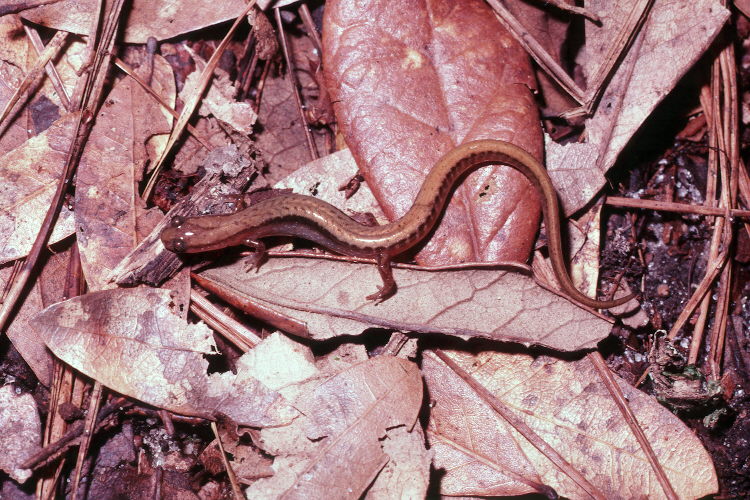
Southeastern Dwarf Salamander

Southeastern Dwarf Salamander

Eurycea quadridigitata

USGS, Public domain, via Wikimedia Commons

Northern Two-lined Salamander

Northern Two-lined Salamander

Eurycea bislineata

Brian Gratwicke, CC BY 2.0, via Wikimedia Commons

Side by side

Southeastern Dwarf SalamanderNorthern Two-lined Salamander
Scientific nameEurycea quadridigitata (Holbrook, 1842)Eurycea bislineata (Green, 1818)
English nameSoutheastern Dwarf SalamanderNorthern Two-lined Salamander
GroupAmphibiansAmphibians
ClassAmphibia AmphibiansAmphibia Amphibians
OrderCaudata SalamandersCaudata Salamanders
FamilyPlethodontidae Lungless SalamandersPlethodontidae Lungless Salamanders
GenusEurycea Brook SalamanderEurycea Brook Salamander
Named in18421818
Red List categoryLeast ConcernLeast Concern
Countries on record1 country2 countries
GBIF occurrence records8,104 records32,342 records

Rows where the two agree are shown in grey.

Where each is found

Both recorded in 1 country

Only Northern Two-lined Salamander (1)

From Catalogue of Life checklists and GBIF occurrence records. A country missing from a list means no record is held, which is not proof of absence.

Checked facts

Southeastern Dwarf SalamanderNorthern Two-lined Salamander
Appearance
  • Adults have yellow to yellowish-brown coloration with two black stripes running along the back. English Wikipedia
  • The flanks are mottled grayish or brown, and the belly is pale yellowish and nearly transparent. English Wikipedia
  • Adults have four toes on their forefeet and five toes on their hind feet. English Wikipedia
  • Adults have 14–16 costal grooves along their sides. English Wikipedia
  • Adult coloration includes a broad yellow, greenish-yellow, or tan stripe bordered by narrow black lines. animaldiversity.org
  • The dorsal stripe may contain a central row of dark spots. animaldiversity.org
  • Breeding males develop whitish lower eyelid glands, a mental gland on the chin, and protruding cirri. animaldiversity.org
  • Young larvae have yellowish ground coloration with gray or brown spots on the head and back. animaldiversity.org
  • Young larvae have short reddish-brown gills. animaldiversity.org
Size
Habitat
  • The species inhabits temperate forests, temperate shrublands, rivers, intermittent rivers, freshwater marshes, and freshwater springs. English Wikipedia
  • The species prefers small rocky streams and forest seeps. English Wikipedia
  • Adults commonly occur along stream banks and prefer habitats with cover from fallen leaves, logs, or rocks. animaldiversity.org
  • Adults may remain active in springs, streams, or waterlogged soil during winter when temperatures remain above freezing. animaldiversity.org
Diet
  • Adult prey includes beetles, mayflies, springtails, spiders, pillbugs, centipedes, earthworms, and snails. animaldiversity.org
  • Larvae consume chironomid larvae, other dipteran larvae, stonefly larvae, cladocerans, and copepods. English Wikipedia
  • Adult diets also include wood roaches, millipedes, flies, hymenopterans, sowbugs, caddisfly larvae, and occasionally trout fry. English Wikipedia
  • Larvae consume aquatic larvae of midges, mosquitoes, caddisflies, stoneflies, and beetles. animaldiversity.org
Behaviour
  • The species spends most of its time beneath leaf litter or debris on the forest floor. English Wikipedia
  • Adults and juveniles commonly hide under rocks and debris along stream edges during daylight. English Wikipedia
  • Most above-ground movements occur after dark and during wet weather. English Wikipedia
  • Adults are territorial, and population density can decrease when resources are scarce. English Wikipedia
  • Adults may drop their tails when threatened by predators, allowing them to escape while the detached tail continues moving. animaldiversity.org
  • Aquatic larvae use chemical cues in water to detect predatory fish and may hide for several days after detecting them. animaldiversity.org
Reproduction
  • Courtship may occur between September in southern populations and May in northern populations. English Wikipedia
  • The breeding season extends from October through May. animaldiversity.org
  • Females generally lay eggs in April or May. animaldiversity.org
  • Fertilization is internal and occurs after the female collects a spermatophore in her cloaca. animaldiversity.org
  • Females may deposit between fifteen and more than one hundred eggs beneath firm substrates, usually rocks, in flowing streams or spring water. animaldiversity.org
  • Females may guard their nests during part of an incubation period lasting 30–60 days. animaldiversity.org
  • Larvae generally transform into semiterrestrial juveniles after two to three years. animaldiversity.org
  • Sexual maturity is generally reached at three to four years of age. English Wikipedia
Distribution
  • Eurycea quadridigitata sensu stricto occurs from North Carolina south to Florida and west to Louisiana. English Wikipedia
  • The dwarf salamander and Chamberlain's dwarf salamander have little overlap in their geographic ranges. ncwildlife.gov
  • The species occurs in Canada and the United States. English Wikipedia
  • Its range includes southern Quebec, New Brunswick, northeastern Ontario, and northeastern regions of the United States. English Wikipedia
  • The southern extent of its range reaches northern Virginia, while its western extent reaches northeastern Ohio. animaldiversity.org
ConservationNo checked fact yet
  • Habitat destruction and collection for fish bait could reduce or eliminate local populations. animaldiversity.org
UsesNo checked fact yet
Similar species
  • A 2017 review identified five cryptic species within the group previously classified as Eurycea quadridigitata. English Wikipedia
  • Eurycea chamberlaini occurs in North Carolina and inland areas of South Carolina. English Wikipedia
  • Eurycea sphagnicola occurs in southern Mississippi, Alabama and the far western Florida Panhandle. English Wikipedia
  • Eurycea hillisi occurs in inland regions of Alabama and Georgia. English Wikipedia
  • Eurycea paludicola occurs in Louisiana, Texas and Arkansas. English Wikipedia
  • The northern two-lined salamander is more associated with aquatic environments than the northern redback salamander. English Wikipedia
Name origin
  • The specific epithet quadridigitata refers to the presence of four toes on each foot. English Wikipedia
No checked fact yet

In brief

Southeastern Dwarf Salamander

The Southeastern Dwarf Salamander is a salamander with a slender body and a long tail. It occurs from North Carolina south to Florida and west to Louisiana. Each foot has four toes. Full profile

Northern Two-lined Salamander

The Northern Two-lined Salamander occurs in Canada and the United States, including southern Quebec, New Brunswick, northeastern Ontario, and northeastern regions of the United States. Adults have yellow to yellowish-brown coloration with a broad dorsal stripe bordered by black lines. Full profile

Compare something else

Page built on 28 November 2026 from the data on the two species pages, where every source is listed.

Cite this page

ScientificNames.org. (2026). Southeastern Dwarf Salamander vs Northern Two-lined Salamander. Retrieved November 28, 2026, from https://scientificnames.org/compare/southeastern-dwarf-salamander-vs-northern-two-lined-salamander