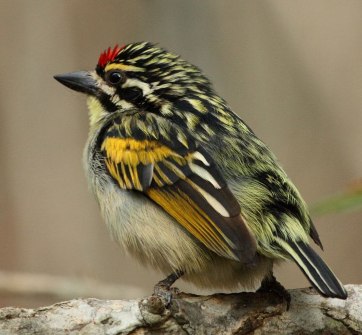
| Appearance | - The adult has black upperparts with extensive yellow and white streaking and a golden patch on its wings. English Wikipedia
- Its head features a prominent black-and-white pattern and a red spot on the forecrown. English Wikipedia
- Its underparts and rump are lemon yellow. English Wikipedia
- Male and female individuals have similar appearances. English Wikipedia
- Juvenile individuals do not have the red forehead marking. English Wikipedia
- The species has a plump body, short neck, large head and short tail. English Wikipedia
| - The species has predominantly yellow-tinged green plumage, a paler belly and darker undersides. English Wikipedia
- Grey feathers with green tips give the upper lores, ear coverts and sides of the neck an olive-grey appearance. English Wikipedia
- A distinctive white stripe extends from the corners of the bill along the lower lores and beneath the eyes. English Wikipedia
- The white facial stripe continues down both sides of the neck, where it broadens and ends abruptly. English Wikipedia
- Its blackish neck sides contrast with its yellow-green back and bright-yellow rump. English Wikipedia
- The tail feathers are black with yellow-green edges. English Wikipedia
- Its wings are black, with green-yellow markings along the inner primary and secondary feathers. English Wikipedia
- Yellow tips on the greater and middle wing coverts create the appearance of a broad yellow wing bar. English Wikipedia
- The underwings are predominantly off-white and visible during flight. English Wikipedia
- The species has black feet and a two-coloured bill. English Wikipedia
- The bill changes from off-white or yellow near its base to grey or black around the middle. English Wikipedia
- Females generally resemble immature males, and the species exhibits little sexual dimorphism. English Wikipedia
- Immature birds may have less brightly coloured yellow patches on their rump and wings. English Wikipedia
- Immature birds may have a larger, paler and more yellowish belly patch. English Wikipedia
- Young chicks possess spiky hypotarsal scutes. English Wikipedia
|
|---|
| Size | | |
|---|
| Habitat | | - The species inhabits high-altitude evergreen forests. English Wikipedia
- Its usual elevation range is 900–2,500 metres above sea level, although it can occur above 3,000 metres. English Wikipedia
- Some individuals inhabit lower elevations of the Usambara mountain range at approximately 450 metres. English Wikipedia
- The species primarily occupies dense interior areas of secondary-growth forests. English Wikipedia
- Suitable habitat must contain four to six mistletoe species to provide fruit throughout the year. English Wikipedia
|
|---|
| Diet | - The species feeds on berries and fruit, with mistletoe being a particularly important food. English Wikipedia
- The species also consumes insects while foraging in dense vegetation. English Wikipedia
| - The species specializes in eating mistletoe fruits from the Loranthaceae and Viscaceae families but also consumes insects. English Wikipedia
- When eating some mistletoe fruits, the bird removes their indigestible outer coverings before swallowing the berries whole. English Wikipedia
- The species regurgitates mistletoe seeds covered in viscin within minutes of eating the fruits. English Wikipedia
|
|---|
| Behaviour | - The species sings from concealed locations rather than prominent perches. English Wikipedia
- The species is more frequently heard than seen. English Wikipedia
- Its call consists of a rapid sequence of repeated tink sounds at approximately 101 repetitions per minute. English Wikipedia
| - Regurgitated mistletoe seeds are deposited on nearby branches, often close to the plant from which the fruits originated. English Wikipedia
- The species contributes to the dispersal of the mistletoe species whose fruits it consumes. English Wikipedia
- Both sexes become particularly vocal during the breeding season. English Wikipedia
- The species usually sings while concealed in dense vegetation. English Wikipedia
- Individuals occasionally vocalize from exposed perches. English Wikipedia
- Its trilled calls last no more than a few seconds. English Wikipedia
- Individuals respond to rivals using varied sequences of vocalizations. English Wikipedia
- Rivals sometimes chatter while aggressively pursuing one another through trees. English Wikipedia
|
|---|
| Reproduction | | - The species nests in cavities excavated by its parents in dead trees. English Wikipedia
- The average diameter of the nest entrance is approximately 2 centimetres. English Wikipedia
- Parents typically produce one or two eggs per brood. English Wikipedia
- Females usually lay eggs between September and November, with December laying occurring rarely. English Wikipedia
- Females that lay early may attempt a second clutch in December after their first brood fledges. English Wikipedia
- A nesting period lasts approximately 33 days. English Wikipedia
- Parents feed their chicks insects and mistletoe berries during the breeding season. English Wikipedia
- Chicks regurgitate mistletoe seeds, which their parents carry away from the nest. English Wikipedia
|
|---|
| Distribution | - The species occurs in southern Mozambique and eastern South Africa. English Wikipedia
| - The species occurs in Kenya, Malawi, Tanzania, Uganda and Zambia. English Wikipedia
- The species is resident throughout its documented range. English Wikipedia
- Although non-migratory, some individuals occasionally move away from established populations to forest patches 30–40 kilometres away. English Wikipedia
|
|---|
| Conservation | | - The species was most recently assessed for the IUCN Red List in 2024. iucnredlist.org
|
|---|
| Similar species | - The species was formerly classified as the same species as the northern red-fronted tinkerbird (Pogoniulus uropygialis). English Wikipedia
- The species can be distinguished from the yellow-fronted tinkerbird by its forehead spot colour, golden wing patch and darker overall appearance. English Wikipedia
- The species is sometimes confused with the red-fronted barbet. English Wikipedia
- The species is smaller than the red-fronted barbet and has a black moustache, a less robust bill and no broad yellow superciliary stripe. English Wikipedia
| - The green tinkerbird (Pogoniulus simplex) is a close relative of the moustached tinkerbird. English Wikipedia
- The moustached tinkerbird and green tinkerbird were considered conspecific in the early twentieth century. English Wikipedia
|
|---|