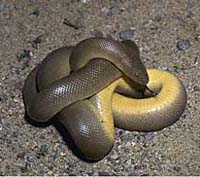
| Appearance | - The southern rubber boa is a small snake with a blunt tail. English Wikipedia
- Adult females have higher percentages of tail-tip scarring and tail shortening than males. English Wikipedia
| - The species has loose, wrinkled skin covered with small, smooth, shiny scales that give it a rubber-like appearance and texture. English Wikipedia
- Adults typically have tan to dark brown coloration with a lighter underside, although olive-green, yellow, and orange individuals also occur. English Wikipedia
- Newborn individuals are often pink and slightly transparent before darkening as they age. English Wikipedia
- The species has small eyes with vertically elliptical pupils and short, blunt heads that are no wider than its body. English Wikipedia
- Its short, blunt tail closely resembles the shape of its head. English Wikipedia
- Individuals typically have brown to olive-green upper coloration and yellow to cream undersides. animaldiversity.org
- Dark spots or mottling can occur on the upper body, particularly in northern populations. animaldiversity.org
- The tail contains a thick bulb of bone and resembles the head. animaldiversity.org
|
|---|
| Size | - Female southern rubber boas have greater length and weight than males. English Wikipedia
| - Adults typically measure between 38 and 84 cm in length. English Wikipedia
- Newborn individuals typically measure between 19 and 23 cm in length. English Wikipedia
- Individuals commonly measure between 38 and 64 cm, although the documented overall range is 35 to 84 cm. animaldiversity.org
|
|---|
| Habitat | - The species typically inhabits woodlands and coniferous forests with developed soils and high vegetative productivity. English Wikipedia
- Its habitats are generally moist and may contain accumulated organic debris. English Wikipedia
- The species uses outcrops, loose and developed soils, and tree debris for burrowing and shelter. English Wikipedia
| - The species inhabits grasslands, meadows, chaparral, deciduous forests, coniferous forests, and high alpine environments. English Wikipedia
- The species occurs at elevations ranging from sea level to over 3,000 metres. English Wikipedia
- The species prefers moist coniferous forests, grassy meadows, and streamsides. animaldiversity.org
- Individuals use rodent burrows, rock outcroppings, fallen logs, and dense leaf and pine-needle litter for shelter. animaldiversity.org
- During summer, individuals are commonly found near streams, springs, and rivers. animaldiversity.org
|
|---|
| Diet | - The southern rubber boa eats lizard eggs rather than the lizards themselves. English Wikipedia
| - The species primarily feeds on young mammals, including shrews, voles, and mice. English Wikipedia
- Its documented prey also includes salamanders, frogs, reptile eggs, lizards, young birds, bats, and other snakes. English Wikipedia
|
|---|
| Behaviour | - The species has a secretive nature that makes collecting specimens for data difficult. English Wikipedia
- The tendency to consume lizard eggs instead of lizards distinguishes the southern rubber boa from other rubber boas. English Wikipedia
- Female southern rubber boas can be injured by animals defending their young against boa predation. English Wikipedia
| - When threatened, individuals can release a strong-smelling musk from their vent. English Wikipedia
- During winter, individuals brumate in underground dens. English Wikipedia
- When threatened by predators, individuals curl around their heads and expose their tails as decoys. English Wikipedia
- The species is solitary outside the breeding season, and individuals can have overlapping territories without being territorial. animaldiversity.org
- The species has a prehensile tail that helps it climb vegetation and swim. animaldiversity.org
|
|---|
| Reproduction | - The species is ovoviviparous, with eggs hatching inside the parent. English Wikipedia
- Southern rubber boas produce between two and eight young. English Wikipedia
- Female boas typically emerge from hibernation in April under reproductive conditions. English Wikipedia
- Mating begins immediately after emergence from hibernation and continues through May. English Wikipedia
- Births occur from late summer through autumn, with most young born between late August and September. English Wikipedia
- Female southern rubber boas lose approximately 47% of their body weight during gestation. English Wikipedia
| |
|---|
| Distribution | - The southern rubber boa is endemic to the United States, specifically southern California. English Wikipedia
- The species occurs in the San Bernardino and San Jacinto Mountains east of Los Angeles, California. English Wikipedia
- The species occurs at elevations between 4,900 and 7,900 feet. English Wikipedia
- An area in northeastern California contains populations of both northern and southern rubber boas. English Wikipedia
- Isolated populations in the Southern Los Padres Ranges contain some intergrades between northern and southern rubber boas. English Wikipedia
| - The species occurs across western North America, from the Pacific Coast to western Utah and Montana, and from central California to southern British Columbia. English Wikipedia
- Its documented range includes California, Oregon, Washington, Nevada, Utah, Wyoming, Montana, and Idaho, as well as British Columbia. English Wikipedia
- The species also occurs in southern Canada and extends south to southern California. animaldiversity.org
|
|---|
| Conservation | - As of April 2017, the southern rubber boa was listed as threatened by the state of California. English Wikipedia
| No checked fact yet |
|---|
| Similar species | - Phylogenetic analyses distinguish northern and southern rubber boas as separate groups. English Wikipedia
| No checked fact yet |
|---|