Comparison

Striated Babbler vs Arabian Babbler

Striated Babbler (Argya earlei) and Arabian Babbler (Argya squamiceps) both belong to the genus Argya and part ways below it.
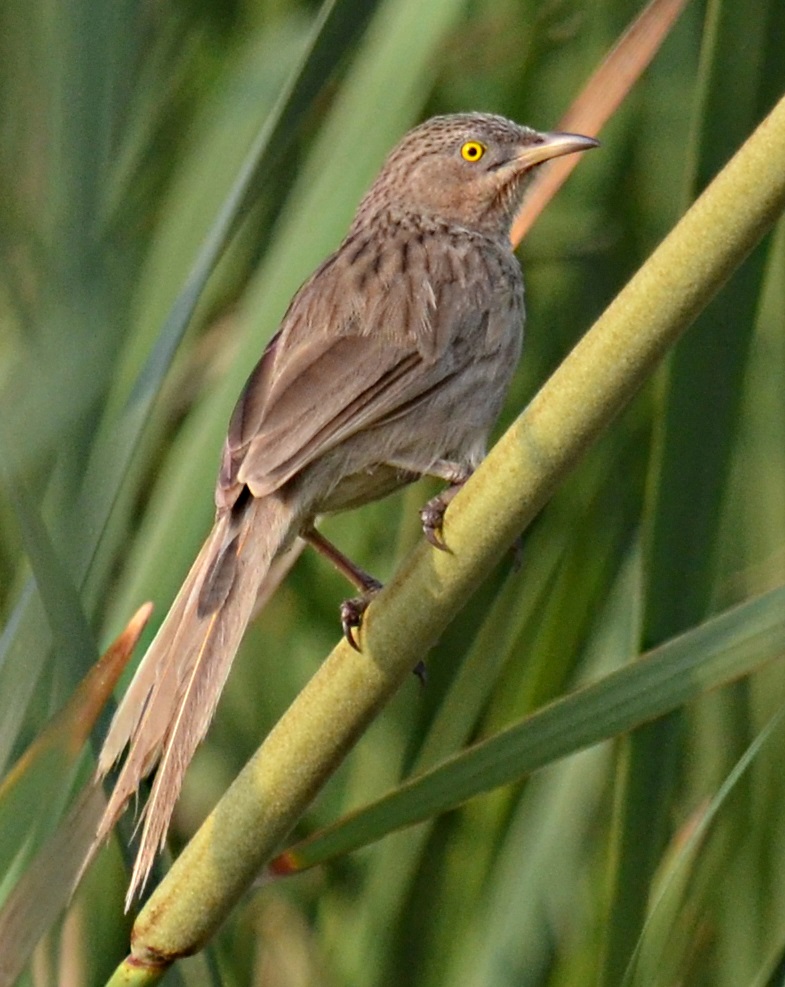
Striated Babbler

Striated Babbler

Argya earlei

Munish Jauhar, CC BY-SA 3.0, via Wikimedia Commons

Arabian Babbler

Arabian Babbler

Argya squamiceps

Zvika Ben-Haim, CC BY 4.0, via Wikimedia Commons

Side by side

Striated BabblerArabian Babbler
Scientific nameArgya earlei (Blyth, 1844)Argya squamiceps (Cretzschmar, 1827)
English nameStriated BabblerArabian Babbler
GroupBirdsBirds
ClassAves BirdAves Bird
OrderPasseriformes PasserinePasseriformes Passerine
FamilyLeiothrichidae LaughingthrushLeiothrichidae Laughingthrush
GenusArgyaArgya
Named in18441827
Red List categoryLeast ConcernLeast Concern
Countries on record5 countries7 countries
GBIF occurrence records14,701 records25,216 records

Rows where the two agree are shown in grey.

Where each is found

Only Striated Babbler (5)

Only Arabian Babbler (7)

From Catalogue of Life checklists and GBIF occurrence records. A country missing from a list means no record is held, which is not proof of absence.

Checked facts

Striated BabblerArabian Babbler
Appearance
  • The species has brown plumage with fine streaking on its back and crown. ebird.org
  • The species has bright yellow eyes. ebird.org
  • The Arabian Babbler has grey-brown upper plumage and paler underparts. English Wikipedia
  • The Arabian Babbler has dark streaks on its back and a whitish throat. English Wikipedia
  • The Arabian Babbler has a fairly long curved bill, a long tail, rounded wings, and strong legs and feet. English Wikipedia
SizeNo checked fact yet
HabitatNo checked fact yet
  • The Arabian Babbler inhabits arid scrub in the Middle East. English Wikipedia
  • The Arabian Babbler prefers dry riverbeds with few trees and bushes. English Wikipedia
  • The Arabian Babbler inhabits arid scrubland and savanna. English Wikipedia
  • In Yemen, the Arabian Babbler occurs at elevations reaching 2,800 metres above sea level. English Wikipedia
DietNo checked fact yet
  • The Arabian Babbler eats a variety of invertebrates, predominantly arthropods. English Wikipedia
  • The Arabian Babbler consumes small vertebrates, including lizards, geckos, and snakes. English Wikipedia
  • The Arabian Babbler eats plant material, including nectar, flowers, berries, leaves, and seeds. English Wikipedia
BehaviourNo checked fact yet
  • The Arabian Babbler lives in relatively stable groups with strict dominance hierarchies. English Wikipedia
  • The Arabian Babbler is a cooperative breeder that lives in groups and defends territories throughout the year. English Wikipedia
  • Arabian Babbler groups contain between two and ten individuals. English Wikipedia
  • Arabian Babbler groups consist of a reproductive pair and additional non-breeding members. English Wikipedia
  • Non-breeding helpers participate in feeding and rearing offspring. English Wikipedia
  • Arabian Babbler helpers may assist with incubation, territory defence, and protection against predators. English Wikipedia
  • Arabian Babblers dance and bathe together, exchange gifts, groom themselves, and sometimes compete to help other group members. English Wikipedia
  • Arabian Babblers sometimes feed other members of their group. English Wikipedia
  • Adult Arabian Babblers use calls and movement to encourage fledglings to move to a different shelter. English Wikipedia
  • Dominant Arabian Babbler pairs habitually conceal their copulations and mating solicitations from other adult group members. English Wikipedia
ReproductionNo checked fact yet
  • Arabian Babblers construct open cup-shaped nests in dense sections of trees or bushes. English Wikipedia
  • The Arabian Babbler's breeding period generally begins in February and can continue until July. English Wikipedia
  • The Arabian Babbler's breeding period depends strongly on seasonal rainfall and the resulting availability of food. English Wikipedia
  • Arabian Babblers copulate throughout the year. English Wikipedia
  • Arabian Babblers usually lay eggs between February and July. English Wikipedia
  • Most Arabian Babbler clutches contain four eggs. English Wikipedia
  • Arabian Babbler eggs are laid on consecutive days. English Wikipedia
  • Arabian Babbler incubation usually begins after the final egg has been laid. English Wikipedia
  • Arabian Babbler eggs are incubated for approximately 14 days. English Wikipedia
  • Arabian Babbler nestlings fledge approximately 14 days after hatching. English Wikipedia
Distribution
  • The species occurs in southern Asia, ranging from Pakistan to Myanmar. English Wikipedia
  • The Arabian Babbler occurs in eastern, southern, and western Arabia. English Wikipedia
  • The Arabian Babbler's range extends northward to Jordan, Israel, and eastern Sinai. English Wikipedia
ConservationNo checked fact yet
  • The Arabian Babbler was assessed as Least Concern on the IUCN Red List in 2018. iucnredlist.org

In brief

Striated Babbler

Argya earlei occurs in southern Asia, ranging from Pakistan to Myanmar. It has brown plumage with fine streaking on its back and crown, and bright yellow eyes. Full profile

Arabian Babbler

Argya squamiceps inhabits arid scrubland and savanna in eastern, southern, and western Arabia, with its range extending northward to Jordan, Israel, and eastern Sinai. It has grey-brown upper plumage, paler underparts, dark streaks on its back, and a whitish throat. Full profile

Compare something else

Page built on 28 November 2026 from the data on the two species pages, where every source is listed.

Cite this page

ScientificNames.org. (2026). Striated Babbler vs Arabian Babbler. Retrieved November 28, 2026, from https://scientificnames.org/compare/striated-babbler-vs-arabian-babbler