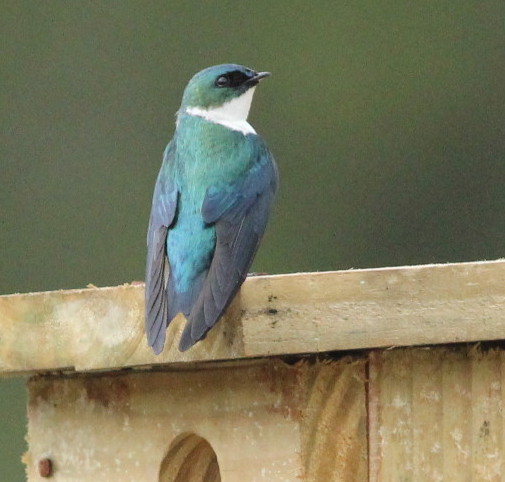
| Appearance | - The Chilean Swallow has glossy blue-black upperparts, white underparts, and a white rump. English Wikipedia
- The species has black wings and tail, with white tips on its inner secondaries and tertials. English Wikipedia
- Its underwing coverts and auxiliaries are grey. English Wikipedia
- The Chilean Swallow has a black bill and black legs. English Wikipedia
- Juvenile Chilean Swallows have duller and browner plumage than adults. English Wikipedia
| - The adult nominate subspecies has iridescent bronze upperparts, including the sides of the head, cheeks, and chin. English Wikipedia
- The nominate subspecies has white underparts with dusky bronze streaks along the flanks. English Wikipedia
- The nominate subspecies has a slightly forked tail. English Wikipedia
- Adult females have grey-brown mottling on the breast and sometimes on the throat and undertail-coverts. English Wikipedia
- Juveniles have grey-brown mottling and less glossy plumage than adults. English Wikipedia
- The legs and feet are dark brown, while the bill is black. English Wikipedia
- The subspecies T. e. sclateri has blue-green forehead and uppertail-coverts and blue-black wings and tail. English Wikipedia
|
|---|
| Size | | - The golden swallow measures approximately 12 cm in average body length. English Wikipedia
|
|---|
| Habitat | - The Chilean Swallow occurs in habitats ranging from coastal areas to Andean foothills. ebird.org
- The species occurs in open forests and on beaches. ebird.org
| - The species is restricted to isolated montane forests dominated primarily by Hispaniolan pine. English Wikipedia
- The species primarily inhabits hills in the interiors of islands and prefers open country. English Wikipedia
- The species occurs from elevations of 800 m on Hispaniola. English Wikipedia
- The species formerly occurred from sea level to elevations of 2,000 m in Jamaica. English Wikipedia
|
|---|
| Diet | | No checked fact yet |
|---|
| Behaviour | | - The golden swallow has a soft, repeated two-note call described as tchee-weet. English Wikipedia
- The species generally forages below 20 m and very rarely above 30 m. English Wikipedia
- The golden swallow forages in most habitats except forests. English Wikipedia
- The species generally begins foraging at dawn, with activity increasing during the morning and declining during the afternoon. English Wikipedia
- The golden swallow usually forages alone or in small groups. English Wikipedia
|
|---|
| Reproduction | - The species nests in natural and artificial cavities, generally near water. English Wikipedia
- Chilean Swallows generally nest individually but sometimes form loose nesting groups when nest sites are close together. English Wikipedia
- The species constructs its nests from mud or dry grass and lines them with feathers. English Wikipedia
- The Chilean Swallow's breeding season generally extends from September to February. English Wikipedia
- In Chile, the species usually produces two to three broods. English Wikipedia
- The typical clutch contains four to six white eggs. English Wikipedia
- The eggs measure approximately 17.8–21 millimetres by 13–14.3 millimetres. English Wikipedia
- Each egg weighs approximately 2 grams. English Wikipedia
| - The golden swallow breeds on Hispaniola from April through July. English Wikipedia
- The species formerly bred in Jamaica from June through July. English Wikipedia
- The golden swallow usually nests in pairs and occasionally forms breeding colonies. English Wikipedia
- The species lays clutches of two to four white to creamy-white eggs. English Wikipedia
- The eggs measure approximately 18.4 by 13.1 mm and weigh an average of 1.7 g. English Wikipedia
- The female incubates the eggs for approximately 17 to 20 days. English Wikipedia
- Young golden swallows usually fledge 24 to 27 days after hatching. English Wikipedia
- The species constructs deep cup nests in dead snags, particularly those of Hispaniolan pine. English Wikipedia
- The golden swallow also nests in caves, beneath house eaves, and in recently burned stands. English Wikipedia
- The species constructs nests using fine vegetable fibres such as silk, cotton, and pappus. English Wikipedia
- The golden swallow sometimes uses nest boxes for breeding. English Wikipedia
|
|---|
| Distribution | - The Chilean Swallow is native to Argentina, Bolivia, Brazil, Chile, the Falkland Islands, Paraguay, and Uruguay. English Wikipedia
| - The golden swallow is native to Hispaniola, which is shared by the Dominican Republic and Haiti. English Wikipedia
- The species formerly occurred in Jamaica, where its nominate subspecies is now extinct. English Wikipedia
- The estimated extent of occurrence of the golden swallow is 8,100 km². English Wikipedia
|
|---|
| Conservation | - The Chilean Swallow is classified as Least Concern by the IUCN. English Wikipedia
- The species has an estimated range of approximately 2,180,000 square kilometres. English Wikipedia
- The Chilean Swallow's population is reported to be increasing. English Wikipedia
| - The golden swallow is classified as Vulnerable by the IUCN. English Wikipedia
- The remaining T. e. sclateri population is declining, largely because of shifting agriculture and predation by introduced mammals. English Wikipedia
- The estimated population consists of 1,500 to 7,000 mature birds. English Wikipedia
- Introduced small Indian mongooses, feral cats, and rats are among the mammalian predators that threaten nests. English Wikipedia
- The golden swallow is legally protected in Jamaica despite being extinct there. English Wikipedia
|
|---|
| Similar species | - The Chilean Swallow is similar in appearance to the White-rumped Swallow (Tachycineta leucorrhoa). English Wikipedia
- Unlike the White-rumped Swallow, the Chilean Swallow lacks a white forehead. English Wikipedia
- The Chilean Swallow has bluer upperparts and grey underwing coverts than the White-rumped Swallow. English Wikipedia
- The breeding ranges of the Chilean Swallow and White-rumped Swallow have almost no overlap. English Wikipedia
| No checked fact yet |
|---|
| Other | | No checked fact yet |
|---|