Comparison
East Asian Free-tailed Bat vs African Giant Free-tailed Bat
East Asian Free-tailed Bat (Tadarida insignis) and African Giant Free-tailed Bat (Tadarida ventralis) both belong to the genus Tadarida (guano bats) and part ways below it.
East Asian Free-tailed Bat
Tadarida insignis
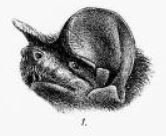
African Giant Free-tailed Bat
Tadarida ventralis
George Edward Dobson, Public domain, via Wikimedia Commons

Side by side
| East Asian Free-tailed Bat | African Giant Free-tailed Bat | |
|---|---|---|
| Scientific name | Tadarida insignis (Blyth, 1862) | Tadarida ventralis (Heuglin, 1861) |
| English name | East Asian Free-tailed Bat | African Giant Free-tailed Bat |
| Group | Mammals | Mammals |
| Class | Mammalia Mammal | Mammalia Mammal |
| Order | Chiroptera Bat | Chiroptera Bat |
| Family | Molossidae Free-tailed Bat | Molossidae Free-tailed Bat |
| Genus | Tadarida Guano Bats | Tadarida Guano Bats |
| Named in | 1862 | 1861 |
| Red List category | Data Deficient | Data Deficient |
| Countries on record | 5 countries | 2 countries |
| GBIF occurrence records | 140 records | 50 records |
Rows where the two agree are shown in grey.
Where each is found
Only East Asian Free-tailed Bat (5)
Only African Giant Free-tailed Bat (2)
From Catalogue of Life checklists and GBIF occurrence records. A country missing from a list means no record is held, which is not proof of absence.
Checked facts
| East Asian Free-tailed Bat | African Giant Free-tailed Bat | |
|---|---|---|
| Appearance |
|
|
| Size |
|
|
| Habitat |
|
|
| Distribution |
|
|
| Conservation |
|
|
| Other | No checked fact yet |
|
In brief
East Asian Free-tailed Bat
The documented range includes China, Japan, North Korea, South Korea, and Taiwan. It has long, narrow wings, long broad ears, and a free tail that extends beyond the tail membrane. Full profile
African Giant Free-tailed Bat
The African Giant Free-tailed Bat is a mammal in the family Molossidae, identified by the scientific name Tadarida ventralis. It inhabits dry savanna and subtropical or tropical dry shrubland. It has fur ranging from umber to fulvous-brown and a distinct white stripe across the middle of its underside. Full profile
Compare something else
Page built on 29 November 2026 from the data on the two species pages, where every source is listed.
Cite this page
ScientificNames.org. (2026). East Asian Free-tailed Bat vs African Giant Free-tailed Bat. Retrieved November 29, 2026, from https://scientificnames.org/compare/east-asian-free-tailed-bat-vs-african-giant-free-tailed-bat
“East Asian Free-tailed Bat vs African Giant Free-tailed Bat.” ScientificNames.org, 2026, scientificnames.org/compare/east-asian-free-tailed-bat-vs-african-giant-free-tailed-bat. Accessed 29 Nov. 2026.
ScientificNames.org. “East Asian Free-tailed Bat vs African Giant Free-tailed Bat.” Accessed November 29, 2026. https://scientificnames.org/compare/east-asian-free-tailed-bat-vs-african-giant-free-tailed-bat.
@misc{scientificnames_east_asian_free_tailed_bat_vs_african_giant_free_tailed_bat,
  author = {{ScientificNames.org}},
  title = {East Asian Free-tailed Bat vs African Giant Free-tailed Bat},
  year = {2026},
  url = {https://scientificnames.org/compare/east-asian-free-tailed-bat-vs-african-giant-free-tailed-bat},
  note = {Accessed 2026-11-29}
}