Comparison

Taiga Tick vs Western Black-legged Tick

Taiga Tick (Ixodes persulcatus) and Western Black-legged Tick (Ixodes pacificus) both belong to the genus Ixodes and part ways below it.
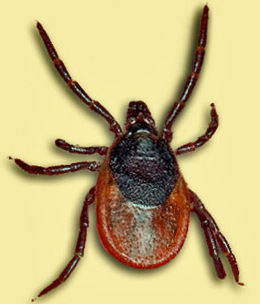
Taiga Tick

Taiga Tick

Ixodes persulcatus

Lamiot, CC BY-SA 3.0, via Wikimedia Commons

Western Black-legged Tick

Western Black-legged Tick

Ixodes pacificus

CDC/ Dr. Amanda Loftis, Dr. William Nicholson, Dr. Will Reeves, Dr. Chris Paddock/ James Gathany, Public domain, via Wikimedia Commons

Side by side

Taiga TickWestern Black-legged Tick
Scientific nameIxodes persulcatus Schulze, 1930Ixodes pacificus Cooley & Kohls, 1943
English nameTaiga TickWestern Black-legged Tick
GroupSpiders and other arachnidsSpiders and other arachnids
ClassArachnida ArachnidArachnida Arachnid
OrderIxodida TickIxodida Tick
FamilyIxodidae Hard TicksIxodidae Hard Ticks
GenusIxodesIxodes
Named in19301943
Countries on record13 countries3 countries
GBIF occurrence records2,898 records2,867 records

Rows where the two agree are shown in grey.

Where each is found

Only Taiga Tick (13)

Only Western Black-legged Tick (3)

From Catalogue of Life checklists and GBIF occurrence records. A country missing from a list means no record is held, which is not proof of absence.

Checked facts

Taiga TickWestern Black-legged Tick
Appearance
  • The species has plate-like body armor characteristic of hard ticks. ipm.ucanr.edu
  • Adult males are oval-shaped and brownish-black. English Wikipedia
  • Larvae have six legs, whereas adult ticks have eight legs. ipm.ucanr.edu
SizeNo checked fact yet
  • Adult males measure approximately 2.54 mm in length. English Wikipedia
  • Unfed adult females measure approximately 3.18 mm in length. English Wikipedia
  • Feeding adult females can expand to at least 9.5 mm in length. English Wikipedia
  • Unfed nymphs measure approximately 1/25 inch in length. ipm.ucanr.edu
  • Unfed adult females measure approximately 1/8 inch in length. ipm.ucanr.edu
  • Feeding adult females can expand to at least 3/8 inch in length. ipm.ucanr.edu
  • Adult males measure approximately 1/10 inch in length. ipm.ucanr.edu
Habitat
  • In northern Sweden, the species was found mainly in vegetation communities containing Alnus incana, Sorbus aucuparia, Picea abies, and Pinus sylvestris on islands in the Bothnian Bay. hpruezi.nihr.ac.uk
  • The species' optimal habitat includes forest cover, cooler temperatures, and annual precipitation of 200–500 mm. pmc.ncbi.nlm.nih.gov
  • Nymphs are commonly found in dense woodlands with leaf litter or fir needles. English Wikipedia
  • Adult ticks inhabit grasslands, woodland grass, and brush areas. English Wikipedia
  • The species inhabits forested areas, oak savannah, and brushy areas in Washington. doh.wa.gov
Diet
  • Adult ticks feed on large and medium-sized wild mammals, including ungulates, carnivores, and hares, as well as domestic cattle, dogs, and cats. pmc.ncbi.nlm.nih.gov
  • Larvae and nymphs parasitize medium-sized and small mammals, reptiles, and birds. pmc.ncbi.nlm.nih.gov
  • Recorded hosts include humans, dogs, rabbits, wild and domestic ungulates, dormice, Amur hedgehogs, and occasionally birds. English Wikipedia
Behaviour
  • The species is a temporary ectoparasite with an extended feeding period and a pasture-questing attack strategy. pmc.ncbi.nlm.nih.gov
  • Unfed individuals crawl from the forest litter onto its surface and surrounding vegetation. pmc.ncbi.nlm.nih.gov
  • Females can generally climb shrubs or grass blades to heights of approximately one metre. pmc.ncbi.nlm.nih.gov
  • Nymphs and larvae crawl to substantially lower heights than adult females. pmc.ncbi.nlm.nih.gov
  • Adult ticks exhibit pronounced spring–summer activity with a single seasonal abundance peak. pmc.ncbi.nlm.nih.gov
  • In Karelia, adult activity reaches its maximum in late May and early June before declining sharply in July. pmc.ncbi.nlm.nih.gov
  • Adult activity decreases to a minimum by midsummer. pmc.ncbi.nlm.nih.gov
  • Monitoring comparisons between the 1980s and the 2010s showed that seasonal activity had begun earlier in the later period. pmc.ncbi.nlm.nih.gov
  • Moose, hares, domestic dogs, and ground-feeding birds are considered likely carriers dispersing the species in northern Sweden. hpruezi.nihr.ac.uk
  • Adult males attach to humans less frequently than adult females. ipm.ucanr.edu
  • Nymphs and adult females are more frequently reported on people than other life stages. cdc.gov
  • The species is a slow-feeding hard tick. English Wikipedia
  • Ticks can remain attached to a host while feeding for several days. English Wikipedia
Reproduction
Distribution
  • The species occurs across Europe, central and northern Asia, China, and Japan. English Wikipedia
  • The species has a boreal distribution extending from Sweden to the Pacific Ocean. pmc.ncbi.nlm.nih.gov
  • The species occurs along the Pacific coast of the United States, particularly in northern California. cdc.gov
  • The species occurs in western Canada, including British Columbia. English Wikipedia
Other
  • The species is a principal vector of tick-borne encephalitis virus. pmc.ncbi.nlm.nih.gov
  • The species transmits Lyme disease, relapsing fever caused by Borrelia miyamotoi, babesiosis, and Siberian and Far Eastern tick-borne encephalitis. English Wikipedia
  • The species can transmit the pathogen responsible for anaplasmosis. doh.wa.gov
  • The species has been recorded feeding on 108 species of lizards, birds, and mammals in California as of 2007. ipm.ucanr.edu

In brief

Taiga Tick

The Taiga tick is a hard-bodied tick in the family Ixodidae, order Ixodida, and class Arachnida. It has a boreal distribution extending from Sweden to the Pacific Ocean. It is a principal vector of tick-borne encephalitis virus and transmits several other diseases. Full profile

Western Black-legged Tick

Ixodes pacificus occurs along the Pacific coast of the United States, particularly in northern California, and in western Canada, including British Columbia. Full profile

Compare something else

Page built on 28 November 2026 from the data on the two species pages, where every source is listed.

Cite this page

ScientificNames.org. (2026). Taiga Tick vs Western Black-legged Tick. Retrieved November 28, 2026, from https://scientificnames.org/compare/taiga-tick-vs-western-black-legged-tick