Comparison

Tarphops elegans vs Summer Flounder

Tarphops elegans (Tarphops elegans) and Summer Flounder (Paralichthys dentatus) both belong to the family Paralichthyidae (sand flounders) and part ways below it.
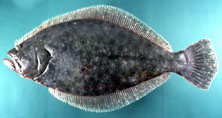
Summer Flounder

Summer Flounder

Paralichthys dentatus

U.S. Government - NOAA, Public domain, via Wikimedia Commons

Side by side

Tarphops elegansSummer Flounder
Scientific nameTarphops elegans Amaoka, 1969Paralichthys dentatus (Linnaeus, 1766)
English nameNot recordedSummer Flounder
GroupFishesFishes
ClassTeleostei TeleostTeleostei Teleost
OrderPleuronectiformesPleuronectiformes
FamilyParalichthyidae Sand FloundersParalichthyidae Sand Flounders
GenusTarphopsParalichthys Summer Flounders
Named in19691766
Red List categoryLeast ConcernLeast Concern
Environmentmarinebrackish, marine
Countries on record2 countries2 countries
GBIF occurrence records58 records15,673 records

Rows where the two agree are shown in grey.

Where each is found

Only Tarphops elegans (2)

Only Summer Flounder (2)

From Catalogue of Life checklists and GBIF occurrence records. A country missing from a list means no record is held, which is not proof of absence.

Checked facts

Tarphops elegansSummer Flounder
AppearanceNo checked fact yet
  • The species has a laterally compressed body that is flattened from side to side. English Wikipedia
  • The body has eye-like spots. English Wikipedia
  • The body typically has between five and fourteen eye-like spots. English Wikipedia
  • Both eyes are located on the left side of the head, while the right side of the body is unpigmented and flatter. animaldiversity.org
  • The ocular side is generally dark brown and gray but can change to lighter colors such as white or pink. animaldiversity.org
  • The blind side remains white because it lacks pigmentation and chromatic pores. animaldiversity.org
  • Five prominent eye-like spots form two triangles on the posterior portion of the body. dnr.sc.gov
  • The dorsal fin begins near the anterior portion of the eye. dnr.sc.gov
SizeNo checked fact yet
HabitatNo checked fact yet
  • The species inhabits the benthic zone, particularly coastal waters and estuaries. animaldiversity.org
  • From late April through early September, the species is most abundant in shallow coastal and estuarine waters less than 100 m deep. animaldiversity.org
  • During the colder months, the species is most abundant offshore along the continental shelf at approximately 150 m depth. animaldiversity.org
  • The species occurs on substrates transitioning from sand to silt or clay, as well as muddy bottoms and marsh beds. animaldiversity.org
  • Adults inhabit estuarine tidal creeks, submerged vegetation, inlets, jetties, beaches and nearshore reefs. dnr.sc.gov
  • Juveniles use bays, estuaries, tidal creeks, submerged vegetation and oyster reefs as nursery habitats. dnr.sc.gov
  • Adults generally prefer salinities of at least 28 ppt. dnr.sc.gov
DietNo checked fact yet
  • Adults consume sand lance, menhaden, Atlantic silverside, mummichog killifish, small bluefish, porgies, squid, shrimp and crabs. English Wikipedia
  • Adult prey also includes anchovy, weakfish, penaeid shrimp, bivalve mollusks and worms. dnr.sc.gov
  • Juveniles primarily consume mysids, polychaete worms and grass shrimp. dnr.sc.gov
  • The proportion of fish in the diet increases as juveniles grow. dnr.sc.gov
  • Larvae consume zooplankton. dnr.sc.gov
  • In Shinnecock Bay, winter flounder accounted for an average of 12.3% of summer flounder diet weight. researchconnect.suny.edu
BehaviourNo checked fact yet
  • Adults commonly bury themselves in the substrate with only their heads exposed while waiting to ambush prey. English Wikipedia
  • The species can rapidly burrow into muddy or sandy bottoms. English Wikipedia
  • The species changes the color and pattern of its ocular side to camouflage itself against the surrounding substrate. English Wikipedia
  • Summer flounder are solitary and typically lie within the seafloor substrate. animaldiversity.org
  • Adults forage during daylight and ambush or stalk prey along the bottom. dnr.sc.gov
  • Adults can swim rapidly over short distances and actively pursue prey at mid-depths and near the surface. English Wikipedia
ReproductionNo checked fact yet
  • Both sexes generally reach sexual maturity at approximately two years of age. English Wikipedia
  • Males reach sexual maturity at approximately 24.6 cm, while females mature at approximately 32.2 cm. animaldiversity.org
  • Summer flounder are broadcast spawners that fertilize eggs externally. animaldiversity.org
  • Spawning occurs in deep waters along the continental shelf. animaldiversity.org
  • In the South Atlantic Bight, spawning occurs between November and February. dnr.sc.gov
  • Females can produce between 460,000 and 4,190,000 eggs during a single breeding season. animaldiversity.org
  • Fertilized eggs hatch approximately 85 hours after spawning. animaldiversity.org
  • Larvae complete metamorphosis into their adult stage approximately 54 to 65 days after hatching. animaldiversity.org
DistributionNo checked fact yet
  • The species occurs along the western Atlantic coast from Nova Scotia to Florida. English Wikipedia
  • The species is most abundant between Massachusetts and North Carolina. animaldiversity.org
  • Summer flounder are less abundant in South Carolina than southern flounder. dnr.sc.gov
ConservationNo checked fact yet
  • Loss or degradation of estuarine nursery habitat is identified as a conservation concern. dnr.sc.gov
UsesNo checked fact yet
  • Summer flounder are commercially harvested using trawling methods. English Wikipedia
  • The species is considered an excellent food fish because of its firm, mild-tasting white flesh. English Wikipedia
  • Summer flounder are important to both commercial and recreational fisheries in the northeastern United States. English Wikipedia

In brief

Summer Flounder

Paralichthys dentatus inhabits coastal waters, estuaries and offshore areas along the western Atlantic coast from Nova Scotia to Florida. It has both eyes on the left side of its head and typically has between five and fourteen eye-like spots on its body. Full profile

Compare something else

Page built on 26 November 2026 from the data on the two species pages, where every source is listed.

Cite this page

ScientificNames.org. (2026). Tarphops elegans vs Summer Flounder. Retrieved November 26, 2026, from https://scientificnames.org/compare/tarphops-elegans-vs-summer-flounder