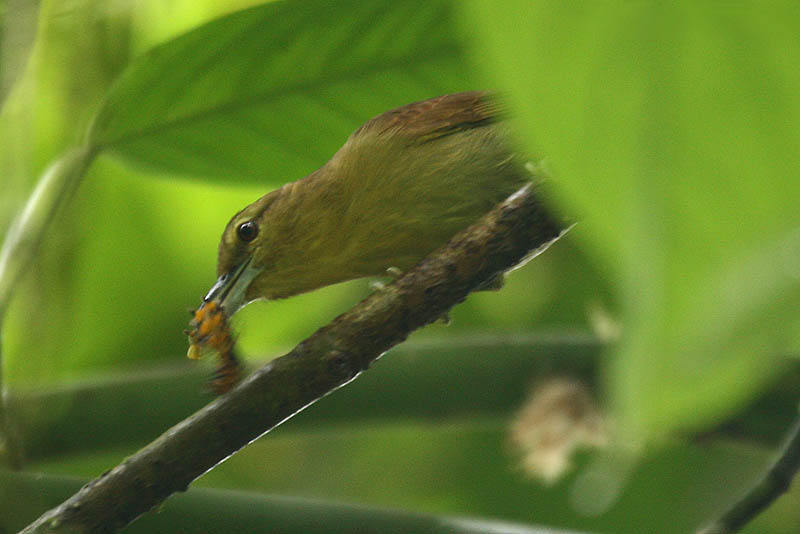
| Appearance | - The russet antshrike has a stocky body and a heavy bill with a hooked tip. English Wikipedia
- The sexes have almost identical plumage. English Wikipedia
- Adults of the nominate subspecies have an olive-yellow supercilium, a dusky line through the eye, and pale olive-brown ear coverts. English Wikipedia
- The nominate subspecies has olive-brown upperparts, a rufous tail, and cinnamon-rufous wings. English Wikipedia
- The nominate subspecies has pale yellowish-olive throat, breast, and belly, with olive flanks and undertail coverts. English Wikipedia
- Male nominate russet antshrikes have a cinnamon or orange-rufous shoulder patch that is difficult to see in the field, whereas females lack it. English Wikipedia
- The nominate subspecies has a red-brown to brown iris, a dark gray to blackish or dark brown bill, and blue-gray to pale gray legs and feet. English Wikipedia
- The subspecies T. a. saturatus is slightly darker than the nominate subspecies. English Wikipedia
- The subspecies T. a. coronatus has a reddish crown and yellower underparts than the nominate subspecies. English Wikipedia
- The subspecies T. a. intermedius is slightly darker than T. a. coronatus. English Wikipedia
- The subspecies T. a. gularis has a more ochre-colored throat than the nominate subspecies. English Wikipedia
- The subspecies T. a. aequatorialis has a very dark olive-brown crown and olive-brown upperparts. English Wikipedia
- The shoulder patch of T. a. aequatorialis is orange-rufous with black spots. English Wikipedia
| - Adult males of the nominate subspecies have predominantly black upperparts and head, white underparts, and white markings on the wings and tail. English Wikipedia
- Both sexes have a prominent crest, red iris, and heavy black bill with a hooked tip. English Wikipedia
- Juveniles have cinnamon or buff barring on their upperparts and underparts. English Wikipedia
- The species has contrasting plumage and a conspicuous red eye. digitalcommons.usf.edu
|
|---|
| Size | | |
|---|
| Habitat | - The russet antshrike inhabits lowland and montane evergreen forests and adjacent secondary forests across much of its range. English Wikipedia
- In northern Central America, the species also occupies semideciduous forest. English Wikipedia
- The russet antshrike usually occupies forest subcanopy and canopy. English Wikipedia
- In northern Central America, the species occurs from near sea level to approximately 1,300 m elevation. English Wikipedia
- In Costa Rica, the russet antshrike occurs at elevations up to approximately 1,500 m. English Wikipedia
- In Ecuador, the species mostly occurs between 400 and 1,300 m elevation. English Wikipedia
| - The species inhabits semi-humid to humid tropical landscapes and generally favors dense understorey vegetation. English Wikipedia
- Its habitats include gallery forest, savanna woodlands, secondary forest, evergreen forest edges and clearings, and river islands. English Wikipedia
- The species is often associated with bamboo stands. English Wikipedia
- The subspecies T. m. stagurus inhabits deciduous forest and taller areas of caatinga. English Wikipedia
- The species generally occurs below 1,000 m elevation, although it reaches 2,200 m in Venezuela. English Wikipedia
- The species occurs in forest borders, thickets, and tangles in humid tropical lowlands. ebird.org
|
|---|
| Diet | - The russet antshrike feeds primarily on arthropods and has also been observed eating fruit. English Wikipedia
| - The species eats large insects, other arthropods, small molluscs, small mammals, lizards, minnows, and small amounts of plant matter. English Wikipedia
|
|---|
| Behaviour | - The species forages alone or in pairs and almost always joins mixed-species feeding flocks. English Wikipedia
- The russet antshrike forages primarily in the forest subcanopy and canopy, moving between trees and hopping energetically along trunks, branches, and vines. English Wikipedia
- The species gleans prey from living and dead foliage, stems, vines, and moss clusters. English Wikipedia
- The russet antshrike has been observed attending army ant swarms and capturing prey fleeing the ants near the ground. English Wikipedia
- The russet antshrike is a year-round resident throughout its range. English Wikipedia
- The russet antshrike is not highly vocal. English Wikipedia
| - The species sometimes joins mixed-species feeding flocks. English Wikipedia
- The species occasionally follows army ant swarms. English Wikipedia
- In the Brazilian Pantanal, individuals have been observed feeding on aquatic prey while standing on water hyacinths. English Wikipedia
- The species is generally presumed to remain in the same area throughout the year, although seasonal movements are suspected in Argentina. English Wikipedia
- The species is more frequently heard than seen because it favors dense understorey vegetation. English Wikipedia
- The species is very skulking and is heard more often than seen. ebird.org
- Its song generally consists of approximately 40 notes that accelerate over 5–14 seconds and usually end in a snarl. English Wikipedia
|
|---|
| Reproduction | - The breeding season generally includes March through July, although it varies geographically. English Wikipedia
- A described nest in Costa Rica was a deep pouch constructed from dead leaves and held together with rootlets and fungal rhizomorphs. English Wikipedia
- The described Costa Rican nest hung from a fork of slender branches and was partially concealed by living foliage. English Wikipedia
- The described Costa Rican nest was approximately 15 m above the ground. English Wikipedia
- Both sexes participate in nest construction, egg incubation, and provisioning nestlings. English Wikipedia
- The incubation period has been estimated at 15–18 days. English Wikipedia
- A second nest documented in Costa Rica contained two eggs. English Wikipedia
| - The breeding season varies geographically, occurring from April to July in Costa Rica, March to July in Trinidad, and October to December in Argentina. English Wikipedia
- The nest is a plant-fiber cup generally suspended by its rim from a branch fork or between two branches. English Wikipedia
- The nest is usually located approximately 3 m above the ground. English Wikipedia
- Clutches usually contain two or three eggs, with three eggs more common in the southern part of the range. English Wikipedia
- The eggs generally have a creamy white to pale buff background color. English Wikipedia
- Both sexes incubate during the day, while only the female incubates at night. English Wikipedia
- In Costa Rica, incubation lasts 17–18 days and fledging occurs 12–13 days after hatching. English Wikipedia
- Shiny cowbirds frequently parasitize the nests of this species in Argentina. English Wikipedia
|
|---|
| Distribution | - The species occurs in Mexico, every Central American country except El Salvador, Colombia, Ecuador, and Venezuela, with possible occurrence in Peru. English Wikipedia
- The nominate subspecies occurs from Chiapas, Tabasco, and Oaxaca in Mexico through northern Guatemala and southern Belize to northern Honduras. English Wikipedia
- The subspecies T. a. saturatus occurs on Nicaragua's Caribbean slope, both slopes of Costa Rica except the far northwest, and slightly into Chiriquí Province in western Panama. English Wikipedia
- The subspecies T. a. coronatus occurs from central Panama to northwestern Colombia, possibly extending into the latter. English Wikipedia
- The subspecies T. a. intermedius occurs along Colombia's Pacific slope and the western Andes of Ecuador, extending south almost to Peru. English Wikipedia
- The subspecies T. a. gularis is recorded from Venezuela's Táchira state and possibly adjacent northeastern Colombia. English Wikipedia
- The subspecies T. a. aequatorialis occurs along the eastern slope of Colombia's Eastern Andes from Meta Department through eastern Ecuador to far northern Peru's Amazonas Department. English Wikipedia
| - The species occurs in southern Mexico, throughout Central America except El Salvador, on Trinidad, and throughout mainland South America except Chile, with only vagrant records in Uruguay. English Wikipedia
- The species has been recorded as a vagrant in Uruguay. English Wikipedia
|
|---|
| Conservation | - The western russet antshrike is assessed as Least Concern under the IUCN taxonomy described in the document. English Wikipedia
- The population size of the assessed russet antshrike taxa is unknown and believed to be decreasing. English Wikipedia
- No immediate threat has been identified for either assessed taxon. English Wikipedia
- The russet antshrike is generally uncommon to fairly common, although it is rarer in Mexico. English Wikipedia
- Five of the six recognized subspecies occur in at least one protected area. English Wikipedia
| - The species is classified as Least Concern by the IUCN. English Wikipedia
- The species has an estimated population of at least five million mature individuals, although its population is believed to be declining. English Wikipedia
- No immediate threats to the species have been identified. English Wikipedia
- The species is fairly common across most of its range and occurs in several protected areas. English Wikipedia
|
|---|
| Similar species | No checked fact yet | - The fasciated antshrike and bamboo antshrikes of the genus Cymbilaimus appear to be its closest relatives. English Wikipedia
|
|---|
| Name origin | - The specific epithet anabatinus derives from the Ancient Greek word anabatēs, meaning climber or mounter. English Wikipedia
| No checked fact yet |
|---|
| Other | - The russet antshrike was described in 1860 by Philip Sclater and Osbert Salvin. English Wikipedia
- The genus Thamnistes was established to accommodate this species. English Wikipedia
- The IUCN assessment of the western russet antshrike was most recently conducted in 2022. iucnredlist.org
- The western and eastern russet antshrikes were previously treated together as one species. datazone.birdlife.org
| No checked fact yet |
|---|