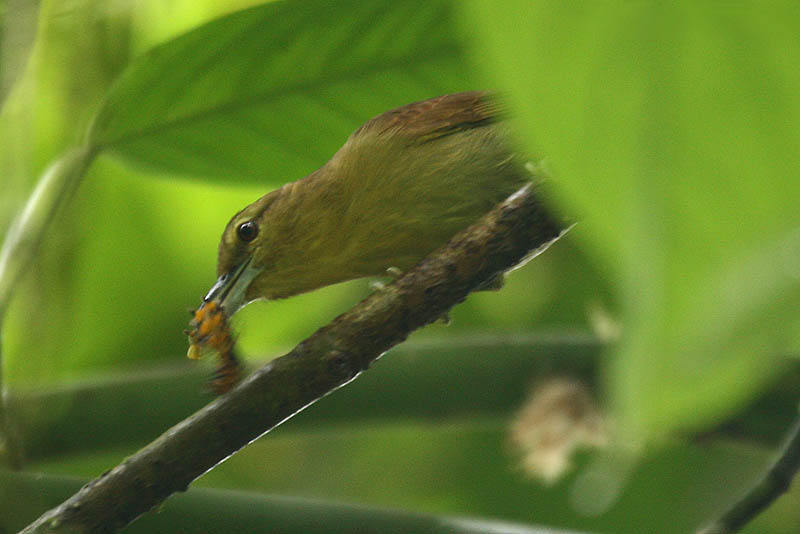
| Appearance | - The species has a stocky body and a heavy bill with a hooked tip. English Wikipedia
- Adult birds have a bright ochraceous face and a faint supercilium. English Wikipedia
- The forehead, crown, and upperparts are olive-brown. English Wikipedia
- The tail is rufous, while the wings are cinnamon-rufous. English Wikipedia
- The throat is dull olive-yellow, and the breast and belly are ochraceous with an olive tinge. English Wikipedia
- Male birds have a bright orange-rufous patch between their shoulders that females lack. English Wikipedia
- Both sexes have light reddish-brown irises, dusky-horn maxillae, lighter-horn mandibles, and olive legs and feet. English Wikipedia
- Male and female plumage is almost identical. English Wikipedia
| - The russet antshrike has a stocky body and a heavy bill with a hooked tip. English Wikipedia
- The sexes have almost identical plumage. English Wikipedia
- Adults of the nominate subspecies have an olive-yellow supercilium, a dusky line through the eye, and pale olive-brown ear coverts. English Wikipedia
- The nominate subspecies has olive-brown upperparts, a rufous tail, and cinnamon-rufous wings. English Wikipedia
- The nominate subspecies has pale yellowish-olive throat, breast, and belly, with olive flanks and undertail coverts. English Wikipedia
- Male nominate russet antshrikes have a cinnamon or orange-rufous shoulder patch that is difficult to see in the field, whereas females lack it. English Wikipedia
- The nominate subspecies has a red-brown to brown iris, a dark gray to blackish or dark brown bill, and blue-gray to pale gray legs and feet. English Wikipedia
- The subspecies T. a. saturatus is slightly darker than the nominate subspecies. English Wikipedia
- The subspecies T. a. coronatus has a reddish crown and yellower underparts than the nominate subspecies. English Wikipedia
- The subspecies T. a. intermedius is slightly darker than T. a. coronatus. English Wikipedia
- The subspecies T. a. gularis has a more ochre-colored throat than the nominate subspecies. English Wikipedia
- The subspecies T. a. aequatorialis has a very dark olive-brown crown and olive-brown upperparts. English Wikipedia
- The shoulder patch of T. a. aequatorialis is orange-rufous with black spots. English Wikipedia
|
|---|
| Size | | |
|---|
| Habitat | - The species inhabits lowland and lower montane evergreen forests as well as adjacent secondary forests. English Wikipedia
- The species usually occupies the forest subcanopy and canopy. English Wikipedia
- In Peru, the species occurs at elevations of 600–1,600 m. English Wikipedia
| - The russet antshrike inhabits lowland and montane evergreen forests and adjacent secondary forests across much of its range. English Wikipedia
- In northern Central America, the species also occupies semideciduous forest. English Wikipedia
- The russet antshrike usually occupies forest subcanopy and canopy. English Wikipedia
- In northern Central America, the species occurs from near sea level to approximately 1,300 m elevation. English Wikipedia
- In Costa Rica, the russet antshrike occurs at elevations up to approximately 1,500 m. English Wikipedia
- In Ecuador, the species mostly occurs between 400 and 1,300 m elevation. English Wikipedia
|
|---|
| Diet | No checked fact yet | - The russet antshrike feeds primarily on arthropods and has also been observed eating fruit. English Wikipedia
|
|---|
| Behaviour | | - The species forages alone or in pairs and almost always joins mixed-species feeding flocks. English Wikipedia
- The russet antshrike forages primarily in the forest subcanopy and canopy, moving between trees and hopping energetically along trunks, branches, and vines. English Wikipedia
- The species gleans prey from living and dead foliage, stems, vines, and moss clusters. English Wikipedia
- The russet antshrike has been observed attending army ant swarms and capturing prey fleeing the ants near the ground. English Wikipedia
- The russet antshrike is a year-round resident throughout its range. English Wikipedia
- The russet antshrike is not highly vocal. English Wikipedia
|
|---|
| Reproduction | | - The breeding season generally includes March through July, although it varies geographically. English Wikipedia
- A described nest in Costa Rica was a deep pouch constructed from dead leaves and held together with rootlets and fungal rhizomorphs. English Wikipedia
- The described Costa Rican nest hung from a fork of slender branches and was partially concealed by living foliage. English Wikipedia
- The described Costa Rican nest was approximately 15 m above the ground. English Wikipedia
- Both sexes participate in nest construction, egg incubation, and provisioning nestlings. English Wikipedia
- The incubation period has been estimated at 15–18 days. English Wikipedia
- A second nest documented in Costa Rica contained two eggs. English Wikipedia
|
|---|
| Distribution | - The species occurs in Bolivia and Peru. English Wikipedia
- Its range extends south of the Río Marañón along the eastern Andean slope through much of eastern Peru. English Wikipedia
- In Bolivia, the species occurs at least in the departments of La Paz and Cochabamba. English Wikipedia
| - The species occurs in Mexico, every Central American country except El Salvador, Colombia, Ecuador, and Venezuela, with possible occurrence in Peru. English Wikipedia
- The nominate subspecies occurs from Chiapas, Tabasco, and Oaxaca in Mexico through northern Guatemala and southern Belize to northern Honduras. English Wikipedia
- The subspecies T. a. saturatus occurs on Nicaragua's Caribbean slope, both slopes of Costa Rica except the far northwest, and slightly into Chiriquí Province in western Panama. English Wikipedia
- The subspecies T. a. coronatus occurs from central Panama to northwestern Colombia, possibly extending into the latter. English Wikipedia
- The subspecies T. a. intermedius occurs along Colombia's Pacific slope and the western Andes of Ecuador, extending south almost to Peru. English Wikipedia
- The subspecies T. a. gularis is recorded from Venezuela's Táchira state and possibly adjacent northeastern Colombia. English Wikipedia
- The subspecies T. a. aequatorialis occurs along the eastern slope of Colombia's Eastern Andes from Meta Department through eastern Ecuador to far northern Peru's Amazonas Department. English Wikipedia
|
|---|
| Conservation | - The IUCN has not assessed the species separately from the eastern russet antshrike because it follows HBW taxonomy. English Wikipedia
- The species is considered uncommon to locally fairly common. English Wikipedia
- The foothill and mid-elevation forests occupied by the species are threatened by deforestation for logging and agriculture. English Wikipedia
- The species is recorded from several protected areas. English Wikipedia
- The overall population health of the species has not been evaluated. English Wikipedia
| - The western russet antshrike is assessed as Least Concern under the IUCN taxonomy described in the document. English Wikipedia
- The population size of the assessed russet antshrike taxa is unknown and believed to be decreasing. English Wikipedia
- No immediate threat has been identified for either assessed taxon. English Wikipedia
- The russet antshrike is generally uncommon to fairly common, although it is rarer in Mexico. English Wikipedia
- Five of the six recognized subspecies occur in at least one protected area. English Wikipedia
|
|---|
| Similar species | - The species was formerly treated as part of the russet antshrike, Thamnistes anabatinus. English Wikipedia
| No checked fact yet |
|---|
| Name origin | No checked fact yet | - The specific epithet anabatinus derives from the Ancient Greek word anabatēs, meaning climber or mounter. English Wikipedia
|
|---|
| Other | - The species is monotypic. English Wikipedia
- The species belongs to the passerine order and the Thamnophilidae family. English Wikipedia
- The taxonomy of the species remains unsettled, with different taxonomic authorities recognizing different classifications. English Wikipedia
- BirdLife International's HBW taxonomy treats the species as a subspecies of the eastern russet antshrike, Thamnistes aequatorialis. English Wikipedia
| - The russet antshrike was described in 1860 by Philip Sclater and Osbert Salvin. English Wikipedia
- The genus Thamnistes was established to accommodate this species. English Wikipedia
- The IUCN assessment of the western russet antshrike was most recently conducted in 2022. iucnredlist.org
- The western and eastern russet antshrikes were previously treated together as one species. datazone.birdlife.org
|
|---|