| Appearance | - The species has a stout bill with a hooked tip. English Wikipedia
- Both sexes have a bushy crest. English Wikipedia
- Adult males of the nominate subspecies have a black crown and crest with white spots on the forehead. English Wikipedia
- Adult males of the nominate subspecies have a white collar that joins their white underparts. English Wikipedia
- Adult males of the nominate subspecies have mostly dull rufous-brown upperparts. English Wikipedia
- Adult males of the nominate subspecies have a black throat with white scaling that extends onto the breast as a pointed marking. English Wikipedia
- Adult males of the nominate subspecies have mostly white underparts with a buff wash on the flanks. English Wikipedia
- Adult females of the nominate subspecies have a dark rufous-brown crest and a black rear crown. English Wikipedia
- Adult females of the nominate subspecies have a buff collar that connects to their upperparts. English Wikipedia
- Adult females of the nominate subspecies have a dark reddish-brown back and a paler reddish-brown rump. English Wikipedia
- Adult females of the nominate subspecies have buff breast and belly plumage. English Wikipedia
- Both sexes have chestnut-brown irises, black maxillae, blue-gray mandibles with black tips, and blue-gray legs and feet. English Wikipedia
- Male T. b. shumbae individuals have gray-brown upperparts. English Wikipedia
- Female T. b. shumbae individuals are paler overall than nominate females, particularly on their underparts. English Wikipedia
- Female T. b. shumbae individuals have white underparts with a pale buff wash on the breast and flanks. English Wikipedia
- The species is described as a stout-billed antshrike. ebird.org
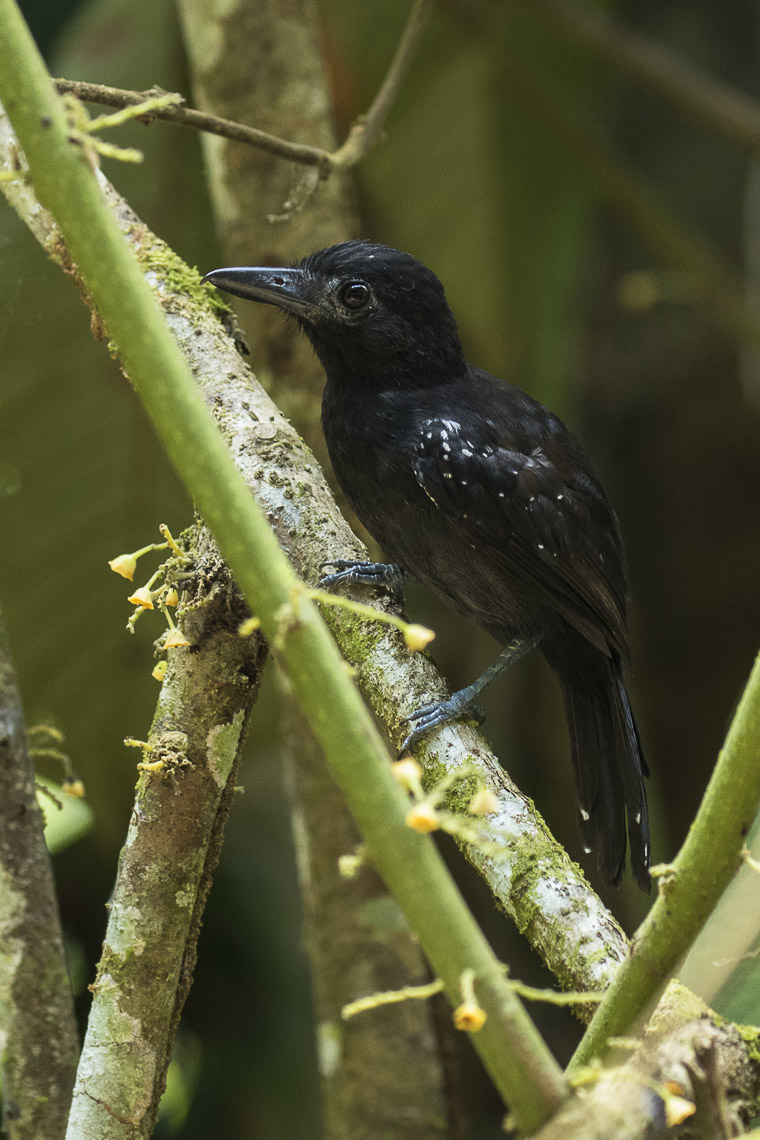
| - Adult males are predominantly black. English Wikipedia
- Adult males have a white patch between the scapulars, small white wing-coverts spots, and dark gray belly and undertail coverts. English Wikipedia
- Adult females have a blackish-gray forehead, crown, and face marked with narrow white streaks. English Wikipedia
- Adult females have very dark grayish-brown upperparts and wings with white-edged scapulars and white-spotted wing coverts. English Wikipedia
- Adult females have olive underparts with white streaking on the throat, breast, and belly. English Wikipedia
- Juveniles are browner than adults and have larger white spots on their wing coverts. English Wikipedia
- Subadult males are browner than adults and have white breast streaks. English Wikipedia
- The species exhibits differences in plumage between the sexes. English Wikipedia
- Male Black-hooded Antshrikes are mostly black with a slightly paler belly and small white shoulder spots. ebird.org
- Female Black-hooded Antshrikes are generally paler gray with whitish streaking. ebird.org
|
|---|
| Size | | |
|---|
| Habitat | - The species inhabits deciduous forest, arid scrublands, and shrubby secondary forest. English Wikipedia
- The species generally occurs at elevations up to 1,500 m, with local records reaching 1,850 m in Ecuador, 1,200 m in western Peru, and 1,950 m in the Marañón Valley. English Wikipedia
- The species occurs in arid areas of western Ecuador and northwestern Peru. ebird.org
| - The species inhabits the edges of lowland evergreen forests. English Wikipedia
- The species occurs in semi-deciduous forests, gallery forests, taller secondary woodland, and mangroves. English Wikipedia
- The species generally occupies vegetation from the understorey to the mid-storey. English Wikipedia
- The species favors shrubby areas and vine tangles. English Wikipedia
- The species also occurs in the interior of gallery forests. English Wikipedia
- The species mostly occurs below 1,000 m elevation but reaches 1,200 m in Costa Rica. English Wikipedia
|
|---|
| Diet | - The species feeds primarily on insects and probably also consumes other small invertebrates. English Wikipedia
| - The species feeds on various insects and other arthropods, including spiders. English Wikipedia
|
|---|
| Behaviour | - The species remains resident throughout its geographic range year-round. English Wikipedia
- The species usually forages in pairs and sometimes joins mixed-species feeding flocks. English Wikipedia
- The species forages mainly on or near the ground but can feed up to 10 m above it. English Wikipedia
- The species obtains food by gleaning and often uses quick stabbing movements. English Wikipedia
- The nominate subspecies produces a slow, accelerating series of monotone, deep barking notes. English Wikipedia
- The song of T. b. shumbae is faster than that of the nominate subspecies and has distinct introductory and terminal notes. English Wikipedia
- The species' calls include complaining or mewing caws and mewing whines. English Wikipedia
| - The species usually forages alone or in pairs. English Wikipedia
- The species often joins mixed-species feeding flocks. English Wikipedia
- The species forages slowly in dense vegetation from near ground level to approximately 15 m above the ground. English Wikipedia
- The species captures prey by gleaning from leaves, stems, branches, and trunks using quick stabs and lunges. English Wikipedia
- In drier habitats, the species commonly forages on the ground by probing and flipping leaf litter. English Wikipedia
- The species occasionally follows army ant swarms to catch fleeing prey. English Wikipedia
- The species is presumed to remain resident throughout its range year-round. English Wikipedia
|
|---|
| Reproduction | - The species breeds between February and April in southwestern Ecuador. English Wikipedia
- The breeding season in Peru appears to extend at least from February through May. English Wikipedia
- The species builds a deep cup-shaped nest loosely woven from dead grass and plant stems. English Wikipedia
- The nest is usually suspended in a branch fork 0.7–1.85 m above the ground. English Wikipedia
- The clutch contains two to three eggs. English Wikipedia
- The female is the only sex confirmed to incubate the eggs, although males are suspected of participating. English Wikipedia
- The incubation period lasts approximately 14–16 days. English Wikipedia
- Young birds fledge 11–12 days after hatching. English Wikipedia
- The species' nests are parasitized by shiny cowbirds. English Wikipedia
| |
|---|
| Distribution | - The species occurs in Ecuador and Peru. English Wikipedia
- The nominate subspecies occurs along the Pacific slope from Manabí and Guayas in west-central Ecuador southward into northwestern and north-central Peru, reaching northern Ancash Department. English Wikipedia
- The subspecies T. b. shumbae occurs in the watersheds of the Marañón and Chinchipe rivers in north-central Peru. English Wikipedia
| - The species occurs in Costa Rica and Panama. English Wikipedia
- Its range extends from southern Guanacaste Province in Costa Rica along the Pacific slope through western Panama to Los Santos Province. English Wikipedia
|
|---|
| Conservation | - The IUCN assessed the nominate subspecies T. b. bernardi as Least Concern. English Wikipedia
- The population of T. b. bernardi is believed to be stable, although its size is unknown. English Wikipedia
- No immediate threats have been identified for T. b. bernardi. English Wikipedia
- The subspecies T. b. shumbae is assessed as Vulnerable. English Wikipedia
- The estimated population of T. b. shumbae is 600–6,000 mature individuals and is believed to be decreasing. English Wikipedia
- Habitat loss and degradation are identified as possible threats to T. b. shumbae. English Wikipedia
- The species is described as common in Ecuador and fairly common to common in Peru. English Wikipedia
| - The IUCN classifies the species as Least Concern. English Wikipedia
- The species has an estimated population of at least 50,000 mature individuals. English Wikipedia
- The estimated mature population is believed to be decreasing. English Wikipedia
- No immediate threats to the species have been identified. English Wikipedia
- The species is considered rare in northern Costa Rica and common in southern Costa Rica. English Wikipedia
- The species has gradually disappeared from much of its formerly occupied range in deforested parts of Panama. English Wikipedia
|
|---|
| Name origin | - The species was described by René Lesson in 1844 under the binomial name Thamnophilus bernardi. English Wikipedia
- The specific epithet bernardi honors Captain Bernard, a French mariner and collector from Bordeaux. English Wikipedia
| - The specific epithet bridgesi honors Mr. Bridges, who collected the holotype. English Wikipedia
|
|---|
| Other | - The IUCN Red List assessment of Collared Antshrike Thamnophilus bernardi was most recently conducted in 2016. iucnredlist.org
| |
|---|