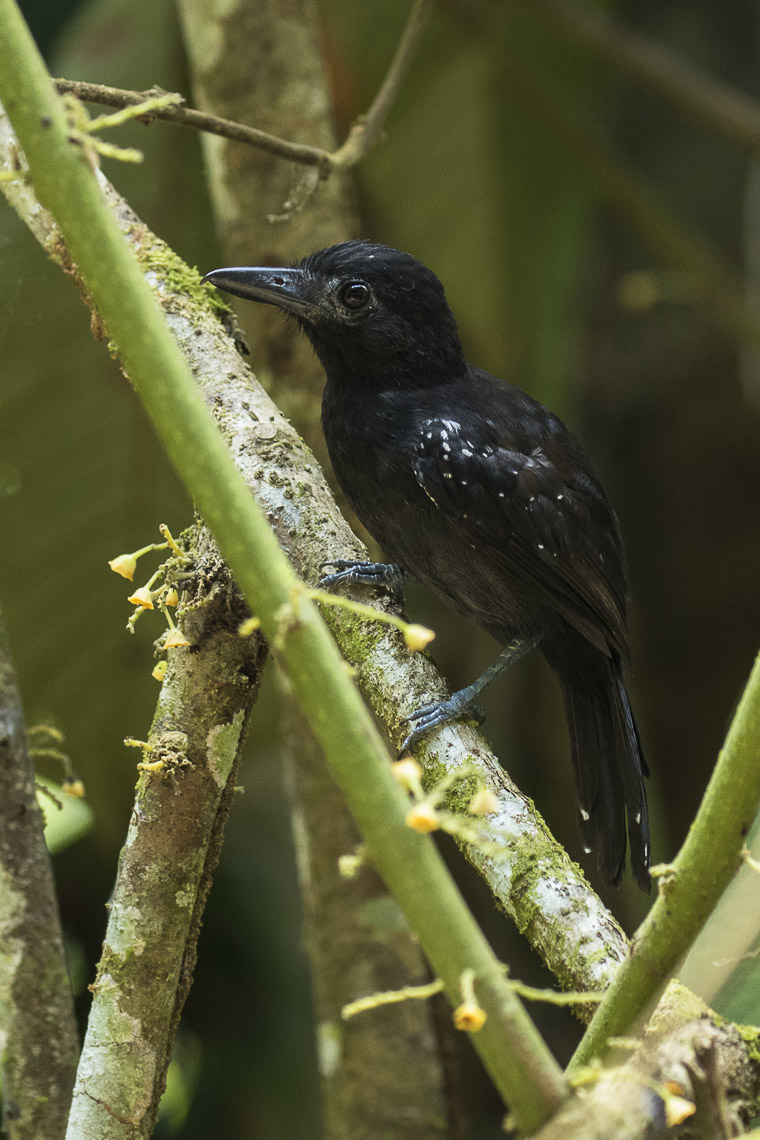
| Appearance | - The species exhibits substantial variation in plumage between subspecies and between sexes. English Wikipedia
- Subadult individuals resemble adult females but have more buff-colored plumage. English Wikipedia
- Members of the genus have stout bills with a hook resembling those of true shrikes. English Wikipedia
| - Adult males are predominantly black. English Wikipedia
- Adult males have a white patch between the scapulars, small white wing-coverts spots, and dark gray belly and undertail coverts. English Wikipedia
- Adult females have a blackish-gray forehead, crown, and face marked with narrow white streaks. English Wikipedia
- Adult females have very dark grayish-brown upperparts and wings with white-edged scapulars and white-spotted wing coverts. English Wikipedia
- Adult females have olive underparts with white streaking on the throat, breast, and belly. English Wikipedia
- Juveniles are browner than adults and have larger white spots on their wing coverts. English Wikipedia
- Subadult males are browner than adults and have white breast streaks. English Wikipedia
- The species exhibits differences in plumage between the sexes. English Wikipedia
- Male Black-hooded Antshrikes are mostly black with a slightly paler belly and small white shoulder spots. ebird.org
- Female Black-hooded Antshrikes are generally paler gray with whitish streaking. ebird.org
|
|---|
| Size | | |
|---|
| Habitat | - The species occupies evergreen forests, secondary woodland, and thickets in relatively open landscapes. English Wikipedia
- The species generally prefers forest edges over the interiors of dense forests. English Wikipedia
- The species avoids arid habitats. English Wikipedia
- Northern Andean populations inhabit humid forest thickets, undergrowth, and stunted ridge forests at elevations of 1,200–2,800 m. English Wikipedia
- In the southern Andes and northwestern Argentina, the species occupies open woodland understories, waterside scrublands, and dense shrub cover on canyon hillsides. English Wikipedia
- The paraguayensis subspecies inhabits dense shrubs, low woodland along watercourses, and scrubby semi-deciduous forest in the Gran Chaco. English Wikipedia
- The gilvigaster subspecies inhabits thick woodland along streams and swampy areas. English Wikipedia
- The nominate subspecies primarily occupies steep, vine-covered forest hillsides and also uses bamboo, streamside vine tangles, and dense secondary growth. English Wikipedia
- The nominate subspecies occurs from sea level to 1,300 m elevation. English Wikipedia
- The ochraceiventer subspecies inhabits gallery forests and small woodlands at elevations of 750–1,350 m. English Wikipedia
- The cearensis subspecies occupies humid and semi-humid, vine-rich patches of Atlantic Forest up to approximately 850 m elevation. English Wikipedia
| - The species inhabits the edges of lowland evergreen forests. English Wikipedia
- The species occurs in semi-deciduous forests, gallery forests, taller secondary woodland, and mangroves. English Wikipedia
- The species generally occupies vegetation from the understorey to the mid-storey. English Wikipedia
- The species favors shrubby areas and vine tangles. English Wikipedia
- The species also occurs in the interior of gallery forests. English Wikipedia
- The species mostly occurs below 1,000 m elevation but reaches 1,200 m in Costa Rica. English Wikipedia
|
|---|
| Diet | - The species feeds primarily on insects and other arthropods, supplemented by small quantities of seeds and fruits. English Wikipedia
| - The species feeds on various insects and other arthropods, including spiders. English Wikipedia
|
|---|
| Behaviour | - The species usually forages alone or in pairs. English Wikipedia
- Foraging generally takes place in the understory and mid-story at heights of 1–5 m above the ground. English Wikipedia
- Individuals sometimes forage at heights of up to 8 m above the ground. English Wikipedia
- The species searches for prey by hopping and creeping through vegetation and gleaning from leaves, stems, vines, and branches. English Wikipedia
- Individuals have been observed dropping to the leaf litter surface to collect prey. English Wikipedia
- Foraging individuals regularly dip their tails and flick their wings. English Wikipedia
- The species frequently joins mixed-species feeding flocks and sometimes follows army ant swarms. English Wikipedia
- Some migration occurs in populations at the southernmost limit of the species' range. English Wikipedia
- Populations outside the southernmost range are presumed to remain in the same areas throughout the year. English Wikipedia
| - The species usually forages alone or in pairs. English Wikipedia
- The species often joins mixed-species feeding flocks. English Wikipedia
- The species forages slowly in dense vegetation from near ground level to approximately 15 m above the ground. English Wikipedia
- The species captures prey by gleaning from leaves, stems, branches, and trunks using quick stabs and lunges. English Wikipedia
- In drier habitats, the species commonly forages on the ground by probing and flipping leaf litter. English Wikipedia
- The species occasionally follows army ant swarms to catch fleeing prey. English Wikipedia
- The species is presumed to remain resident throughout its range year-round. English Wikipedia
|
|---|
| Reproduction | - The breeding season in Brazil extends from October through February. English Wikipedia
- The breeding season in Bolivia and Peru extends from August through November. English Wikipedia
- The breeding season in Argentina extends from October through December. English Wikipedia
- The nest is generally a cup constructed from plant fibers and fungal rhizomorphs, often with moss covering its exterior. English Wikipedia
- The nest is suspended by its rim from a forked branch and is frequently positioned close to the ground. English Wikipedia
- The nest is often partly or completely concealed by vegetation. English Wikipedia
- The usual clutch contains three eggs, although some clutches contain two. English Wikipedia
- Both parents incubate the eggs during the day and feed the nestlings. English Wikipedia
- In an experimental study in southern Brazil, pairs receiving supplementary food were more likely to increase their clutch size from two eggs to three than control pairs. pmc.ncbi.nlm.nih.gov
- In the southern Brazil supplementation experiment, food-supplemented pairs tended to renest after an average interval of 20 days. pmc.ncbi.nlm.nih.gov
- Nest duration, nest success, and breeding season length were greater in the largest forest fragments studied. pmc.ncbi.nlm.nih.gov
- Renesting intervals were shorter in the largest forest fragments studied. pmc.ncbi.nlm.nih.gov
- No evidence of nesting was found in two small forest fragments monitored in southern Brazil. pmc.ncbi.nlm.nih.gov
- The shiny cowbird is recorded as a nest parasite of the species in Argentina. English Wikipedia
| |
|---|
| Distribution | - The species occurs in Argentina, Bolivia, Brazil, Paraguay, Peru, and Uruguay. English Wikipedia
| - The species occurs in Costa Rica and Panama. English Wikipedia
- Its range extends from southern Guanacaste Province in Costa Rica along the Pacific slope through western Panama to Los Santos Province. English Wikipedia
|
|---|
| Conservation | - The species is classified as Least Concern by the IUCN in the assessment reported in document 1. English Wikipedia
- The species has a very large geographic range. English Wikipedia
- The species' population size is unknown and is believed to be declining. English Wikipedia
- No immediate threats to the species have been identified. English Wikipedia
- The species is considered fairly common across most of its geographic range. English Wikipedia
- The species occurs in several protected areas. English Wikipedia
- The cearensis subspecies faces conservation concerns because humid forest within its range has been substantially reduced to remnant patches surrounded by large-scale agriculture. English Wikipedia
- The species' ability to use forest edges, secondary woodland, and other human-created habitats reduces its sensitivity to habitat disturbance. English Wikipedia
| - The IUCN classifies the species as Least Concern. English Wikipedia
- The species has an estimated population of at least 50,000 mature individuals. English Wikipedia
- The estimated mature population is believed to be decreasing. English Wikipedia
- No immediate threats to the species have been identified. English Wikipedia
- The species is considered rare in northern Costa Rica and common in southern Costa Rica. English Wikipedia
- The species has gradually disappeared from much of its formerly occupied range in deforested parts of Panama. English Wikipedia
|
|---|
| Name origin | No checked fact yet | - The specific epithet bridgesi honors Mr. Bridges, who collected the holotype. English Wikipedia
|
|---|
| Other | - The species was described by French ornithologist Louis Pierre Vieillot in 1816. English Wikipedia
- The species' song generally consists of six or seven plaintive whistles delivered at an even pace and at the same pitch and intensity. English Wikipedia
| |
|---|