| Appearance | - Adult males have predominantly black to blackish-brown heads and backs, with white scapular edges and a concealed white patch between the scapulars. English Wikipedia
- Adult males have light gray lower backs and rumps. English Wikipedia
- Adult males have black wings with broad white covert tips and white flight-feather edges. English Wikipedia
- Adult males have black tails with white feather tips and white edges on the outermost tail feathers. English Wikipedia
- Adult males have black throats and breasts and white flanks, bellies, and crissums. English Wikipedia
- Adult females have dark brown crowns with cinnamon feather edges and buff faces. English Wikipedia
- Adult females have brown upperparts with dark feather centers. English Wikipedia
- Adult females have brownish-black wings with pale buff edges and tips. English Wikipedia
- Adult females have rufous-brown tails with whitish feather tips and edges. English Wikipedia
- Adult females have buff underparts that become somewhat whiter on the belly. English Wikipedia
- Subadult males resemble adult females but begin developing black feathers. English Wikipedia
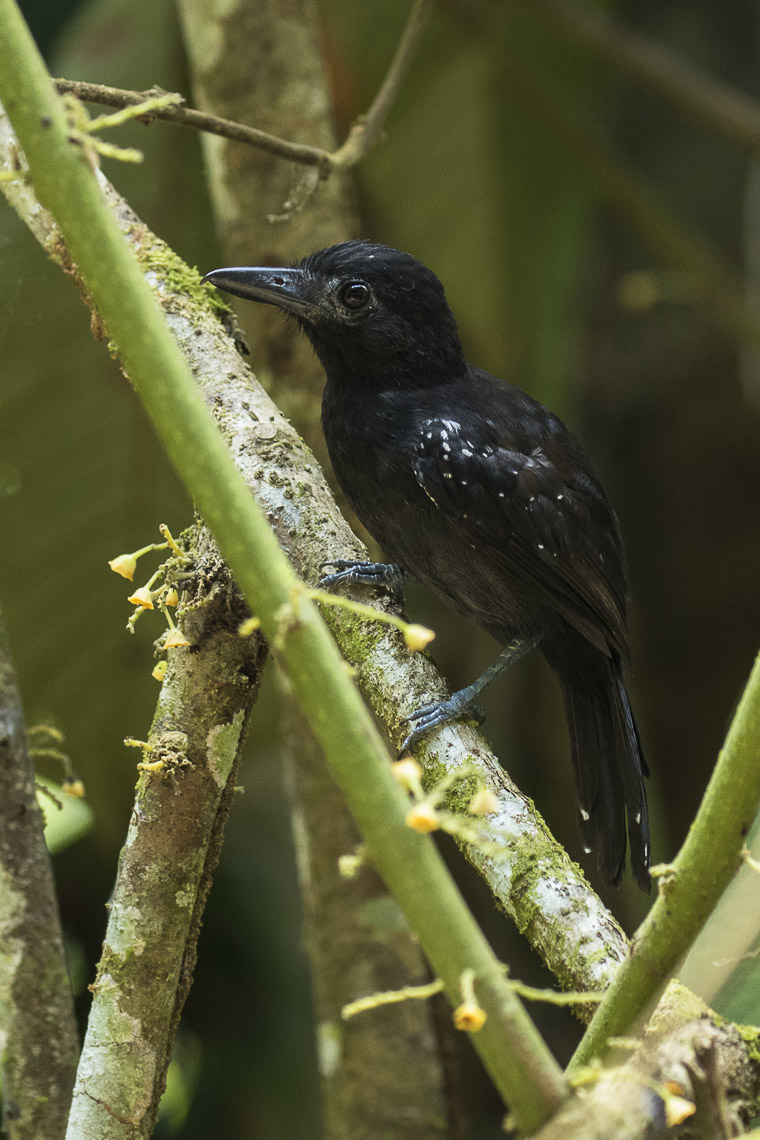
- Males are predominantly black with white flanks and distinctive white wing and tail markings. ebird.org
| - Adult males are predominantly black. English Wikipedia
- Adult males have a white patch between the scapulars, small white wing-coverts spots, and dark gray belly and undertail coverts. English Wikipedia
- Adult females have a blackish-gray forehead, crown, and face marked with narrow white streaks. English Wikipedia
- Adult females have very dark grayish-brown upperparts and wings with white-edged scapulars and white-spotted wing coverts. English Wikipedia
- Adult females have olive underparts with white streaking on the throat, breast, and belly. English Wikipedia
- Juveniles are browner than adults and have larger white spots on their wing coverts. English Wikipedia
- Subadult males are browner than adults and have white breast streaks. English Wikipedia
- The species exhibits differences in plumage between the sexes. English Wikipedia
- Male Black-hooded Antshrikes are mostly black with a slightly paler belly and small white shoulder spots. ebird.org
- Female Black-hooded Antshrikes are generally paler gray with whitish streaking. ebird.org
|
|---|
| Size | | |
|---|
| Habitat | - The species inhabits the understory and midstory of dry deciduous forests, particularly areas with dense vine thickets. English Wikipedia
| - The species inhabits the edges of lowland evergreen forests. English Wikipedia
- The species occurs in semi-deciduous forests, gallery forests, taller secondary woodland, and mangroves. English Wikipedia
- The species generally occupies vegetation from the understorey to the mid-storey. English Wikipedia
- The species favors shrubby areas and vine tangles. English Wikipedia
- The species also occurs in the interior of gallery forests. English Wikipedia
- The species mostly occurs below 1,000 m elevation but reaches 1,200 m in Costa Rica. English Wikipedia
|
|---|
| Diet | - The species feeds primarily on insects and probably also consumes other small arthropods. English Wikipedia
| - The species feeds on various insects and other arthropods, including spiders. English Wikipedia
|
|---|
| Behaviour | - The species is considered a year-round resident throughout its range. English Wikipedia
- The species forages mostly alone or in pairs and seldom joins mixed-species feeding flocks. English Wikipedia
- The species forages from the ground to approximately 6 m above it, especially in vine tangles. English Wikipedia
- The species obtains food by gleaning, making short upward jumps, and pouncing onto the ground. English Wikipedia
- The species occasionally follows army ant swarms while foraging. English Wikipedia
- The species apparently produces two songs, consisting of a single soft cuua and a short nasal roll. English Wikipedia
- The species has additional vocalizations including nasal calls, grunts, rolled notes, and soft nasal sounds. English Wikipedia
| - The species usually forages alone or in pairs. English Wikipedia
- The species often joins mixed-species feeding flocks. English Wikipedia
- The species forages slowly in dense vegetation from near ground level to approximately 15 m above the ground. English Wikipedia
- The species captures prey by gleaning from leaves, stems, branches, and trunks using quick stabs and lunges. English Wikipedia
- In drier habitats, the species commonly forages on the ground by probing and flipping leaf litter. English Wikipedia
- The species occasionally follows army ant swarms to catch fleeing prey. English Wikipedia
- The species is presumed to remain resident throughout its range year-round. English Wikipedia
|
|---|
| Reproduction | | |
|---|
| Distribution | - The species occurs on the Caribbean slope of northern Colombia, extending south to northern Bolívar Department and east into northwestern Venezuela as far as Miranda state. English Wikipedia
- A second population occurs in the Zulia River valley of Norte de Santander Department, Colombia, and the adjacent Cordillera de Mérida in western Venezuela. English Wikipedia
- The species occurs from sea level to 1,000 m elevation in Colombia. English Wikipedia
- The species occurs up to 1,300 m elevation in Venezuela, although it is mostly found below 500 m. English Wikipedia
- The species is recorded from Colombia and Venezuela. birdnet.cornell.edu
| - The species occurs in Costa Rica and Panama. English Wikipedia
- Its range extends from southern Guanacaste Province in Costa Rica along the Pacific slope through western Panama to Los Santos Province. English Wikipedia
|
|---|
| Conservation | - The IUCN assessed the species as Least Concern. English Wikipedia
- The species has a large geographic range, but its population size is unknown and believed to be decreasing. English Wikipedia
- No immediate threats to the species have been identified. English Wikipedia
- The species is considered uncommon in Colombia and uncommon and locally distributed in Venezuela. English Wikipedia
- The species occurs in one protected area in Venezuela. English Wikipedia
- Conversion of dry and semi-deciduous forests into agricultural land, particularly goat pasture, is a potential threat requiring monitoring. English Wikipedia
| - The IUCN classifies the species as Least Concern. English Wikipedia
- The species has an estimated population of at least 50,000 mature individuals. English Wikipedia
- The estimated mature population is believed to be decreasing. English Wikipedia
- No immediate threats to the species have been identified. English Wikipedia
- The species is considered rare in northern Costa Rica and common in southern Costa Rica. English Wikipedia
- The species has gradually disappeared from much of its formerly occupied range in deforested parts of Panama. English Wikipedia
|
|---|
| Name origin | No checked fact yet | - The specific epithet bridgesi honors Mr. Bridges, who collected the holotype. English Wikipedia
|
|---|
| Other | - The species was described by Philip Sclater in 1855 under the scientific name Thamnophilus melanonotus. English Wikipedia
- The species received its most recent IUCN Red List assessment in 2024. iucnredlist.org
| |
|---|