Comparison

Band-tailed Antshrike vs Black-hooded Antshrike

Band-tailed Antshrike (Thamnophilus melanothorax) and Black-hooded Antshrike (Thamnophilus bridgesi) both belong to the genus Thamnophilus (antshrikes) and part ways below it.

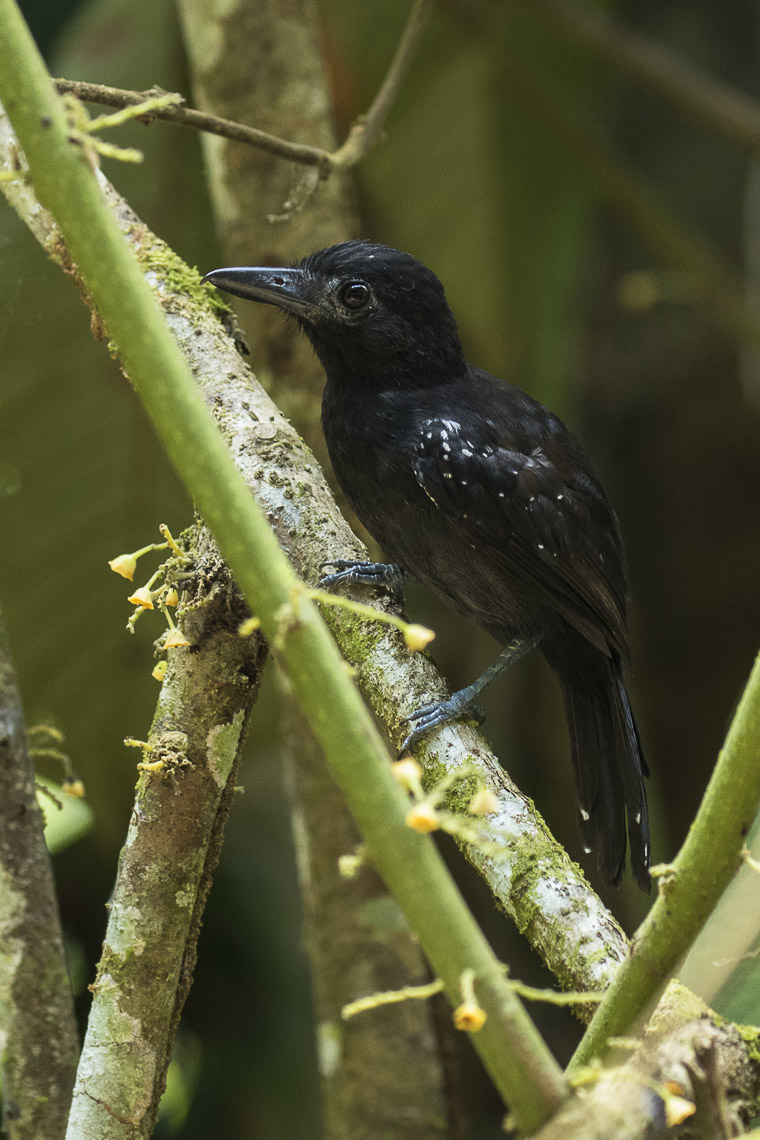
Band-tailed Antshrike

Band-tailed Antshrike

Thamnophilus melanothorax

Hector Bottai, CC BY-SA 4.0, via Wikimedia Commons

Black-hooded Antshrike

Black-hooded Antshrike

Thamnophilus bridgesi

Francesco Veronesi from Italy, CC BY-SA 2.0, via Wikimedia Commons

Side by side

Band-tailed AntshrikeBlack-hooded Antshrike
Scientific nameThamnophilus melanothorax P. L. Sclater, 1857Thamnophilus bridgesi P. L. Sclater, 1856
English nameBand-tailed AntshrikeBlack-hooded Antshrike
GroupBirdsBirds
ClassAves BirdAves Bird
OrderPasseriformes PasserinePasseriformes Passerine
FamilyThamnophilidae AntbirdThamnophilidae Antbird
GenusThamnophilus AntshrikesThamnophilus Antshrikes
Named in18571856
Red List categoryLeast ConcernLeast Concern
Countries on record4 countries2 countries
GBIF occurrence records376 records40,536 records

Rows where the two agree are shown in grey.

Where each is found

Only Band-tailed Antshrike (4)

Only Black-hooded Antshrike (2)

From Catalogue of Life checklists and GBIF occurrence records. A country missing from a list means no record is held, which is not proof of absence.

Checked facts

Band-tailed AntshrikeBlack-hooded Antshrike
Appearance
  • Adult males are predominantly black, with a concealed white patch between the scapulars, small white wing-covert spots and a broad white band at the end of the tail. English Wikipedia
  • Adult females have bright deep-rufous crowns, upperparts, wings and tails. English Wikipedia
  • Adult females have black faces, throats and breasts. English Wikipedia
  • Adult females have gray underparts with a reddish-brown cast on the flanks and crissum. English Wikipedia
  • The species has a stout bill with a hook resembling the bill of a true shrike. English Wikipedia
  • The male is predominantly black and has a broad white tail band. ebird.org
  • Adult males are predominantly black. English Wikipedia
  • Adult males have a white patch between the scapulars, small white wing-coverts spots, and dark gray belly and undertail coverts. English Wikipedia
  • Adult females have a blackish-gray forehead, crown, and face marked with narrow white streaks. English Wikipedia
  • Adult females have very dark grayish-brown upperparts and wings with white-edged scapulars and white-spotted wing coverts. English Wikipedia
  • Adult females have olive underparts with white streaking on the throat, breast, and belly. English Wikipedia
  • Juveniles are browner than adults and have larger white spots on their wing coverts. English Wikipedia
  • Subadult males are browner than adults and have white breast streaks. English Wikipedia
  • The species exhibits differences in plumage between the sexes. English Wikipedia
  • Male Black-hooded Antshrikes are mostly black with a slightly paler belly and small white shoulder spots. ebird.org
  • Female Black-hooded Antshrikes are generally paler gray with whitish streaking. ebird.org
Size
Habitat
  • The species primarily inhabits the understory of evergreen forests. English Wikipedia
  • The species also occurs in the mid-storey of forests. English Wikipedia
  • The species favors dense vines and vegetation growing in gaps created by fallen trees and abandoned human-made openings. English Wikipedia
  • The species also inhabits swampy depressions and dense riverside thickets. English Wikipedia
  • The species inhabits the edges of lowland evergreen forests. English Wikipedia
  • The species occurs in semi-deciduous forests, gallery forests, taller secondary woodland, and mangroves. English Wikipedia
  • The species generally occupies vegetation from the understorey to the mid-storey. English Wikipedia
  • The species favors shrubby areas and vine tangles. English Wikipedia
  • The species also occurs in the interior of gallery forests. English Wikipedia
  • The species mostly occurs below 1,000 m elevation but reaches 1,200 m in Costa Rica. English Wikipedia
Diet
  • The species is presumed to feed on insects and other small arthropods, although its diet is poorly documented. English Wikipedia
  • The species feeds on various insects and other arthropods, including spiders. English Wikipedia
Behaviour
  • The species is thought to remain resident throughout its range throughout the year. English Wikipedia
  • The species usually forages alone or in pairs and only rarely joins mixed-species feeding flocks. English Wikipedia
  • The species forages mainly in dense cover near the ground, reaching heights of approximately 10 m. English Wikipedia
  • The species obtains food by gleaning vegetation, vines, branches and the ground. English Wikipedia
  • The species produces a song consisting of seven to nine low, hollow notes that accelerate slightly. English Wikipedia
  • The species gives a muffled nasal growl that is sometimes doubled. English Wikipedia
  • The species is described as a rarely encountered large antshrike. ebird.org
  • The species usually forages alone or in pairs. English Wikipedia
  • The species often joins mixed-species feeding flocks. English Wikipedia
  • The species forages slowly in dense vegetation from near ground level to approximately 15 m above the ground. English Wikipedia
  • The species captures prey by gleaning from leaves, stems, branches, and trunks using quick stabs and lunges. English Wikipedia
  • In drier habitats, the species commonly forages on the ground by probing and flipping leaf litter. English Wikipedia
  • The species occasionally follows army ant swarms to catch fleeing prey. English Wikipedia
  • The species is presumed to remain resident throughout its range year-round. English Wikipedia
Reproduction
Distribution
  • The species occurs in southern Guyana, Suriname, French Guiana and northeastern Brazil. English Wikipedia
  • The species occurs in Costa Rica and Panama. English Wikipedia
  • Its range extends from southern Guanacaste Province in Costa Rica along the Pacific slope through western Panama to Los Santos Province. English Wikipedia
Conservation
  • The species was most recently assessed for the IUCN Red List in 2024. iucnredlist.org
  • The species is classified as Least Concern by the IUCN. English Wikipedia
  • The species has a large geographical range. English Wikipedia
  • The population size of the species is unknown and is believed to be decreasing. English Wikipedia
  • No immediate threats to the species have been identified. English Wikipedia
  • Large areas of potentially suitable habitat remain in Suriname, French Guiana and Amapá, Brazil. English Wikipedia
  • The IUCN classifies the species as Least Concern. English Wikipedia
  • The species has an estimated population of at least 50,000 mature individuals. English Wikipedia
  • The estimated mature population is believed to be decreasing. English Wikipedia
  • No immediate threats to the species have been identified. English Wikipedia
  • The species is considered rare in northern Costa Rica and common in southern Costa Rica. English Wikipedia
  • The species has gradually disappeared from much of its formerly occupied range in deforested parts of Panama. English Wikipedia
Name originNo checked fact yet
  • The specific epithet bridgesi honors Mr. Bridges, who collected the holotype. English Wikipedia
OtherNo checked fact yet

In brief

Band-tailed Antshrike

Thamnophilus melanothorax occurs in southern Guyana, Suriname, French Guiana and northeastern Brazil. Adult males are predominantly black with a broad white band at the end of the tail, while adult females have deep-rufous upperparts and black faces, throats and breasts. Full profile

Black-hooded Antshrike

The Black-hooded Antshrike is a monotypic bird species described by Philip Sclater in 1856. It occurs in Costa Rica and Panama, ranging from southern Guanacaste Province in Costa Rica along the Pacific slope through western Panama to Los Santos Province. The species exhibits differences in plumage between the sexes. Full profile

Compare something else

Page built on 28 November 2026 from the data on the two species pages, where every source is listed.

Cite this page

ScientificNames.org. (2026). Band-tailed Antshrike vs Black-hooded Antshrike. Retrieved November 28, 2026, from https://scientificnames.org/compare/band-tailed-antshrike-vs-black-hooded-antshrike