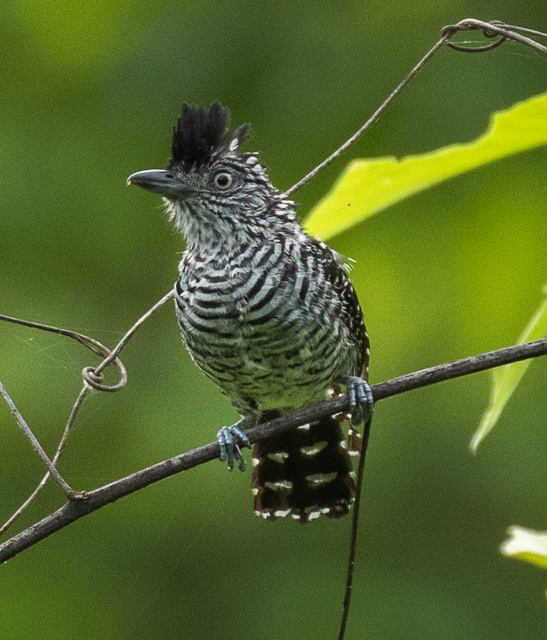
| Appearance | - The species exhibits pronounced sexual dimorphism. English Wikipedia
- Adult males of the nominate subspecies have a black forehead with gray spots and a black crown. English Wikipedia
- Adult males of the nominate subspecies have backs patterned with black and gray and a concealed white patch between the scapulars. English Wikipedia
- Adult males of the nominate subspecies have gray faces and black wings with white spots and edges. English Wikipedia
- Adult males of the nominate subspecies have black tails with white feather tips. English Wikipedia
- Adult males of the nominate subspecies have gray underparts and whitish bellies. English Wikipedia
- Adult females of the nominate subspecies have rufous crowns and reddish yellow-brown upperparts. English Wikipedia
- Adult females of the nominate subspecies have dark brown wings with white spots on the coverts and clay-colored flight-feather edges. English Wikipedia
- Adult females of the nominate subspecies have dark brown tails with white feather tips. English Wikipedia
- Adult females of the nominate subspecies have light clay and light gray underparts, with paler coloration on the throat and belly. English Wikipedia
- Males of T. s. parkeri have gray foreheads and backs with a few black spots. English Wikipedia
- Males of T. s. parkeri have paler underparts and a white belly center. English Wikipedia
- Females of T. s. parkeri have less reddish upperparts than females of the nominate subspecies. English Wikipedia
| - Both sexes possess a bushy crest and exhibit pronounced sexual dimorphism. English Wikipedia
- Adult males of the nominate subspecies have predominantly black-and-white barred plumage. English Wikipedia
- Adult females of the nominate subspecies have cinnamon-rufous crests and upperparts. English Wikipedia
- Adults of both sexes have pale yellow irises, black upper mandibles, bluish-gray lower mandibles, and lead-gray legs and feet. English Wikipedia
- Juvenile males have black and light yellowish-brown barring. English Wikipedia
|
|---|
| Size | No checked fact yet | |
|---|
| Habitat | - Along the Amazon, the species mainly inhabits forest patches on white-sand soil. English Wikipedia
- Along the Amazon, the species also occurs at the edges of humid evergreen forest. English Wikipedia
- The species inhabits forest clearings, including those created by fallen trees. English Wikipedia
- At the southern end of its Brazilian range, the species occurs in semi-deciduous and gallery forests. English Wikipedia
- In the Serranía de Huanchaca, the species inhabits evergreen forest edges within grasslands and cerrado. English Wikipedia
- The species occurs from near sea level to approximately 700 m elevation. English Wikipedia
| - The Coiba Island subspecies inhabits tropical deciduous forest. English Wikipedia
- The Tobago subspecies inhabits mature humid forest. English Wikipedia
- The eastern Brazilian subspecies T. d. capistratus primarily inhabits caatinga and restinga. English Wikipedia
- In eastern Colombia, the species frequently occurs on river islands. English Wikipedia
- In Ecuador, northern Peru, and much of Brazilian Amazonia, the species occurs almost exclusively on river islands. English Wikipedia
- In southern Bolivia, Paraguay, and Argentina, its habitats include savanna, scrub, secondary forest, and riverine belts. English Wikipedia
- In Mexico, Central America, and Colombia, the species occurs from sea level to approximately 1,500 m elevation. English Wikipedia
- In Venezuela, the species reaches elevations of 2,000 m, although most records are below 1,250 m. English Wikipedia
- In Ecuador, the species occurs only below 250 m elevation. English Wikipedia
|
|---|
| Diet | | - Its diet consists primarily of mature and larval insects, supplemented by other arthropods, small lizards, fruit, and seeds. English Wikipedia
- The species also feeds on prey escaping army ant swarms. English Wikipedia
|
|---|
| Behaviour | - The species is presumed to remain resident throughout its range year-round. English Wikipedia
- The species usually forages alone or in pairs. English Wikipedia
- The species is not known to participate in mixed-species feeding flocks. English Wikipedia
- The species generally forages between 1 and 10 m above the ground in the understorey to mid-storey. English Wikipedia
- The species hops through vegetation and captures prey by gleaning while reaching or lunging from perches. English Wikipedia
- The species also captures prey through short upward sallies. English Wikipedia
- The species occasionally follows army ant swarms within its territory. English Wikipedia
| - The species remains resident throughout its geographical range year-round. English Wikipedia
- Individuals typically forage in closely associated pairs within dense foliage from ground level to approximately 3 m, occasionally reaching 10 m. English Wikipedia
- The species almost never participates in mixed-species feeding flocks. English Wikipedia
- It captures prey by rapidly stabbing at leaves, stems, branches, and trunks. English Wikipedia
- Both sexes sing while stretching their necks, bowing forward, and pumping their tails up and down. English Wikipedia
|
|---|
| Reproduction | | - The species is monogamous, and breeding pairs vigorously defend territories throughout the year. English Wikipedia
- Territory sizes measured in one study ranged from approximately 2,500 to 4,200 square metres. English Wikipedia
- Breeding has been recorded in every month of the year somewhere within the species' range. English Wikipedia
- In Trinidad and Tobago, the species apparently breeds throughout the year. English Wikipedia
- The nest is an open, tightly woven cup with thin walls constructed from fungal and vegetable fibers, vines, grasses, and twigs. English Wikipedia
- The nest is generally suspended by its rim from a branch fork at heights reaching 10 m above the ground. English Wikipedia
- Both sexes participate in nest construction. English Wikipedia
- The usual clutch contains two eggs, although clutches of three have been reported in Trinidad. English Wikipedia
- Both parents incubate eggs during daylight, while only the female incubates at night. English Wikipedia
- A Costa Rican study recorded an incubation period of 13 days after the second egg was laid. English Wikipedia
- Studies in multiple countries recorded a period of 10–13 days between hatching and fledging. English Wikipedia
- Both parents brood and feed the nestlings. English Wikipedia
|
|---|
| Distribution | | - The species occurs in Mexico, every Central American country, Trinidad and Tobago, and all mainland South American countries except Chile and Uruguay. English Wikipedia
- One accepted occurrence record exists from southern Texas. English Wikipedia
- The subspecies T. d. intermedius occurs from San Luis Potosí and Tamaulipas in east-central Mexico south through Central America to Costa Rica and possibly Panama. English Wikipedia
- The subspecies T. d. nesiotes occurs on the Pearl Islands in the Gulf of Panama. English Wikipedia
- The subspecies T. d. eremnus occurs on Coiba Island off western Panama. English Wikipedia
|
|---|
| Conservation | - The species was assessed as Least Concern by the IUCN. English Wikipedia
- The species has a large geographic range, but its population size is unknown and believed to be decreasing. English Wikipedia
- No immediate threats to the species have been identified. English Wikipedia
- The species is considered locally fairly common throughout its range. English Wikipedia
- The species occurs in large protected areas in both Bolivia and Brazil. English Wikipedia
| - The IUCN classifies the species as Least Concern. English Wikipedia
- The estimated population comprises at least 50 million mature individuals and is considered stable. English Wikipedia
- Deforestation, habitat destruction, and habitat fragmentation are identified as challenges to the species' survival. English Wikipedia
|
|---|
| Similar species | - The nominate subspecies was formerly classified as a subspecies of T. punctatus. English Wikipedia
| No checked fact yet |
|---|
| Name origin | No checked fact yet | - The specific epithet doliatus derives from Neo-Latin and means barred. English Wikipedia
|
|---|
| Other | - The species was most recently assessed for the IUCN Red List in 2024. iucnredlist.org
| No checked fact yet |
|---|