| Appearance | - Adult males of the nominate subspecies have predominantly black and white barred plumage, with a black crown and crest and a black-and-white streaked throat. English Wikipedia
- Adult females have rufous crowns, crests, upperparts, wings, and tails. English Wikipedia
- Both sexes possess a crest. English Wikipedia
- Adults of both sexes have pale irises whose coloration varies. English Wikipedia
- Subadult males have plumage resembling adult males but with a yellowish-brown tinge on the body and flight feathers. English Wikipedia
- Males of the tenuifasciatus and berlepschi subspecies have approximately equal-width black and white bars and more white on their foreheads than nominate males. English Wikipedia
- Females of the tenuifasciatus and berlepschi subspecies are paler than nominate females and have wider white bars on their underparts. English Wikipedia
- The species has a stout bill. ebird.org
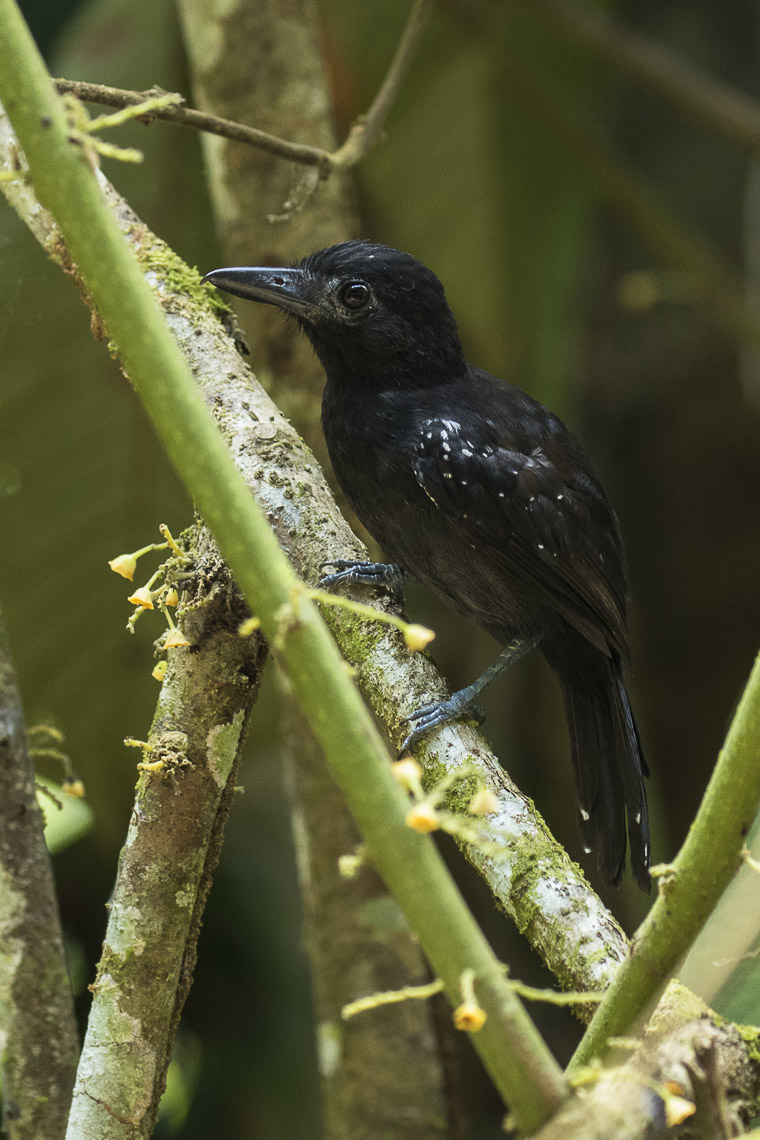
| - Adult males are predominantly black. English Wikipedia
- Adult males have a white patch between the scapulars, small white wing-coverts spots, and dark gray belly and undertail coverts. English Wikipedia
- Adult females have a blackish-gray forehead, crown, and face marked with narrow white streaks. English Wikipedia
- Adult females have very dark grayish-brown upperparts and wings with white-edged scapulars and white-spotted wing coverts. English Wikipedia
- Adult females have olive underparts with white streaking on the throat, breast, and belly. English Wikipedia
- Juveniles are browner than adults and have larger white spots on their wing coverts. English Wikipedia
- Subadult males are browner than adults and have white breast streaks. English Wikipedia
- The species exhibits differences in plumage between the sexes. English Wikipedia
- Male Black-hooded Antshrikes are mostly black with a slightly paler belly and small white shoulder spots. ebird.org
- Female Black-hooded Antshrikes are generally paler gray with whitish streaking. ebird.org
|
|---|
| Size | | |
|---|
| Habitat | - The species primarily inhabits the edges of humid evergreen forests and secondary forests, particularly areas with abundant shrubs and undergrowth. English Wikipedia
- The species inhabits dense vegetation along the edges of humid forests in the eastern Andean foothills. ebird.org
- In Colombia, the species occurs at elevations of 400–1,500 m. English Wikipedia
- In Ecuador, the species occurs mostly at elevations of 400–1,400 m. English Wikipedia
- In Peru, the species occurs at elevations of 700–1,700 m in the Andes and locally at elevations as low as 200 m in the Marañón River valley. English Wikipedia
| - The species inhabits the edges of lowland evergreen forests. English Wikipedia
- The species occurs in semi-deciduous forests, gallery forests, taller secondary woodland, and mangroves. English Wikipedia
- The species generally occupies vegetation from the understorey to the mid-storey. English Wikipedia
- The species favors shrubby areas and vine tangles. English Wikipedia
- The species also occurs in the interior of gallery forests. English Wikipedia
- The species mostly occurs below 1,000 m elevation but reaches 1,200 m in Costa Rica. English Wikipedia
|
|---|
| Diet | | - The species feeds on various insects and other arthropods, including spiders. English Wikipedia
|
|---|
| Behaviour | - The species usually forages alone or in pairs and only rarely joins mixed-species feeding flocks. English Wikipedia
- The species forages in dense vegetation from near ground level to approximately 10 m above the ground. English Wikipedia
- The species captures prey by hopping between branches and gleaning from leaves, stems, branches, and trunks with quick stabs. English Wikipedia
- The species is presumed to remain resident throughout its range year-round. English Wikipedia
- The species' song consists of an accelerating sequence of abrupt nasal notes that initially rises in pitch, falls toward the end, and finishes with a strong raspy note. English Wikipedia
| - The species usually forages alone or in pairs. English Wikipedia
- The species often joins mixed-species feeding flocks. English Wikipedia
- The species forages slowly in dense vegetation from near ground level to approximately 15 m above the ground. English Wikipedia
- The species captures prey by gleaning from leaves, stems, branches, and trunks using quick stabs and lunges. English Wikipedia
- In drier habitats, the species commonly forages on the ground by probing and flipping leaf litter. English Wikipedia
- The species occasionally follows army ant swarms to catch fleeing prey. English Wikipedia
- The species is presumed to remain resident throughout its range year-round. English Wikipedia
|
|---|
| Reproduction | - The species' breeding season has not been established. English Wikipedia
- A nest containing two eggs was found in Ecuador in late March. English Wikipedia
- The species constructs cup-shaped nests from rootlets, leaf petioles, and fungal rhizomorphs, with moss covering the exterior. English Wikipedia
- One recorded nest was suspended from a shrub branch fork 2.2 m above the ground. English Wikipedia
- Another recorded used nest in Ecuador was approximately 1 m above the ground. English Wikipedia
| |
|---|
| Distribution | - The species occurs along the eastern slope of the Andes in Colombia, Ecuador, and Peru. English Wikipedia
- The species' distribution extends from north-central Colombia through Ecuador to north-central Peru along the eastern Andes. datazone.birdlife.org
- The nominate subspecies occurs in the Colombian departments of Cundinamarca and Meta and separately in Norte de Santander. English Wikipedia
- The tenuifasciatus subspecies occurs from Putumayo in south-central Colombia through most of Ecuador to northern Zamora-Chinchipe. English Wikipedia
- The berlepschi subspecies occurs from southern Zamora-Chinchipe into the Peruvian departments of Amazonas, Cajamarca, and San Martín. English Wikipedia
| - The species occurs in Costa Rica and Panama. English Wikipedia
- Its range extends from southern Guanacaste Province in Costa Rica along the Pacific slope through western Panama to Los Santos Province. English Wikipedia
|
|---|
| Conservation | - The species was classified as Vulnerable in 2012 before being returned to Least Concern in 2023. English Wikipedia
- The species' population size is unknown but is believed to be stable. English Wikipedia
- Deforestation associated with agricultural land clearance is identified as a potential threat to the species. English Wikipedia
- The species is not considered negatively affected by habitat disturbance because its sensitivity is low and tree-cover loss is currently slow. English Wikipedia
- The species is considered fairly common in Colombia and Peru and fairly numerous in Ecuador. English Wikipedia
| - The IUCN classifies the species as Least Concern. English Wikipedia
- The species has an estimated population of at least 50,000 mature individuals. English Wikipedia
- The estimated mature population is believed to be decreasing. English Wikipedia
- No immediate threats to the species have been identified. English Wikipedia
- The species is considered rare in northern Costa Rica and common in southern Costa Rica. English Wikipedia
- The species has gradually disappeared from much of its formerly occupied range in deforested parts of Panama. English Wikipedia
|
|---|
| Similar species | - The lined antshrike was previously classified by some authors as a subspecies of the chestnut-backed antshrike. English Wikipedia
- A study published in 2007 confirmed the lined antshrike as a distinct species and its sister relationship to the chestnut-backed antshrike. English Wikipedia
| No checked fact yet |
|---|
| Name origin | No checked fact yet | - The specific epithet bridgesi honors Mr. Bridges, who collected the holotype. English Wikipedia
|
|---|
| Other | | |
|---|