| Appearance | - Adult females have a rufous crest and cinnamon-rufous upperparts, wings, and tail. English Wikipedia
- Adult females have a pale-buff throat with thin black streaks. English Wikipedia
- Adults of both sexes have a pale iris, black maxilla, blue-gray mandible, and blue-gray legs and feet. English Wikipedia
- Immature males have black-and-cinnamon-buff barring and dusky flight feathers. English Wikipedia
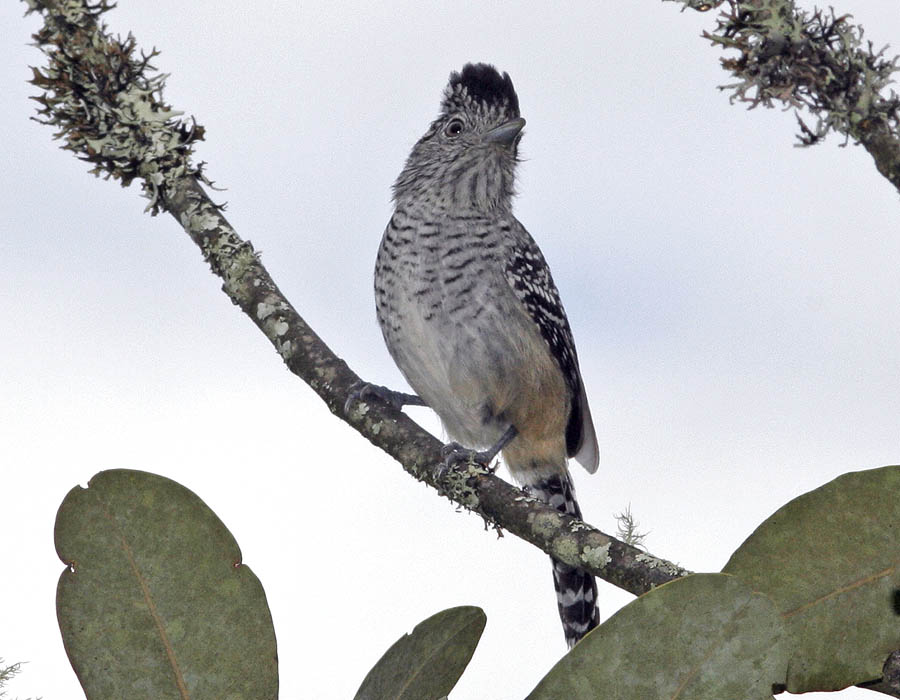
- Both sexes have a bushy crest. English Wikipedia
| - Both sexes of the Bar-crested Antshrike possess a crest. English Wikipedia
- Adult males of the nominate subspecies have predominantly alternating black and white plumage bars, including on the crest. English Wikipedia
- Adult males of the nominate subspecies have black-and-white streaking on the face and throat. English Wikipedia
- Adult females have cinnamon-rufous crests, crowns, upperparts, wings, and tails. English Wikipedia
- Adult females have a narrow black-and-white band across the nape. English Wikipedia
- Adult females have black-and-white streaking on the sides of the head and throat. English Wikipedia
- Adult females have black-and-white barred underparts with a reddish-brown tinge on the lower flanks. English Wikipedia
- Adults of both sexes have yellowish irises. English Wikipedia
- Subadult males resemble adult males but have a yellowish-brown tinge on the body and flight feathers. English Wikipedia
- The brachyurus subspecies has a shorter tail and wider white underpart bars than the nominate subspecies. English Wikipedia
- The selvae subspecies has a shorter tail and wider black underpart bars than the nominate subspecies. English Wikipedia
- The oecotonophilus subspecies resembles selvae but has a longer tail. English Wikipedia
|
|---|
| Size | | |
|---|
| Habitat | - The species inhabits the interior and edges of deciduous and semi-deciduous forests and secondary woodland. English Wikipedia
- Chapman's antshrike favors dense understory and mid-story vegetation, including areas with abundant vines. English Wikipedia
- In Ecuador, the species occurs mostly at elevations between 800 and 2,000 m. English Wikipedia
- In Peru, the species occurs mostly between 600 and 2,100 m elevation, with local records reaching 2,600 m. English Wikipedia
| - The Bar-crested Antshrike inhabits dry to humid deciduous and evergreen forests as well as second-growth scrub. English Wikipedia
- The species favors forest edges with thickets and shrubby borders. English Wikipedia
- The species also occurs in cultivated lands, gardens, orchards, and well-vegetated parks. English Wikipedia
- The species mostly occupies elevations between 900 and 2,200 m. English Wikipedia
- The species occurs locally at elevations as low as 250 m on Colombia's Pacific side. English Wikipedia
- The 1951 Venezuelan specimen was collected at an elevation of 1,650 m. English Wikipedia
|
|---|
| Diet | | No checked fact yet |
|---|
| Behaviour | - Chapman's antshrike is a year-round resident throughout its range. English Wikipedia
- The species usually forages alone or in pairs and occasionally joins mixed-species feeding flocks. English Wikipedia
- Chapman's antshrike forages in dense vegetation from near ground level to approximately 15 m above the ground. English Wikipedia
- The species hops between branches and climbs branches and vines while gleaning prey. English Wikipedia
- Chapman's antshrike collects prey from leaves, stems, branches, and trunks. English Wikipedia
- The species has been observed probing small bromeliads. English Wikipedia
| |
|---|
| Reproduction | No checked fact yet | - The Bar-crested Antshrike's breeding season appears to extend from March through June. English Wikipedia
|
|---|
| Distribution | - Chapman's antshrike has a disjunct geographical distribution. English Wikipedia
- The nominate subspecies occurs in Ecuador's El Oro and Loja provinces and extends into Peru's Tumbes Department and northeastern Piura. English Wikipedia
- The subspecies T. d. palamblae occurs in southeastern Piura and eastern Lambayeque Department in Peru. English Wikipedia
- The species is found in Ecuador and Peru. inaturalist.org
| - The Bar-crested Antshrike occurs in Colombia and Venezuela. English Wikipedia
- The species has a geographically discontinuous distribution. English Wikipedia
- The brachyurus subspecies occurs in Colombia's Western Andes, excluding the San Juan River headwaters, and on the western slope of the Central Andes between Antioquia and Cauca. English Wikipedia
- The selvae subspecies occurs at the San Juan River headwaters on the western slope of Colombia's Western Andes in Risaralda and Caldas. English Wikipedia
- The nominate multistriatus subspecies occurs on the eastern slope of Colombia's Central Andes and the western slope of the Eastern Andes, from Antioquia and Santander south to Nariño. English Wikipedia
- The oecotonophilus subspecies occurs on the western slope of Colombia's Eastern Andes in Norte de Santander and Boyacá. English Wikipedia
- The oecotonophilus subspecies has also been reported from Venezuela's Serranía del Perijá. English Wikipedia
- The most recent record of the species in Venezuela mentioned in the document was a specimen collected in 1951. English Wikipedia
|
|---|
| Conservation | - Chapman's antshrike was assessed as Least Concern by the IUCN in the cited account. English Wikipedia
- The species has a restricted geographical range and an unknown population size that is believed to be decreasing. English Wikipedia
- Agricultural land clearance and continuing habitat destruction affect the species within its restricted elevational range. English Wikipedia
- Some authors consider Chapman's antshrike deserving of threatened status. English Wikipedia
- Chapman's antshrike is considered uncommon in Peru. English Wikipedia
- The Tumbes National Reserve protects a significant amount of habitat for Chapman's antshrike. English Wikipedia
| - The IUCN classifies the Bar-crested Antshrike as Least Concern. English Wikipedia
- The species has a large geographic range. English Wikipedia
- The species' population size is unknown but is believed to be stable. English Wikipedia
- No immediate threats to the species have been identified. English Wikipedia
- The species is considered locally fairly common and common overall. English Wikipedia
- The species is considered to have low sensitivity to environmental disturbance because it favors forest edges and second-growth habitats. English Wikipedia
|
|---|
| Other | No checked fact yet | - The species was most recently assessed for the IUCN Red List in 2024. iucnredlist.org
|
|---|