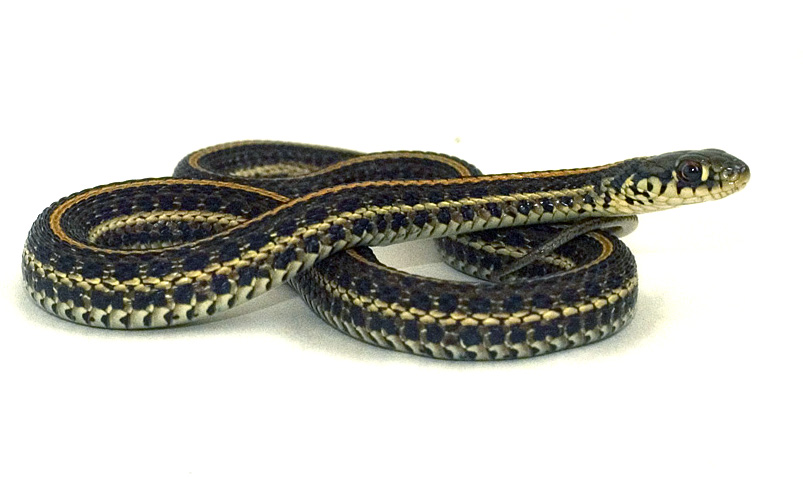
| Appearance | - The species has a blue-grey, olive-grey, greenish, or brown background coloration with brown, orange, or black dorsal spots. English Wikipedia
- The species has a long, narrow snout that gives its head a triangular shape. English Wikipedia
- Its background coloration can be reddish brown, charcoal, tan, or olive, with paired reddish, brown, or grey dorsal blotches. in.nau.edu
- The dorsal blotches are generally more prominent near the head and become less distinct toward the tail. in.nau.edu
- The belly is lighter than the back and is often yellowish or greenish, sometimes with irregular dark markings. in.nau.edu
- Older adults generally have less distinct coloration patterns than younger individuals. in.nau.edu
- Some populations exhibit melanism, while others include nearly green individuals with red spots or nearly uniformly red individuals with faint spots. in.nau.edu
- Individuals from the same litter can exhibit different normal brown or red color morphs. in.nau.edu
- The species has eyes positioned forward on the head. in.nau.edu
| |
|---|
| Habitat | - The species inhabits high-elevation riverbanks and streams, particularly clear rocky streams with pools and riffles. English Wikipedia
- The species has also been observed along lake shorelines. English Wikipedia
- The species occupies fast-flowing headwater streams near and below the Mogollon Rim. in.nau.edu
- The species is generally associated with riparian habitats and is dependent on aquatic environments. in.nau.edu
- Hibernation sites include rocky outcrops, rocky slopes, and rock piles situated above floodplains. in.nau.edu
- When away from water, individuals may shelter beneath large boulders, in rock talus, or in burrows beneath vegetation. in.nau.edu
| - The species inhabits meadows and prairies near marshes, streams, and ponds. English Wikipedia
- It occurs in grasslands near ponds, streams, marshes, and sloughs. animaldiversity.org
- The species can inhabit swampy areas and riverbanks. animaldiversity.org
- It can occur in vacant lots in suburban and urban areas. animaldiversity.org
- In the Chicago area, individuals have been observed in abandoned buildings, trash heaps, and vacant lots. English Wikipedia
- Individuals may use drier habitats when they occur alongside common garter snakes. animaldiversity.org
- The species hibernates in burrows and rock crevices. animaldiversity.org
- Hibernation sites can include rodent burrows, ant mounds, crayfish burrows, and artificial crevices. animaldiversity.org
|
|---|
| Diet | - The species primarily feeds on fish. English Wikipedia
- Documented fish prey include dace, chub, suckers, and native and introduced trout. English Wikipedia
- Native fish, particularly suckers, dace, and trout, are primary prey items. in.nau.edu
- The species also consumes non-native soft-rayed fish, including trout and mosquitofish. in.nau.edu
| - Its diet includes earthworms, slugs, and small amphibians. English Wikipedia
- The species has been recorded eating frogs, toads, salamanders, fish, birds, small rodents, leeches, earthworms, and grasshoppers. animaldiversity.org
- Its recorded fish prey include mosquitofish, southern redbelly dace, and bluntnose minnows. animaldiversity.org
- Recorded bird prey include bank swallows and eastern meadowlarks. animaldiversity.org
|
|---|
| Behaviour | - The species is among the most aquatic members of the garter snake group. English Wikipedia
- Individuals frequently forage underwater along the bottoms of streams. English Wikipedia
- The species uses ambush predation, waiting for prey to approach. English Wikipedia
- Individuals can remain underwater while holding their breath for several minutes. English Wikipedia
- Individuals may swim at the water surface or perch in willows, sedges, and other vegetation above water. in.nau.edu
- When alarmed near water, individuals typically escape by diving beneath large boulders. in.nau.edu
- The species generally hibernates from late October or November until March. English Wikipedia
- Telemetered individuals in Oak Creek Canyon were not observed active during winter at or outside their hibernation sites. in.nau.edu
| - The species is active during the day when temperatures are warm. animaldiversity.org
- Its daytime activity generally occurs at air temperatures between 21 and 29 degrees Celsius. animaldiversity.org
- It switches to nighttime activity when air temperatures exceed 31 degrees Celsius. animaldiversity.org
- Individuals may emerge from hibernation to bask during warm winter days. English Wikipedia
- The species is active from March to November, depending on its geographic region. animaldiversity.org
- Individuals are generally solitary except during mating interactions and communal hibernation. animaldiversity.org
- Individuals may move no more than 76 meters over periods exceeding one year. animaldiversity.org
- The species uses chemical trails to locate prey, mates, and hibernation sites. animaldiversity.org
- When threatened, individuals may bite, release foul-smelling musk, or defecate. animaldiversity.org
- The species is described as mildly venomous, with venom that is not toxic to humans. English Wikipedia
|
|---|
| Reproduction | - The species is viviparous and gives birth to live young. English Wikipedia
- Reported litter sizes typically range from 8 to 18 young. in.nau.edu
- Births generally occur between July and August. in.nau.edu
- The mating season is presumed to occur during spring and early summer. in.nau.edu
- Individuals develop a form of placentation during pregnancy. in.nau.edu
- Sexual maturity is reached at approximately two years of age. English Wikipedia
| |
|---|
| Distribution | No checked fact yet | - The species occurs across the central United States, extending north into Canada and south to Texas. English Wikipedia
- Its documented Canadian range includes southern Alberta, Saskatchewan, and Manitoba. animaldiversity.org
- Its documented United States range includes the Oklahoma panhandle, northern Texas, northeastern New Mexico, Minnesota, Wisconsin, and Indiana. animaldiversity.org
- The species occurs at elevations from 400 to 7,500 feet. English Wikipedia
- The species generally prefers elevations below 6,000 feet. English Wikipedia
|
|---|
| Conservation | - The species is federally listed as threatened in the United States. in.nau.edu
- The species' population has declined significantly throughout its range. English Wikipedia
- Habitat loss, habitat degradation, and invasive species are identified as major causes of the species' decline. fws.gov
- The species' range contraction has resulted in ecologically and genetically isolated populations. in.nau.edu
- The U.S. Fish and Wildlife Service designated 23,785 acres of critical habitat for the species in October 2021. English Wikipedia
| |
|---|
| Similar species | - The spotted, non-striped morph of the wandering garter snake resembles the narrow-headed garter snake. in.nau.edu
| - The species shares portions of its habitat with the common garter snake. English Wikipedia
- The plains garter snake and common garter snake may hybridize where their ranges overlap. English Wikipedia
|
|---|