Comparison

Double Drummer vs 17-year Decim Cicada

Double Drummer (Thopha saccata) and 17-year Decim Cicada (Magicicada septendecim) both belong to the family Cicadidae (cicada) and part ways below it.

Double Drummer

Double Drummer

Thopha saccata

Toby Hudson, CC BY-SA 3.0 au, via Wikimedia Commons

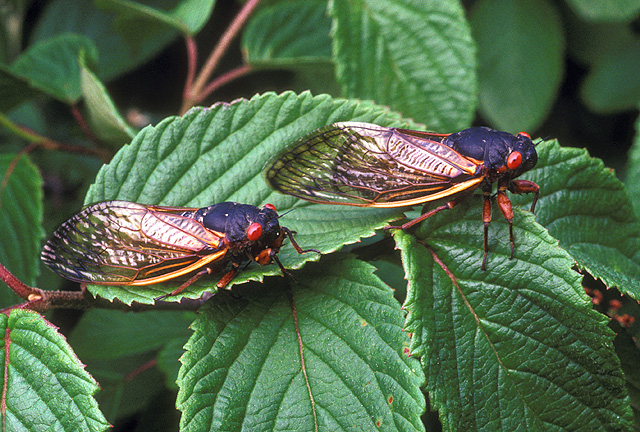
17-year Decim Cicada

17-year Decim Cicada

Magicicada septendecim

Unknown author, Public domain, via Wikimedia Commons

Side by side

Double Drummer17-year Decim Cicada
Scientific nameThopha saccata (Fabricius, 1803)Magicicada septendecim (Linnaeus, 1758)
English nameDouble Drummer17-year Decim Cicada
GroupInsectsInsects
ClassInsecta InsectInsecta Insect
OrderHemipteraHemiptera
FamilyCicadidae CicadaCicadidae Cicada
GenusThopha DrummersMagicicada Periodical Cicadas
Named in18031758
Red List categoryNot recordedNear Threatened
Countries on record1 country3 countries
GBIF occurrence records1,676 records14,019 records

Rows where the two agree are shown in grey.

Where each is found

Only Double Drummer (1)

Only 17-year Decim Cicada (3)

From Catalogue of Life checklists and GBIF occurrence records. A country missing from a list means no record is held, which is not proof of absence.

Checked facts

Double Drummer17-year Decim Cicada
Appearance
  • The adult double drummer has a broad head, a predominantly brown body, black markings across the thorax, and red-brown and black underparts. English Wikipedia
  • Adult males have large dark red-brown sac-like structures on either side of the abdomen that cover their tymbals. English Wikipedia
  • The adult's wings are transparent and have light brown veins. English Wikipedia
  • The legs are dark brown and covered with grey velvety hairs. English Wikipedia
  • The female has an ovipositor measuring 1.76 cm in length. English Wikipedia
  • The species has a black dorsal thorax, reddish eyes and wing veins, broad orange stripes on the underside of its abdomen, and orange patches on the sides of its thorax. English Wikipedia
  • Adults have clear wings with orange veins and generally reddish-orange eyes and legs. animaldiversity.org
SizeNo checked fact yet
Habitat
  • The species inhabits dry sclerophyll forests. English Wikipedia
  • Adults preferentially perch and feed on large eucalypts with trunk diameters exceeding 20 cm. English Wikipedia
  • The species spends most of its life in an underground habitat. animaldiversity.org
  • Its habitat requires large populations of deciduous trees whose roots provide food for underground nymphs. animaldiversity.org
Diet
Behaviour
  • Adult males produce loud songs to attract females. English Wikipedia
  • The species' song can exceed 120 decibels when many individuals are close together. English Wikipedia
  • The song consists of pulses emitted at a rate of 240–250 per second. English Wikipedia
  • Groups of double drummers congregate to amplify their calls, probably deterring potential bird predators. English Wikipedia
  • Adult males produce a sharp, irregular, fragmented distress call when seized by a predator. English Wikipedia
  • In hot weather, adults perch on the upper branches of trees. English Wikipedia
  • On overcast or rainy days, adults may move lower down onto tree trunks near the ground. English Wikipedia
  • Adults can fly at a moderate cruising speed of 2.5 metres per second. English Wikipedia
  • The maximum recorded flight speed described in the document is 4.0 metres per second. English Wikipedia
  • Adults sometimes fly out to sea and subsequently wash up dead on beaches. English Wikipedia
  • Males produce songs using a pair of rigid membranes called tymbals near the abdomen. animaldiversity.org
  • Male calling songs are commonly described as resembling the word Pharaoh. animaldiversity.org
  • Males form singing choruses within four or five days after emergence. animaldiversity.org
  • The species emerges in coordinated groups called broods. animaldiversity.org
  • A brood can emerge entirely during a single night. animaldiversity.org
  • Brood emergence is generally believed to help the species overwhelm predators through large numbers of individuals. animaldiversity.org
  • Some individuals emerge in years outside their brood's normal cycle, a phenomenon known as straggling. animaldiversity.org
Reproduction
  • Females lay their eggs in slits cut into branches or twigs, usually of eucalypts, using their ovipositors. English Wikipedia
  • Approximately twelve eggs are deposited in each slit, with several hundred eggs produced in total. English Wikipedia
  • Eggs generally hatch approximately 70 days after being laid. English Wikipedia
  • Newly hatched larvae fall to the ground and burrow into the soil. English Wikipedia
  • Adults mate and reproduce during their four-to-five-week adult lifespan. English Wikipedia
  • Female adults die after laying their eggs. English Wikipedia
Lifespan
Distribution
  • The species occurs in northern Queensland from Shiptons Flat and Cooktown south to Ingham and Sarina. English Wikipedia
  • A separate southern population range extends from Gympie in southeastern Queensland to Moruya in southern New South Wales. English Wikipedia
  • The species is found throughout eastern Australia. australian.museum
  • Adults are present from November until early March. English Wikipedia
  • The species occurs in greater numbers in some years and is absent in others. English Wikipedia
Conservation
  • The species has limited distribution in cities because it has not adapted well to urban environments. English Wikipedia
No checked fact yet
Uses
  • Schoolchildren sometimes collect live adults and keep them as pets in shoeboxes. English Wikipedia
  • The species' long life cycle and synchronized brood emergence are extensively studied by scientists. animaldiversity.org
Other
  • The species was described by Danish zoologist Johan Christian Fabricius in 1803 as the first named cicada native to Australia. English Wikipedia

In brief

Double Drummer

The Double Drummer is a cicada in the family Cicadidae, order Hemiptera and class Insecta. It inhabits dry sclerophyll forests and occurs throughout eastern Australia. Adult males have large dark red-brown sac-like structures covering their tymbals and produce loud songs that can exceed 120 decibels when many individuals are close together. Full profile

17-year Decim Cicada

Magicicada septendecim is native to Canada and the United States and occurs primarily in the northern Midwestern and eastern United States. Its nymphs remain underground for seventeen years, and adults emerge in coordinated groups called broods. Full profile

Compare something else

Page built on 27 November 2026 from the data on the two species pages, where every source is listed.

Cite this page

ScientificNames.org. (2026). Double Drummer vs 17-year Decim Cicada. Retrieved November 27, 2026, from https://scientificnames.org/compare/double-drummer-vs-17-year-decim-cicada