Comparison
Three-banded Courser vs Jerdon's Courser
Three-banded Courser (Rhinoptilus cinctus) and Jerdon's Courser (Rhinoptilus bitorquatus) both belong to the genus Rhinoptilus (short-billed coursers) and part ways below it.

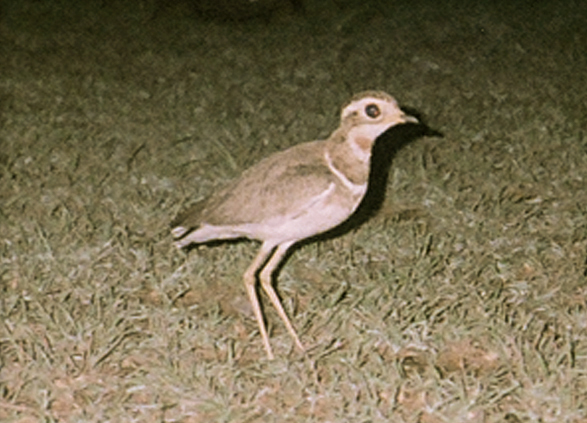
Three-banded Courser
Rhinoptilus cinctus
Steve Garvie from Dunfermline, Fife, Scotland, CC BY-SA 2.0, via Wikimedia Commons


Side by side
| Three-banded Courser | Jerdon's Courser | |
|---|---|---|
| Scientific name | Rhinoptilus cinctus (Heuglin, 1863) | Rhinoptilus bitorquatus (Blyth, 1848) |
| English name | Three-banded Courser | Jerdon's Courser |
| Group | Birds | Birds |
| Class | Aves Bird | Aves Bird |
| Order | Charadriiformes Auks | Charadriiformes Auks |
| Family | Glareolidae Coursers | Glareolidae Coursers |
| Genus | Rhinoptilus Short-billed Coursers | Rhinoptilus Short-billed Coursers |
| Named in | 1863 | 1848 |
| Red List category | Least Concern | Critically Endangered |
| Countries on record | 11 countries | 1 country |
| GBIF occurrence records | 5,643 records | 31 records |
Rows where the two agree are shown in grey.
Where each is found
Only Three-banded Courser (11)
Only Jerdon's Courser (1)
From Catalogue of Life checklists and GBIF occurrence records. A country missing from a list means no record is held, which is not proof of absence.
Checked facts
| Three-banded Courser | Jerdon's Courser | |
|---|---|---|
| Appearance |
|
|
| Size | No checked fact yet |
|
| Habitat | No checked fact yet |
|
| Diet | No checked fact yet |
|
| Behaviour |
|
|
| Reproduction | No checked fact yet |
|
| Distribution |
|
|
| Conservation | No checked fact yet |
|
| Other |
| No checked fact yet |
In brief
Three-banded Courser
The Three-banded Courser is a bird in the family Glareolidae. It occurs in Angola, Botswana, Ethiopia, Kenya, Namibia, Rwanda, Somalia, Somaliland, South Africa, South Sudan, Tanzania, Uganda, Zambia, and Zimbabwe. It produces a repeated metallic call resembling “chik.” Full profile
Jerdon's Courser
Jerdon's Courser (Rhinoptilus bitorquatus) is a bird in the family Glareolidae, order Charadriiformes and class Aves. The species is principally known from southern Andhra Pradesh and currently occurs in Sri Lankamalleswara Wildlife Sanctuary and Sri Penusila Narasimha Wildlife Sanctuary. It has two brown breast-bands, a broad buff supercilium and an orange-chestnut throat patch. Full profile
Compare something else
Page built on 29 November 2026 from the data on the two species pages, where every source is listed.
Cite this page
ScientificNames.org. (2026). Three-banded Courser vs Jerdon's Courser. Retrieved November 29, 2026, from https://scientificnames.org/compare/three-banded-courser-vs-jerdons-courser
“Three-banded Courser vs Jerdon's Courser.” ScientificNames.org, 2026, scientificnames.org/compare/three-banded-courser-vs-jerdons-courser. Accessed 29 Nov. 2026.
ScientificNames.org. “Three-banded Courser vs Jerdon's Courser.” Accessed November 29, 2026. https://scientificnames.org/compare/three-banded-courser-vs-jerdons-courser.
@misc{scientificnames_three_banded_courser_vs_jerdons_courser,
  author = {{ScientificNames.org}},
  title = {Three-banded Courser vs Jerdon's Courser},
  year = {2026},
  url = {https://scientificnames.org/compare/three-banded-courser-vs-jerdons-courser},
  note = {Accessed 2026-11-29}
}