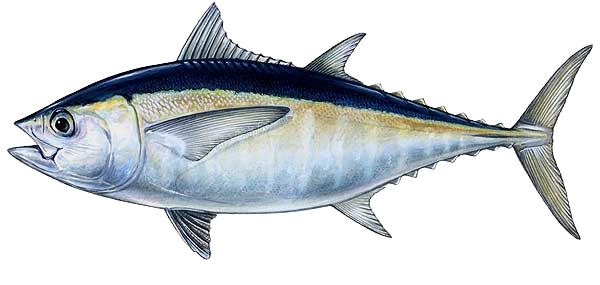
| Appearance | - The blackfin tuna has an oval-shaped body with a dark blue to black back, silver sides and belly, and a yellow lateral stripe. English Wikipedia
- The blackfin tuna has small, brownish dorsal finlets with white edges. English Wikipedia
- The blackfin tuna has 20–23 gill rakers, fewer than other tuna species. English Wikipedia
- The ventral surface of the blackfin tuna's liver is smooth rather than striated. English Wikipedia
- The blackfin tuna has a robust, fusiform body covered completely by small, compact scales. floridamuseum.ufl.edu
- The blackfin tuna has a bluish-black back, gray to silver sides, and a white belly. floridamuseum.ufl.edu
- The blackfin tuna has a prominent yellow to golden lateral band that usually fades after death. floridamuseum.ufl.edu
- The blackfin tuna has a crescent-shaped caudal fin and short keels at its base. floridamuseum.ufl.edu
- The dorsal finlets are dusky with bronze reflections and white edges, while the ventral finlets are usually gray. floridamuseum.ufl.edu
- The blackfin tuna has a small swim bladder. floridamuseum.ufl.edu
- The blackfin tuna has a dark metallic-blue back, silvery-gray sides, and a white belly. seagrantfish.lsu.edu
- The blackfin tuna's small finlets behind its dorsal and anal fins are distinctly dusky, sometimes with a yellowish tinge. seagrantfish.lsu.edu
| |
|---|
| Size | - The recorded all-tackle world record blackfin tuna weighed 20.6 kg and was caught off Florida. English Wikipedia
| |
|---|
| Habitat | - Blackfin tuna inhabit open ocean waters throughout the Gulf of Mexico. seagrantfish.lsu.edu
- Blackfin tuna occur in oceanic waters close to coastlines, generally seaward of the continental shelf. floridamuseum.ufl.edu
- Blackfin tuna prefer water temperatures above 21°C during their summer movements into temperate waters. floridamuseum.ufl.edu
- Blackfin tuna prefer water temperatures above 20°C. English Wikipedia
- Blackfin tuna can venture closer to land than other tuna species and enter green water. seagrantfish.lsu.edu
| - Albacore inhabit epipelagic and mesopelagic waters at depths ranging from the surface to 600 m. English Wikipedia
- The species most frequently occupies surface waters with temperatures between 15.6 and 19.4 °C. English Wikipedia
- Albacore favor marine areas where warm and cool water masses mix. English Wikipedia
- Large albacore weighing approximately 21 kg typically occupy depths of 0 to 450 m. animaldiversity.org
- Large individuals have their greatest abundance between 250 and 300 m depth. animaldiversity.org
- Albacore are pelagic and do not depend on the sea floor for their habitat. animaldiversity.org
|
|---|
| Diet | - Blackfin tuna consume epipelagic and mesopelagic fish and squid. English Wikipedia
- Blackfin tuna consume shrimp, crabs, amphipods, stomatopods, and decapod larvae. English Wikipedia
- Blackfin tuna feed by filtering smaller prey from the water and chasing larger prey. English Wikipedia
- The blackfin tuna consumes fish larvae, stomatopod larvae, shrimp, and crab larvae. seagrantfish.lsu.edu
| - Albacore feed on fish, crustaceans, and cephalopods, with cephalopods forming their primary food source. English Wikipedia
- The deep-water squid Heteroteuthis dispar is the most abundant cephalopod recorded in the albacore diet. English Wikipedia
- Berryteuthis anonychus is another cephalopod species consumed by albacore. English Wikipedia
- Recorded fish prey include Cololabis saira, Engraulis japonicus, and Engraulis mordax. English Wikipedia
- The primary diet includes Pacific saury, northern anchovy, crustacean zooplankton, gonatid squid, and Japanese anchovy. animaldiversity.org
- Anchovies can account for up to 96% of albacore stomach contents. animaldiversity.org
|
|---|
| Behaviour | | - Albacore form migratory schools that can include skipjack, yellowfin, and bluefin tuna. English Wikipedia
- Schools of albacore are segregated according to maturity, with older individuals forming more compact groups. English Wikipedia
- Albacore sometimes form schools around floating objects such as sargassum weeds. English Wikipedia
- Albacore in Baja California frequently dive deeper than 200 m during daylight and remain near the surface at night. English Wikipedia
- Albacore off Washington and Oregon remain near the surface throughout the day. English Wikipedia
- Albacore maintain continuous movement because they require a constant supply of oxygen. English Wikipedia
- Albacore exhibit diel vertical migration, following prey through the water column. animaldiversity.org
|
|---|
| Reproduction | - Blackfin tuna reach sexual maturity at approximately two years of age and a weight of 4–6 pounds. English Wikipedia
- Blackfin tuna spawn off Florida between April and November. English Wikipedia
- Blackfin tuna spawn in the Gulf of Mexico and near northern Brazil between June and September. English Wikipedia
- Female blackfin tuna release eggs into the water column, where sperm fertilizes them. English Wikipedia
- Blackfin tuna produce pelagic larvae that occur from the water surface to depths of 164 feet. English Wikipedia
| - Albacore reproduce by laying eggs that develop and hatch outside the female's body. English Wikipedia
- Spawning generally occurs between November and February. English Wikipedia
- A 20 kg female can produce between two and three million eggs per spawning. English Wikipedia
- Albacore reach reproductive maturity at approximately five to six years of age. English Wikipedia
- Albacore release their eggs and sperm into the water during group spawning. animaldiversity.org
- Albacore eggs are fertilized externally and scattered throughout the ocean. animaldiversity.org
- Albacore provide no parental investment beyond producing gametes and migrating to spawning grounds. animaldiversity.org
|
|---|
| Distribution | - Blackfin tuna occur in the western Atlantic Ocean from Massachusetts to Rio de Janeiro, including the Gulf of Mexico and Caribbean Sea. floridamuseum.ufl.edu
| - Albacore occur in tropical and temperate waters across all oceans and the Mediterranean Sea. English Wikipedia
- The species' latitudinal distribution extends from 59°N to 46°S. English Wikipedia
|
|---|
| Conservation | - The blackfin tuna was assessed as globally Least Concern by the IUCN as of 2022. English Wikipedia
| No checked fact yet |
|---|
| Uses | | - Albacore are commercially harvested and sold fresh, frozen, or canned. animaldiversity.org
- Albacore is the only tuna species that can be marketed as white meat tuna. English Wikipedia
|
|---|
| Similar species | No checked fact yet | - Juvenile bigeye tuna are sometimes confused with albacore because both have exceptionally long pectoral fins. animaldiversity.org
- Juvenile bigeye tuna have rounded pectoral-fin tips, whereas albacore have more pointed tips. animaldiversity.org
|
|---|
| Other | - The estimated protein content of blackfin tuna is 22.9% by wet weight. fishbase.se
| No checked fact yet |
|---|