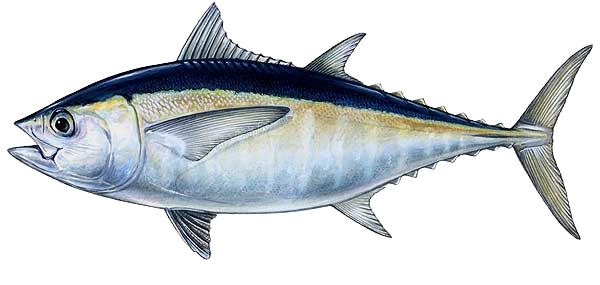
| Appearance | - The blackfin tuna has an oval-shaped body with a dark blue to black back, silver sides and belly, and a yellow lateral stripe. English Wikipedia
- The blackfin tuna has small, brownish dorsal finlets with white edges. English Wikipedia
- The blackfin tuna has 20–23 gill rakers, fewer than other tuna species. English Wikipedia
- The ventral surface of the blackfin tuna's liver is smooth rather than striated. English Wikipedia
- The blackfin tuna has a robust, fusiform body covered completely by small, compact scales. floridamuseum.ufl.edu
- The blackfin tuna has a bluish-black back, gray to silver sides, and a white belly. floridamuseum.ufl.edu
- The blackfin tuna has a prominent yellow to golden lateral band that usually fades after death. floridamuseum.ufl.edu
- The blackfin tuna has a crescent-shaped caudal fin and short keels at its base. floridamuseum.ufl.edu
- The dorsal finlets are dusky with bronze reflections and white edges, while the ventral finlets are usually gray. floridamuseum.ufl.edu
- The blackfin tuna has a small swim bladder. floridamuseum.ufl.edu
- The blackfin tuna has a dark metallic-blue back, silvery-gray sides, and a white belly. seagrantfish.lsu.edu
- The blackfin tuna's small finlets behind its dorsal and anal fins are distinctly dusky, sometimes with a yellowish tinge. seagrantfish.lsu.edu
| - The dorsal surface is black or dark blue with grayish-green iridescence, while the belly has silver or gray spots. animaldiversity.org
- Small yellow fins edged in black extend from behind the second dorsal fin toward the tail. animaldiversity.org
- The species has relatively small pectoral fins and eyes compared with other tuna species. animaldiversity.org
- Its tail is crescent-shaped and lunate. animaldiversity.org
|
|---|
| Size | - The recorded all-tackle world record blackfin tuna weighed 20.6 kg and was caught off Florida. English Wikipedia
| |
|---|
| Habitat | - Blackfin tuna inhabit open ocean waters throughout the Gulf of Mexico. seagrantfish.lsu.edu
- Blackfin tuna occur in oceanic waters close to coastlines, generally seaward of the continental shelf. floridamuseum.ufl.edu
- Blackfin tuna prefer water temperatures above 21°C during their summer movements into temperate waters. floridamuseum.ufl.edu
- Blackfin tuna prefer water temperatures above 20°C. English Wikipedia
- Blackfin tuna can venture closer to land than other tuna species and enter green water. seagrantfish.lsu.edu
| |
|---|
| Diet | - Blackfin tuna consume epipelagic and mesopelagic fish and squid. English Wikipedia
- Blackfin tuna consume shrimp, crabs, amphipods, stomatopods, and decapod larvae. English Wikipedia
- Blackfin tuna feed by filtering smaller prey from the water and chasing larger prey. English Wikipedia
- The blackfin tuna consumes fish larvae, stomatopod larvae, shrimp, and crab larvae. seagrantfish.lsu.edu
| - The species consumes small schooling squid, including Abraliopsis felis. English Wikipedia
- Its fish prey include anchovies, jack mackerel, Pacific mackerel, lanternfish, Pacific saury, rockfish and sardines. English Wikipedia
- The species also consumes pelagic red crabs, krill and Daphnia. English Wikipedia
- Its diet in the Southern California Bight during 2008 was dominated by midwater lanternfishes and enoploteuthid squids. pmc.ncbi.nlm.nih.gov
- Between 2009 and 2014, individuals in the Southern California Bight consumed diverse fishes, cephalopods and crustaceans. pmc.ncbi.nlm.nih.gov
- During 2015–2016, individuals in the Southern California Bight specialized on relatively high-energy schooling prey near the surface, including anchovies and pelagic red crabs. pmc.ncbi.nlm.nih.gov
|
|---|
| Behaviour | | - The species is an opportunistic predator capable of exploiting diverse food resources. pmc.ncbi.nlm.nih.gov
- Individuals commonly swim in schools with other tuna species, including Atlantic and southern bluefin tuna. animaldiversity.org
- Seasonal migration is influenced by changes in water temperature and food availability. animaldiversity.org
- The species migrates during daylight hours. animaldiversity.org
- Individuals can tolerate water temperatures as low as 9°C during migration. animaldiversity.org
- The species is endothermic and can regulate its body temperature. English Wikipedia
- Individuals can maintain body temperatures up to 20°C above the surrounding water in cold conditions. English Wikipedia
|
|---|
| Reproduction | - Blackfin tuna reach sexual maturity at approximately two years of age and a weight of 4–6 pounds. English Wikipedia
- Blackfin tuna spawn off Florida between April and November. English Wikipedia
- Blackfin tuna spawn in the Gulf of Mexico and near northern Brazil between June and September. English Wikipedia
- Female blackfin tuna release eggs into the water column, where sperm fertilizes them. English Wikipedia
- Blackfin tuna produce pelagic larvae that occur from the water surface to depths of 164 feet. English Wikipedia
| - The species spawns in the northwestern Philippine Sea and the Sea of Japan. English Wikipedia
- Spawning occurs between April and August, with timing varying by geographic region. English Wikipedia
- Spawning in the Ryukyu Islands generally occurs between April and July, while spawning in the Sea of Japan occurs between June and August. animaldiversity.org
- Spawning generally takes place at water temperatures between 23.5 and 29.5°C. animaldiversity.org
- Fertilization occurs externally. animaldiversity.org
- The species has separate sexes and exhibits polygynandrous mating. animaldiversity.org
- Female individuals can produce between 780,000 and 35 million eggs per clutch. animaldiversity.org
- Eggs generally hatch approximately 38 hours after spawning. animaldiversity.org
- Young individuals are independent from birth and swim alone or in schools. animaldiversity.org
- Males and females provide no parental investment beyond mating. animaldiversity.org
- Sexual maturity typically occurs at approximately five years of age. animaldiversity.org
|
|---|
| Distribution | - Blackfin tuna occur in the western Atlantic Ocean from Massachusetts to Rio de Janeiro, including the Gulf of Mexico and Caribbean Sea. floridamuseum.ufl.edu
| - Some juveniles migrate from the western Pacific to Australia or the western coast of the United States at approximately one year of age. animaldiversity.org
- The migration from the western coast of the United States to Japan covers approximately 8,000 km. animaldiversity.org
|
|---|
| Conservation | - The blackfin tuna was assessed as globally Least Concern by the IUCN as of 2022. English Wikipedia
| - The species is currently classified as Near Threatened by the IUCN. English Wikipedia
- A 2024 stock assessment determined that the population had rebuilt and was no longer overfished or subject to overfishing. English Wikipedia
- The population increased from approximately 2 percent of historic levels in 2010 to approximately 23 percent in 2020. English Wikipedia
|
|---|
| Uses | | |
|---|
| Other | - The estimated protein content of blackfin tuna is 22.9% by wet weight. fishbase.se
| No checked fact yet |
|---|