Comparison
Tiger Pistol Shrimp vs Forceps Snapping Shrimp
Tiger Pistol Shrimp (Alpheus bellulus) and Forceps Snapping Shrimp (Alpheus digitalis) both belong to the genus Alpheus (pistol shrimps) and part ways below it. Both are recorded in 1 country.
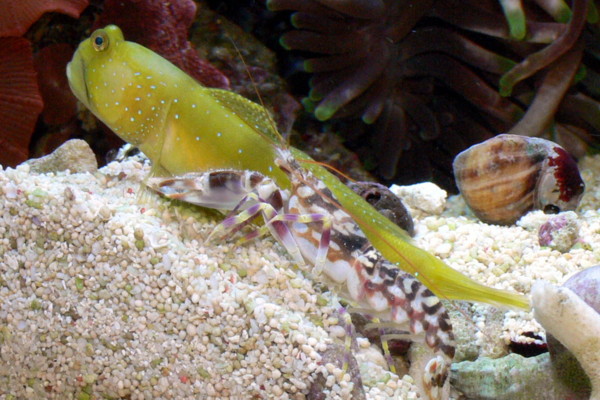


Side by side
| Tiger Pistol Shrimp | Forceps Snapping Shrimp | |
|---|---|---|
| Scientific name | Alpheus bellulus Miya & Miyake, 1969 | Alpheus digitalis de Haan, 1844 |
| English name | Tiger Pistol Shrimp | Forceps Snapping Shrimp |
| Group | Crustaceans | Crustaceans |
| Class | Malacostraca | Malacostraca |
| Order | Decapoda | Decapoda |
| Family | Alpheidae Snapping Shrimps | Alpheidae Snapping Shrimps |
| Genus | Alpheus Pistol Shrimps | Alpheus Pistol Shrimps |
| Named in | 1969 | 1844 |
| Environment | marine | marine |
| Countries on record | 4 countries | 11 countries |
| GBIF occurrence records | 208 records | 332 records |
Rows where the two agree are shown in grey.
Where each is found
Both recorded in 1 country
Only Tiger Pistol Shrimp (3)
Only Forceps Snapping Shrimp (10)
From Catalogue of Life checklists and GBIF occurrence records. A country missing from a list means no record is held, which is not proof of absence.
Checked facts
| Tiger Pistol Shrimp | Forceps Snapping Shrimp | |
|---|---|---|
| Appearance |
| No checked fact yet |
| Size |
| No checked fact yet |
| Habitat |
| No checked fact yet |
| Diet |
| No checked fact yet |
| Behaviour |
| No checked fact yet |
| Reproduction |
| No checked fact yet |
| Uses |
| No checked fact yet |
| Similar species |
| No checked fact yet |
| Other |
|
|
In brief
Tiger Pistol Shrimp
Alpheus bellulus inhabits sandy, muddy and detrital substrates in shallow water at depths of up to 20 m. It is distinguished by its enlarged right claw, which produces powerful bubbles that stun prey. Full profile
Forceps Snapping Shrimp
The forceps snapping shrimp is a crustacean in the family Alpheidae, order Decapoda, and class Malacostraca. The species was originally described from a single specimen with abnormal chelipeds. Full profile
Compare something else
Page built on 28 November 2026 from the data on the two species pages, where every source is listed.
Cite this page
ScientificNames.org. (2026). Tiger Pistol Shrimp vs Forceps Snapping Shrimp. Retrieved November 28, 2026, from https://scientificnames.org/compare/tiger-pistol-shrimp-vs-forceps-snapping-shrimp
“Tiger Pistol Shrimp vs Forceps Snapping Shrimp.” ScientificNames.org, 2026, scientificnames.org/compare/tiger-pistol-shrimp-vs-forceps-snapping-shrimp. Accessed 28 Nov. 2026.
ScientificNames.org. “Tiger Pistol Shrimp vs Forceps Snapping Shrimp.” Accessed November 28, 2026. https://scientificnames.org/compare/tiger-pistol-shrimp-vs-forceps-snapping-shrimp.
@misc{scientificnames_tiger_pistol_shrimp_vs_forceps_snapping_shrimp,
  author = {{ScientificNames.org}},
  title = {Tiger Pistol Shrimp vs Forceps Snapping Shrimp},
  year = {2026},
  url = {https://scientificnames.org/compare/tiger-pistol-shrimp-vs-forceps-snapping-shrimp},
  note = {Accessed 2026-11-28}
}