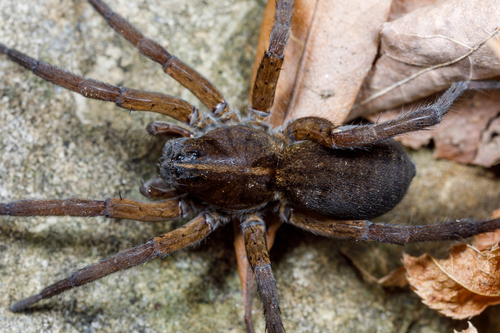
| Appearance | - The species has a brown carapace with a distinctive yellow stripe extending from the anterior eyes down the cephalothorax. English Wikipedia
- The underside of its abdomen bears several distinct black spots. English Wikipedia
- Males have yellow legs without distinct markings, whereas females have reddish-brown legs without bands or additional markings. English Wikipedia
- Faint yellow stripes extend posteriorly from the posterior median eyes. English Wikipedia
| - The spider has an overall light-brown coloration with darker-brown patterns on its back and a dark underside. English Wikipedia
- Adult males can have orange coloration on the sides of their abdomen. English Wikipedia
- The spider's eyes reflect light, making individuals easier to detect at night. English Wikipedia
- Its camouflage makes it difficult to see against its surroundings. nhmu.utah.edu
|
|---|
| Size | - The average body length of this species is approximately 17 mm. English Wikipedia
- Mature females typically weigh more than 300 mg and have carapace widths of approximately 6.5 mm. English Wikipedia
- Males typically weigh more than 200 mg and have carapace widths of approximately 4.5 mm. English Wikipedia
- Females are larger than males in this species. English Wikipedia
| |
|---|
| Habitat | - The species inhabits woods, marshes, fields, and riparian areas. English Wikipedia
- The species generally prefers wetter environments over dry habitats. English Wikipedia
- In Florida and Mississippi, the species is most frequently found in wet habitats such as marshes and lakes. English Wikipedia
- Females construct nests beneath stones or boards in fields and woods. English Wikipedia
- Female nests consist of silk-lined burrows. English Wikipedia
| - The species inhabits self-constructed burrows as well as burrows made by other organisms. English Wikipedia
- The species tends to prefer relatively flat and open areas. English Wikipedia
- Its burrows can extend to depths of approximately 30 cm below ground. English Wikipedia
- The interior of its burrows is typically about 4°C cooler than the surface temperature. English Wikipedia
- The species can inhabit desert ecosystems and other environments with substantial temperature fluctuations. English Wikipedia
- The species is generally found on the ground and is a poor climber. nhmu.utah.edu
|
|---|
| Diet | - The species feeds on insects including crickets, fly grubs, cockroaches, mealworms, and beetles. English Wikipedia
- The species can prey on smaller spiders, including Pardosa milvina. English Wikipedia
- Individuals receiving a varied diet have higher survivorship and reach sexual maturity earlier than individuals receiving a single-prey-type diet. English Wikipedia
| - The species commonly consumes insects and other small invertebrates. English Wikipedia
- Grasshoppers and crickets are among its typical prey. English Wikipedia
- The species sometimes consumes cockroaches and other pests found around human homes. English Wikipedia
- The species has been observed consuming juvenile Texas banded geckos. English Wikipedia
- The spiders consumed a greater mass of micronutrients when feeding on frogs than when feeding on crickets in the study. pmc.ncbi.nlm.nih.gov
|
|---|
| Behaviour | - Individuals are solitary and generally hunt alone except when mating. English Wikipedia
- The species is usually active at night and hunts during nighttime. English Wikipedia
- The species does not construct webs. English Wikipedia
- Females construct burrows beneath rocks or boards. English Wikipedia
- Females wait for prey near their silk burrows, while males generally roam in search of feeding opportunities. English Wikipedia
- Individuals alternate between several different foraging locations. English Wikipedia
- Females may engage in sexual cannibalism before or after copulation. English Wikipedia
- Females are more likely to cannibalize males when they are hungry. English Wikipedia
- Copulation typically lasts approximately eight minutes. English Wikipedia
- The species is generally not aggressive toward humans and does not normally attack unless provoked. English Wikipedia
| |
|---|
| Reproduction | - Mating usually takes place in May or June. English Wikipedia
- Egg sacs are produced during May and July and measure approximately 8–12 mm in diameter. English Wikipedia
- Individual eggs are tan or yellow and measure approximately 1–2 mm in diameter. English Wikipedia
- Females carry their egg sacs on their backs until the eggs hatch. English Wikipedia
- Females continue carrying hatchlings on their backs until they are sufficiently mature to hunt independently. English Wikipedia
- Male maturation occurs between May and September. English Wikipedia
- Female maturation can occur at any time of the year. English Wikipedia
- Individuals undergo periodic moulting as they mature. English Wikipedia
| - The species mates in late summer. English Wikipedia
- Females carry their egg sacs attached to their abdomens during incubation. English Wikipedia
- Egg incubation lasts approximately two weeks. English Wikipedia
- The main egg-carrying periods occur in late July and late August. English Wikipedia
- Each egg sac contains approximately 200 spiderlings upon hatching. English Wikipedia
- Newly hatched spiderlings generally remain with their mother for their first six days. English Wikipedia
- Immature individuals undergo multiple developmental instars before reaching breeding age at approximately three years. English Wikipedia
|
|---|
| Distribution | No checked fact yet | - The species occurs across a large part of North America. English Wikipedia
- Its documented North American range includes South Carolina, Kansas, the Great Lake States, and the American Southwest. English Wikipedia
|
|---|
| Conservation | No checked fact yet | - The species was designated the state spider of South Carolina in 2000. English Wikipedia
|
|---|
| Similar species | - Tigrosa helluo is frequently mistaken for the nursery web spider Pisaurina mira because of their physical resemblance. English Wikipedia
- Tigrosa helluo is smaller than its close relative Tigrosa aspersa. English Wikipedia
| No checked fact yet |
|---|
| Name origin | - The genus name Tigrosa refers to the fierce, tiger-like appearance or nature of these spiders. English Wikipedia
| No checked fact yet |
|---|
| Other | - The species was formerly classified under the genus Hogna as Hogna helluo. English Wikipedia
- Its venomous bite generally causes only minor pain and swelling in humans. English Wikipedia
| No checked fact yet |
|---|