| Appearance | - Male butterflies have dark brown upper wings with small reddish spots near the anal area of the hindwings. English Wikipedia
- Female butterflies have reddish-yellow forewings, except along the costal and distal margins. English Wikipedia
- Both sexes have undersides resembling those of Chrysophanus phlaeas, with verdigris-colored dusting on the basal hindwing area. English Wikipedia
- The larva is relatively thick, with swollen segments separated by deep incisions. English Wikipedia
- The larva is greenish yellow with a bluish dorsal stripe and a red-brown lateral stripe. English Wikipedia
- The larva has thin oblique streaks between its dorsal and lateral stripes. English Wikipedia
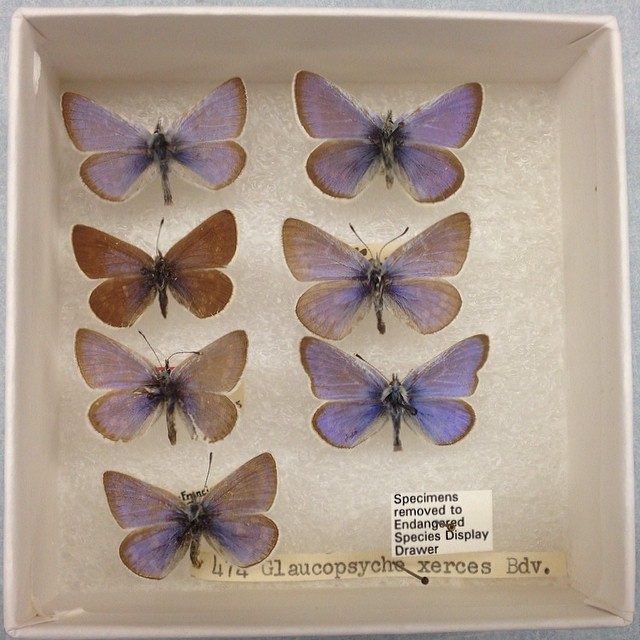
| - Males have iridescent blue coloration on the upper surfaces of their wings and pale spots on the undersides. floridamuseum.ufl.edu
- The species exhibited extensive variation in wing patterns, with several named forms. floridamuseum.ufl.edu
- The species was characterized by blue wings with white spots. English Wikipedia
|
|---|
| Size | | |
|---|
| Habitat | No checked fact yet | - The species inhabited coastal sand dunes on the San Francisco Peninsula in California. English Wikipedia
- The species preferred stabilized sandy sites where its low-growing larval host plant grew. floridamuseum.ufl.edu
- The species occupied coastal sand dunes in the upper San Francisco Peninsula, including areas now within the Golden Gate National Recreation Area. floridamuseum.ufl.edu
|
|---|
| Diet | | - The caterpillars used Lotus scoparius (Deerweed) as their preferred larval host plant. pmc.ncbi.nlm.nih.gov
- The butterflies fed on plants belonging to the genera Lotus and Lupinus. English Wikipedia
- Lupinus was another recorded vegetative food source, but it was unsuitable for the larval stages. English Wikipedia
|
|---|
| Behaviour | - The larvae remain in the pods of their food plants until the end of May. English Wikipedia
- Adult butterflies are active from February through April in locations where their food plants grow. English Wikipedia
- Adult butterflies can occur in exceptionally large numbers. English Wikipedia
- When caught under a net, specimens often drop to the ground and hide in the grass. English Wikipedia
- The adult flight period is reported as January through April. English Wikipedia
| - The species had a major flight period documented in historical biological studies. pmc.ncbi.nlm.nih.gov
|
|---|
| Reproduction | - Females lay green, somewhat flattened eggs individually on the upper surfaces of Boujeania hispida leaves. English Wikipedia
- The eggs have a network of polygonal markings. English Wikipedia
- The pupa is oval and rounded throughout, with shallow, minute punctures. English Wikipedia
- The larva is reported to pupate freely on the ground. English Wikipedia
| |
|---|
| Distribution | - The species occurs on the Iberian Peninsula, in northern Africa and along the Mediterranean coast of France. English Wikipedia
- The species is recorded from the French Riviera, Spain and North Africa. English Wikipedia
| - The species was endemic to the coastal sand dunes of the upper San Francisco Peninsula in California. floridamuseum.ufl.edu
|
|---|
| Conservation | No checked fact yet | - The Xerces blue is extinct, with its extinction associated with habitat loss caused by urban development. English Wikipedia
- The last known living individuals were observed in the early 1940s. pmc.ncbi.nlm.nih.gov
- Urban development and disturbance of sandy soils caused the local loss of important host plants, contributing to the species' extinction. pmc.ncbi.nlm.nih.gov
- The loss of Lotus plants used by the larvae is considered a contributing factor in the species' extinction. English Wikipedia
- The introduction of the Argentine ant coincided with the species' decline and has been proposed as a possible contributing factor. pmc.ncbi.nlm.nih.gov
- The invasive Argentine ant was proposed as a possible threat because it may have outcompeted native ants that tend and protect the caterpillars. pmc.ncbi.nlm.nih.gov
- The species' extinction inspired the establishment of the Xerces Society for Invertebrate Conservation in 1971. floridamuseum.ufl.edu
- The species is recognized as an important symbol of insect conservation in North America. pmc.ncbi.nlm.nih.gov
|
|---|
| Similar species | No checked fact yet | - The closest relatives of the Xerces blue are Glaucopsyche australis and Glaucopsyche pseudoxerces. English Wikipedia
- The Xerces blue's closest relative group is most closely related to Glaucopsyche lygdamus, commonly called the silvery blue. English Wikipedia
- Historical researchers considered the Xerces blue and Glaucopsyche lygdamus closely related but separate species. pmc.ncbi.nlm.nih.gov
|
|---|
| Other | No checked fact yet | - Genetic analyses of museum specimens confirmed that the Xerces blue was a distinct species. pmc.ncbi.nlm.nih.gov
- DNA analysis was conducted using a museum specimen collected in 1928. pmc.ncbi.nlm.nih.gov
- The DNA analysis recovered 210,182,214 nucleotides from the museum specimen. pmc.ncbi.nlm.nih.gov
- Preserved specimens of the species are held by the California Academy of Sciences, Bohart Museum, and Harvard Museum of Natural History. English Wikipedia
- The Florida Museum of Natural History's McGuire Center holds specimens of the species. floridamuseum.ufl.edu
|
|---|