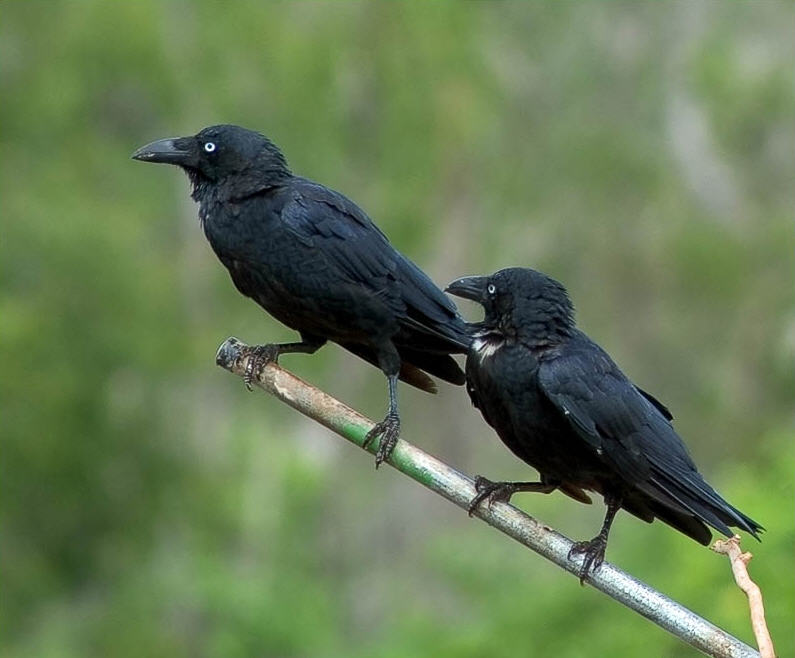
| Appearance | - The Torresian crow has predominantly black plumage, a black beak and mouth, and white irises. English Wikipedia
- The feathers at the bases of the bird's head and neck are white. English Wikipedia
- The bird has glossy black back feathers and dull black breast feathers. English Wikipedia
- Its tail is broad and has a square-shaped tip. English Wikipedia
- Its eyes have white irises surrounded by a fine blue eye-ring. English Wikipedia
- The white bases of its head and neck feathers become visible when the feathers are ruffled. English Wikipedia
- Juveniles have blue eyes and lack the glossy dorsal feathers of adults until approximately nine months of age. English Wikipedia
| - Adult carrion crows have predominantly black plumage with a green or purple sheen. English Wikipedia
- The bill, legs, and feet of carrion crows are black. English Wikipedia
- Juvenile carrion crows have brownish plumage and blue eyes that darken as they mature. English Wikipedia
- Male and female carrion crows have similar external appearances. animaldiversity.org
|
|---|
| Size | No checked fact yet | |
|---|
| Habitat | - The Torresian crow occupies habitats within its range where permanent water is available. English Wikipedia
- Its documented natural habitats include tropical rainforests, eucalyptus woodland, open scrub, beaches, swamps and offshore islands. English Wikipedia
- The species also inhabits farmland, towns and cities. English Wikipedia
- In central Australia's arid regions, the species is concentrated around locations with permanent water. English Wikipedia
| - Carrion crows inhabit marshlands, lightly cultivated areas with sparse tree cover, and coastal environments. animaldiversity.org
- Carrion crows inhabit suburban and urban environments, including parks and buildings. animaldiversity.org
- Carrion crows occupy environments ranging from sea level to mountainous areas. animaldiversity.org
- Carrion crows also inhabit moors, woodland, sea cliffs, and farmland. English Wikipedia
|
|---|
| Diet | - The Torresian crow is an omnivore. English Wikipedia
- Its diet outside urban areas primarily includes invertebrates, berries and carrion. English Wikipedia
- The species also eats stranded fish, roadkill, fruit, grain, smaller birds and rodents. English Wikipedia
- Urban populations rely more heavily on human-associated food sources than populations in natural habitats. English Wikipedia
| - Carrion crows consume carrion, insects, earthworms, other invertebrates, grains, fruits, seeds, nuts, small mammals, amphibians, fish, food scraps, and stolen eggs. English Wikipedia
- Carrion crows forage for food in landfills and dumpsters in urban environments. animaldiversity.org
- Carrion crows sometimes obtain food by dropping hard-shelled animals and nuts from heights to break them open. blogs.ucl.ac.uk
|
|---|
| Behaviour | - Torresian crows sometimes cooperate in teams to steal food from larger birds. English Wikipedia
- Females display more aggressive behaviour than males and dominate most other species except large birds of prey and Australian magpies. English Wikipedia
- Torresian crows defend their nests and territories by attacking large birds of prey, including wedge-tailed eagles and owls. English Wikipedia
- Large groups of Torresian crows roam nomadically across farmland, forests and urban suburbs between January and August. English Wikipedia
- From September to December, many individuals leave nomadic flocks to breed in temporary territories. English Wikipedia
- Breeding pairs return to the same territory annually, although other pairs may take over territories between years. English Wikipedia
- Torresian crows characteristically shuffle their wings after landing. English Wikipedia
| - Carrion crows often perch on elevated locations and produce three or four calls in succession. English Wikipedia
- Carrion crows can become tame in the vicinity of humans. English Wikipedia
- Carrion crows can use sticks as tools to reach food in laboratory settings. animaldiversity.org
- Carrion crows have been observed using cars to crack nuts that they cannot break with their beaks. animaldiversity.org
- Carrion crows show increased object exploration when other individuals are present. pmc.ncbi.nlm.nih.gov
- Carrion crows exhibit high tolerance toward conspecifics while feeding. pmc.ncbi.nlm.nih.gov
- Carrion crows form monogamous pairs that generally remain together throughout their lives. animaldiversity.org
- Non-breeding carrion crows form communal roosts and foraging groups. pmc.ncbi.nlm.nih.gov
- Carrion crows defend nesting territories throughout the year in most populations. animaldiversity.org
- Carrion crow pairs defend territories measuring approximately 200–500 square metres. animaldiversity.org
|
|---|
| Reproduction | - The main breeding season extends from August to January. English Wikipedia
- Most eggs are laid in September and October. English Wikipedia
- Torresian crows usually build stick nests high in trees, commonly in eucalyptus trees. English Wikipedia
- The species occasionally nests on power pylons and tall buildings. English Wikipedia
- A typical clutch contains two to four eggs. English Wikipedia
- The female incubates the eggs for approximately twenty days. English Wikipedia
- The male assists in rearing the chicks for approximately forty days until they leave the nest. English Wikipedia
- Young birds remain with their parents for several months after fledging before joining nomadic flocks. English Wikipedia
| - Carrion crows generally begin reproducing at approximately three years of age. animaldiversity.org
- Carrion crows generally breed between March and April. animaldiversity.org
- A breeding pair generally lays one clutch of four to five eggs each spring. animaldiversity.org
- Carrion crow eggs hatch after approximately 17–20 days of incubation. animaldiversity.org
- Female carrion crows alone incubate the eggs while males provide food. animaldiversity.org
- Carrion crow nestlings generally fledge after spending 28–30 days in the nest. animaldiversity.org
- Carrion crows generally construct nests in trees or on cliffs. animaldiversity.org
- Carrion crow nests are usually constructed from sticks and placed in tall trees. English Wikipedia
- Carrion crows sometimes retain offspring from the previous year to help raise new hatchlings. English Wikipedia
|
|---|
| Distribution | - The Torresian crow occurs in Australia, Papua New Guinea and parts of Indonesia. English Wikipedia
| |
|---|
| Conservation | - The geographic range of the Torresian crow expanded into highly urbanized Australian regions between 1993 and 2004. English Wikipedia
| No checked fact yet |
|---|
| Similar species | - The Torresian crow is morphologically similar to the little crow but has a larger body and more robust bill. English Wikipedia
| |
|---|
| Name origin | No checked fact yet | - The scientific name Corvus corone combines the Latin word for raven with the Greek word for crow. English Wikipedia
|
|---|