Comparison

Torresian Crow vs Common Raven

Torresian Crow (Corvus orru) and Common Raven (Corvus corax) both belong to the genus Corvus (crows) and part ways below it.
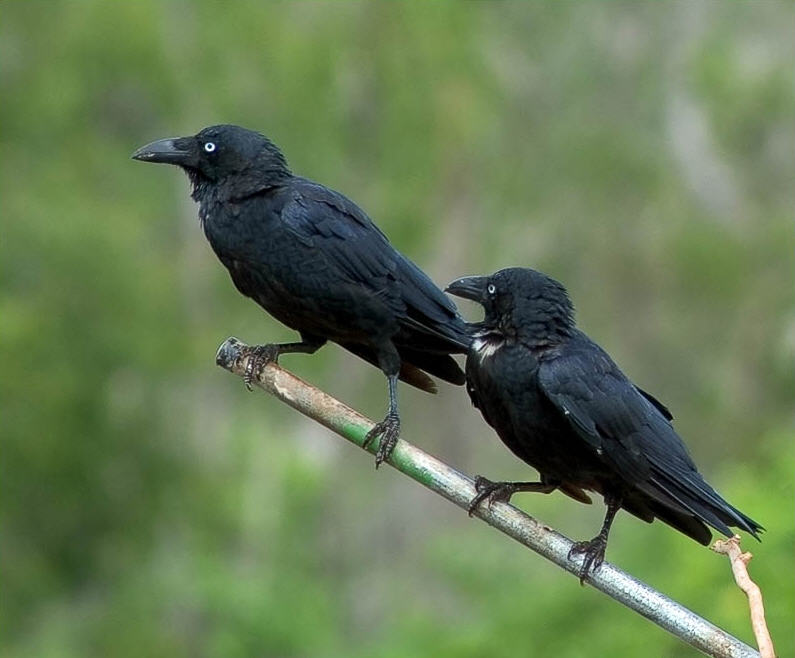
Torresian Crow

Torresian Crow

Corvus orru

Richard Mc Donald, CC BY-SA 3.0, via Wikimedia Commons

Common Raven

Common Raven

Corvus corax

Accipiter (R. Altenkamp, Berlin), CC BY-SA 3.0, via Wikimedia Commons

Side by side

Torresian CrowCommon Raven
Scientific nameCorvus orru Bonaparte, 1850Corvus corax Linnaeus, 1758
English nameTorresian CrowCommon Raven
GroupBirdsBirds
ClassAves BirdAves Bird
OrderPasseriformes PasserinePasseriformes Passerine
FamilyCorvidae JaysCorvidae Jays
GenusCorvus CrowsCorvus Crows
Named in18501758
Red List categoryLeast ConcernLeast Concern
EnvironmentNot recordedterrestrial
Countries on record3 countries94 countries
GBIF occurrence records671,788 records11,832,447 records

Rows where the two agree are shown in grey.

Where each is found

Only Torresian Crow (3)

Only Common Raven (94)

From Catalogue of Life checklists and GBIF occurrence records. A country missing from a list means no record is held, which is not proof of absence.

Checked facts

Torresian CrowCommon Raven
Appearance
  • The Torresian crow has predominantly black plumage, a black beak and mouth, and white irises. English Wikipedia
  • The feathers at the bases of the bird's head and neck are white. English Wikipedia
  • The bird has glossy black back feathers and dull black breast feathers. English Wikipedia
  • Its tail is broad and has a square-shaped tip. English Wikipedia
  • Its eyes have white irises surrounded by a fine blue eye-ring. English Wikipedia
  • The white bases of its head and neck feathers become visible when the feathers are ruffled. English Wikipedia
  • Juveniles have blue eyes and lack the glossy dorsal feathers of adults until approximately nine months of age. English Wikipedia
SizeNo checked fact yet
Habitat
  • The Torresian crow occupies habitats within its range where permanent water is available. English Wikipedia
  • Its documented natural habitats include tropical rainforests, eucalyptus woodland, open scrub, beaches, swamps and offshore islands. English Wikipedia
  • The species also inhabits farmland, towns and cities. English Wikipedia
  • In central Australia's arid regions, the species is concentrated around locations with permanent water. English Wikipedia
  • Common ravens inhabit Arctic and temperate environments in North America and Eurasia. English Wikipedia
  • Common ravens also inhabit deserts in North Africa. English Wikipedia
  • Common ravens frequently use wooded areas with nearby expanses of open land. English Wikipedia
  • Common ravens use coastal regions as nesting and feeding grounds. English Wikipedia
  • Common ravens can inhabit parks containing tall trees. English Wikipedia
  • Common ravens occupy rural and urban areas when reliable food supplies are available. nps.gov
  • Common ravens occur in most habitat types except rainforests. animaldiversity.org
Diet
  • The Torresian crow is an omnivore. English Wikipedia
  • Its diet outside urban areas primarily includes invertebrates, berries and carrion. English Wikipedia
  • The species also eats stranded fish, roadkill, fruit, grain, smaller birds and rodents. English Wikipedia
  • Urban populations rely more heavily on human-associated food sources than populations in natural habitats. English Wikipedia
  • Common ravens consume carrion, insects, cereal grains, berries, fruit, small animals, nesting birds, and food waste. English Wikipedia
  • Mammals constitute the dominant category of live prey taken by common ravens. nps.gov
  • Common ravens consume arthropods, grains, and fruit. nps.gov
  • Common ravens prey on rock doves and take nestlings from nests. nps.gov
  • Common ravens cache food, usually underground. nps.gov
Behaviour
  • Torresian crows sometimes cooperate in teams to steal food from larger birds. English Wikipedia
  • Females display more aggressive behaviour than males and dominate most other species except large birds of prey and Australian magpies. English Wikipedia
  • Torresian crows defend their nests and territories by attacking large birds of prey, including wedge-tailed eagles and owls. English Wikipedia
  • Large groups of Torresian crows roam nomadically across farmland, forests and urban suburbs between January and August. English Wikipedia
  • From September to December, many individuals leave nomadic flocks to breed in temporary territories. English Wikipedia
  • Breeding pairs return to the same territory annually, although other pairs may take over territories between years. English Wikipedia
  • Torresian crows characteristically shuffle their wings after landing. English Wikipedia
  • Common ravens generally travel in mated pairs, although juveniles may form flocks. English Wikipedia
  • Common ravens can mimic sounds from their surroundings, including human speech. English Wikipedia
  • Common ravens demonstrate problem-solving abilities associated with high intelligence. English Wikipedia
  • Common ravens perform aerial dives, rolls, and loops, particularly during spring. nps.gov
  • Common ravens sometimes gather at concentrated or semi-permanent food sources. nps.gov
  • Some common ravens roost communally at night, primarily individuals that are not breeding. nps.gov
Reproduction
  • The main breeding season extends from August to January. English Wikipedia
  • Most eggs are laid in September and October. English Wikipedia
  • Torresian crows usually build stick nests high in trees, commonly in eucalyptus trees. English Wikipedia
  • The species occasionally nests on power pylons and tall buildings. English Wikipedia
  • A typical clutch contains two to four eggs. English Wikipedia
  • The female incubates the eggs for approximately twenty days. English Wikipedia
  • The male assists in rearing the chicks for approximately forty days until they leave the nest. English Wikipedia
  • Young birds remain with their parents for several months after fledging before joining nomadic flocks. English Wikipedia
  • Common raven juveniles may begin courtship early but generally do not form pair bonds until two or three years of age. English Wikipedia
  • Paired common ravens generally nest together for life. English Wikipedia
  • Common raven nests are usually constructed in large trees or on cliff ledges. English Wikipedia
  • Female common ravens usually lay four to six eggs, with clutches of two to seven occurring occasionally. English Wikipedia
  • Female common ravens incubate their eggs for approximately 18 to 21 days. English Wikipedia
  • Common raven nestlings fledge between 35 and 49 days after hatching. English Wikipedia
  • Both parents feed common raven nestlings. English Wikipedia
  • Female common ravens lay an average of five eggs. nps.gov
  • Common raven eggs hatch after almost three weeks of incubation. nps.gov
LifespanNo checked fact yet
Distribution
  • The Torresian crow occurs in Australia, Papua New Guinea and parts of Indonesia. English Wikipedia
No checked fact yet
Conservation
  • The geographic range of the Torresian crow expanded into highly urbanized Australian regions between 1993 and 2004. English Wikipedia
No checked fact yet
Similar species
  • The Torresian crow is morphologically similar to the little crow but has a larger body and more robust bill. English Wikipedia
  • The brown-necked raven, pied crow, and Chihuahuan raven are identified as close relatives of the common raven. English Wikipedia
Name originNo checked fact yet
  • The genus name Corvus derives from the Latin word for raven. English Wikipedia
  • The specific epithet corax is derived from the Greek word κόραξ, meaning raven or crow. English Wikipedia
OtherNo checked fact yet

In brief

Torresian Crow

Corvus orru occurs in Australia, Papua New Guinea and parts of Indonesia. It has predominantly black plumage, white irises and white feather bases on its head and neck. Full profile

Common Raven

The Common Raven (Corvus corax Linnaeus, 1758) is a bird in the family Corvidae, order Passeriformes, and class Aves. It is the type species of the genus Corvus. It inhabits Arctic and temperate environments in North America and Eurasia, as well as deserts in North Africa. It is distinguished by predominantly iridescent black adult plumage, a large slightly curved bill, elongated pointed throat feathers, and a long strongly graduated tail. Full profile

Compare something else

Page built on 26 November 2026 from the data on the two species pages, where every source is listed.

Cite this page

ScientificNames.org. (2026). Torresian Crow vs Common Raven. Retrieved November 26, 2026, from https://scientificnames.org/compare/torresian-crow-vs-common-raven