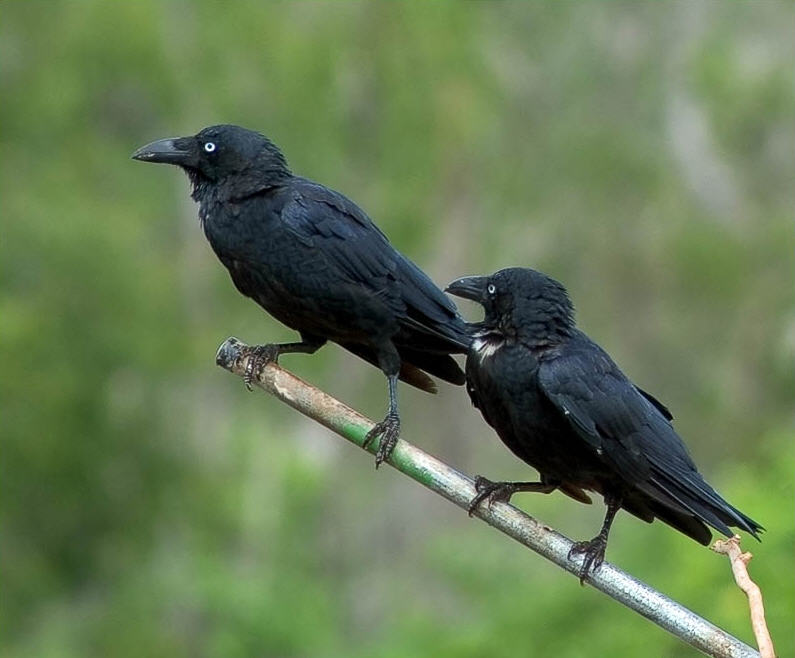
| Appearance | - The Torresian crow has predominantly black plumage, a black beak and mouth, and white irises. English Wikipedia
- The feathers at the bases of the bird's head and neck are white. English Wikipedia
- The bird has glossy black back feathers and dull black breast feathers. English Wikipedia
- Its tail is broad and has a square-shaped tip. English Wikipedia
- Its eyes have white irises surrounded by a fine blue eye-ring. English Wikipedia
- The white bases of its head and neck feathers become visible when the feathers are ruffled. English Wikipedia
- Juveniles have blue eyes and lack the glossy dorsal feathers of adults until approximately nine months of age. English Wikipedia
| - The hooded crow has ash-grey plumage on its body, while its head, throat, wings, tail and thigh feathers are black. English Wikipedia
- Juvenile hooded crows have duller plumage, bluish or greyish eyes and initially red mouths. English Wikipedia
- The hooded crow undergoes one annual moult in autumn. English Wikipedia
- Male hooded crows tend to be larger than females, although their appearance is otherwise similar. English Wikipedia
- The hooded crow has an ashy-grey body contrasting with its black head, wings and tail. ebird.org
|
|---|
| Size | No checked fact yet | |
|---|
| Habitat | - The Torresian crow occupies habitats within its range where permanent water is available. English Wikipedia
- Its documented natural habitats include tropical rainforests, eucalyptus woodland, open scrub, beaches, swamps and offshore islands. English Wikipedia
- The species also inhabits farmland, towns and cities. English Wikipedia
- In central Australia's arid regions, the species is concentrated around locations with permanent water. English Wikipedia
| - In urban areas, hooded crow numbers during the breeding season increase with the availability of nesting sites and the number of trashbins. pmc.ncbi.nlm.nih.gov
- During the breeding season, hooded crows are more likely to colonize parks, sports complexes and quieter residential areas than traffic-busy residential areas. pmc.ncbi.nlm.nih.gov
- Hooded crows are attracted to urban areas offering anthropogenic food sources but avoid nesting in areas with high human disturbance. pmc.ncbi.nlm.nih.gov
|
|---|
| Diet | - The Torresian crow is an omnivore. English Wikipedia
- Its diet outside urban areas primarily includes invertebrates, berries and carrion. English Wikipedia
- The species also eats stranded fish, roadkill, fruit, grain, smaller birds and rodents. English Wikipedia
- Urban populations rely more heavily on human-associated food sources than populations in natural habitats. English Wikipedia
| - The hooded crow is an omnivore and regularly scavenges for food. English Wikipedia
- The hooded crow eats small mammals, scraps, smaller birds and carrion. English Wikipedia
- The hooded crow steals eggs from gulls, cormorants and other birds when their owners are absent. English Wikipedia
- The hooded crow enters puffin burrows to steal their eggs. English Wikipedia
- The hooded crow drops molluscs and crabs to break their shells. English Wikipedia
|
|---|
| Behaviour | - Torresian crows sometimes cooperate in teams to steal food from larger birds. English Wikipedia
- Females display more aggressive behaviour than males and dominate most other species except large birds of prey and Australian magpies. English Wikipedia
- Torresian crows defend their nests and territories by attacking large birds of prey, including wedge-tailed eagles and owls. English Wikipedia
- Large groups of Torresian crows roam nomadically across farmland, forests and urban suburbs between January and August. English Wikipedia
- From September to December, many individuals leave nomadic flocks to breed in temporary territories. English Wikipedia
- Breeding pairs return to the same territory annually, although other pairs may take over territories between years. English Wikipedia
- Torresian crows characteristically shuffle their wings after landing. English Wikipedia
| - The hooded crow typically flies slowly, heavily and in a straight direction. English Wikipedia
- The hooded crow frequently hides food, particularly meat, nuts and insects, for later consumption. English Wikipedia
- The hooded crow can imitate human language. English Wikipedia
- The hooded crow can use sticks to retrieve food from cracks and small holes. English Wikipedia
|
|---|
| Reproduction | - The main breeding season extends from August to January. English Wikipedia
- Most eggs are laid in September and October. English Wikipedia
- Torresian crows usually build stick nests high in trees, commonly in eucalyptus trees. English Wikipedia
- The species occasionally nests on power pylons and tall buildings. English Wikipedia
- A typical clutch contains two to four eggs. English Wikipedia
- The female incubates the eggs for approximately twenty days. English Wikipedia
- The male assists in rearing the chicks for approximately forty days until they leave the nest. English Wikipedia
- Young birds remain with their parents for several months after fledging before joining nomadic flocks. English Wikipedia
| - Hooded crows in northwest Russia, Shetland and the Faroe Islands generally begin nesting between mid-May and mid-June. English Wikipedia
- In warmer parts of Europe, hooded crows generally lay their clutches in April. English Wikipedia
- The hooded crow usually builds its bulky stick nest in a tall tree. English Wikipedia
- Hooded crow nests may also be situated on cliff ledges, old buildings and pylons. English Wikipedia
- A hooded crow clutch typically contains four to six blue eggs with brown speckles. English Wikipedia
- The female hooded crow incubates the eggs alone for 17–19 days while the male provides her with food. English Wikipedia
- Young hooded crows leave the nest after approximately 32–36 days. English Wikipedia
- Hooded crow females have been reported to obtain most of their own food during incubation and subsequently obtain food for their young. English Wikipedia
|
|---|
| Distribution | - The Torresian crow occurs in Australia, Papua New Guinea and parts of Indonesia. English Wikipedia
| - The hooded crow breeds across northern and eastern Europe. English Wikipedia
- The hooded crow regularly breeds in northern and western Scotland, the Isle of Man, the Scottish Islands and throughout Ireland. English Wikipedia
- The hooded crow occurs in Turkey, Greece, Cyprus, Iraq, Iran, Jordan, Egypt and Israel, and migrates as far as Afghanistan. English Wikipedia
|
|---|
| Conservation | - The geographic range of the Torresian crow expanded into highly urbanized Australian regions between 1993 and 2004. English Wikipedia
| - Hooded crows have been protected under the Wildlife and Countryside Act since 1981. English Wikipedia
|
|---|
| Similar species | - The Torresian crow is morphologically similar to the little crow but has a larger body and more robust bill. English Wikipedia
| - The hooded crow is visually distinguishable from the carrion crow and rook by its contrasting grey and black plumage. English Wikipedia
- The vocalizations of hooded crows and carrion crows are almost indistinguishable. English Wikipedia
|
|---|
| Name origin | No checked fact yet | - The scientific name Corvus cornix was assigned to the hooded crow by Carl Linnaeus in 1758. English Wikipedia
- The genus name Corvus derives from the Latin word for raven. English Wikipedia
- The specific epithet cornix derives from the Latin word for crow. English Wikipedia
|
|---|
| Other | No checked fact yet | - The hooded crow is difficult to distinguish from similar-looking crows when observed in poor lighting or from a distance. ebird.org
|
|---|