Comparison

Dwarf Gourami vs Giant Gourami

Dwarf Gourami (Trichogaster lalius) and Giant Gourami (Osphronemus goramy) both belong to the family Osphronemidae (gourami) and part ways below it. Both are recorded in 2 countries.

Dwarf Gourami

Dwarf Gourami

Trichogaster lalius

Unknown author, Public domain, via Wikimedia Commons

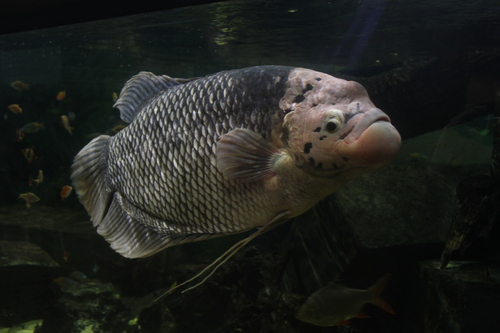
Giant Gourami

Giant Gourami

Osphronemus goramy

(c) Tim Sheerman-Chase, some rights reserved (CC BY), CC BY 4.0, via iNaturalist

Side by side

Dwarf GouramiGiant Gourami
Scientific nameTrichogaster lalius (Hamilton, 1822)Osphronemus goramy Lacepède, 1801
English nameDwarf GouramiGiant Gourami
GroupFishesFishes
ClassTeleostei TeleostTeleostei Teleost
OrderAnabantiformesAnabantiformes
FamilyOsphronemidae GouramiOsphronemidae Gourami
GenusTrichogasterOsphronemus Kaloi Fishes
Named in18221801
Red List categoryLeast ConcernLeast Concern
Environmentfreshwaterbrackish, freshwater
Countries on record6 countries13 countries
GBIF occurrence records120 records406 records

Rows where the two agree are shown in grey.

Where each is found

Both recorded in 2 countries

Only Dwarf Gourami (4)

Only Giant Gourami (11)

From Catalogue of Life checklists and GBIF occurrence records. A country missing from a list means no record is held, which is not proof of absence.

Checked facts

Dwarf GouramiGiant Gourami
Appearance
  • Wild males have diagonal stripes alternating between blue and red. English Wikipedia
  • Females have silvery coloration. English Wikipedia
  • Males have pointed dorsal fins, whereas females have rounded or curved dorsal fins. English Wikipedia
  • The species has touch-sensitive cells on its thread-like pelvic fins. English Wikipedia
  • Aquarium-bred dwarf gouramis are available in solid-color forms, including powder blue and red flame varieties. English Wikipedia
Size
Habitat
  • The dwarf gourami inhabits slow-moving waters in rivulets, streams and lakes. English Wikipedia
  • The species occurs in aquatic areas with plentiful vegetation. English Wikipedia
No checked fact yet
Diet
  • The species is omnivorous in the wild and consumes fish, frogs and earthworms. English Wikipedia
  • The species sometimes feeds on dead animals and aquatic weeds. English Wikipedia
  • The species tends towards herbivory and prefers algae-based foods. English Wikipedia
Behaviour
  • The dwarf gourami can project a stream of water from its mouth to hunt prey above the water surface. English Wikipedia
  • Its water-projecting hunting behaviour can reach a maximum distance of approximately 5 centimetres. English Wikipedia
  • Dwarf gouramis are generally peaceful but can exhibit slight territoriality. English Wikipedia
  • The species can breathe moist air and survive outside water for extended periods. English Wikipedia
Reproduction
  • The male constructs a floating bubble nest in which the eggs are deposited. English Wikipedia
  • Male dwarf gouramis incorporate plant fragments, twigs and other debris into their bubble nests. English Wikipedia
  • During spawning, the recommended water depth is 7–10 centimetres. English Wikipedia
  • The recommended spawning temperature is approximately 28–30 °C. English Wikipedia
  • Vegetation is essential for bubble-nest construction. English Wikipedia
  • A female signals readiness to spawn by touching the male's back or tail with her mouth. English Wikipedia
  • A female releases approximately five dozen clear eggs during spawning. English Wikipedia
  • The male immediately fertilizes the eggs after their release. English Wikipedia
  • A spawning session can produce between 300 and 800 eggs. English Wikipedia
  • The dwarf gourami has a reported fecundity of approximately 600 eggs. English Wikipedia
  • The male protects the eggs and fry within the bubble nest. English Wikipedia
  • The eggs hatch within 12 to 24 hours. English Wikipedia
  • The fry become sufficiently developed to swim freely and leave the nest after three days. English Wikipedia
  • The male should be removed when the fry are two to three days old because he may consume them. English Wikipedia
  • Newly hatched fry should initially be fed infusoria. English Wikipedia
  • Older fry can be fed brine shrimp and finely ground flakes. English Wikipedia
LifespanNo checked fact yet
Distribution
  • The species' native distribution includes the lower Mekong in Cambodia and Vietnam. English Wikipedia
  • The species is native to the Chao Phraya and Mae Klong river systems in Thailand. English Wikipedia
  • Its native range includes river basins of the Malay Peninsula and Sarawak in Malaysia. English Wikipedia
  • Its native range includes Java, Sumatra and Western Kalimantan in Indonesia. English Wikipedia
  • Introduced populations occur across an Asian range extending from southern China to India and Sri Lanka. English Wikipedia
  • Introduced populations have been recorded in Australia, Mauritius, Réunion and Madagascar. English Wikipedia
  • The species has also been introduced to locations outside its native Southeast Asian range. inaturalist.org
Conservation
  • A study reported that 22% of Singapore Trichogaster lalius carried dwarf gourami iridovirus. English Wikipedia
No checked fact yet
Uses
Similar species
  • Young dwarf gouramis are often confused with the closely related thick-lipped gourami. English Wikipedia
  • The red flame colour variety can be confused with the red variety of honey gourami (Trichogaster chuna). English Wikipedia
No checked fact yet
OtherNo checked fact yet
  • The flesh of the species is rich in protein and minerals. English Wikipedia
  • The species has higher market value partly because its flesh lacks the fine bones found in carp and milkfish. English Wikipedia

In brief

Dwarf Gourami

Trichogaster lalius is native to Pakistan, India and Bangladesh and inhabits slow-moving, vegetated waters in rivulets, streams and lakes. It is distinguished by thread-like pelvic fins with touch-sensitive cells and, in wild males, alternating diagonal blue and red stripes. Full profile

Giant Gourami

Osphronemus goramy is substantially larger than most other gouramis and can reach a maximum standard length of 80 cm. Full profile

Compare something else

Page built on 26 November 2026 from the data on the two species pages, where every source is listed.

Cite this page

ScientificNames.org. (2026). Dwarf Gourami vs Giant Gourami. Retrieved November 26, 2026, from https://scientificnames.org/compare/dwarf-gourami-vs-giant-gourami