Comparison
Norway Pout vs Atlantic Cod
Norway Pout (Trisopterus esmarkii) and Atlantic Cod (Gadus morhua) both belong to the family Gadidae (cods) and part ways below it. Both are recorded in 15 countries.
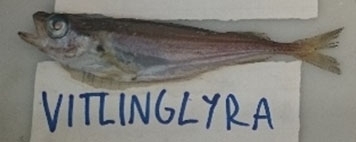
Norway Pout
Trisopterus esmarkii
iNaturalist Sweden user: marefred, CC BY-SA 4.0, via Wikimedia Commons


Side by side
| Norway Pout | Atlantic Cod | |
|---|---|---|
| Scientific name | Trisopterus esmarkii (Nilsson, 1855) | Gadus morhua Linnaeus, 1758 |
| English name | Norway Pout | Atlantic Cod |
| Group | Fishes | Fishes |
| Class | Teleostei Teleost | Teleostei Teleost |
| Order | Gadiformes | Gadiformes |
| Family | Gadidae Cods | Gadidae Cods |
| Genus | Trisopterus | Gadus Common Codfishes |
| Named in | 1855 | 1758 |
| Red List category | Least Concern | Vulnerable |
| Environment | marine | brackish, marine |
| Countries on record | 15 countries | 29 countries |
| GBIF occurrence records | 214,372 records | 3,361,355 records |
Rows where the two agree are shown in grey.
Where each is found
Both recorded in 15 countries
- Belgium
- Denmark
- Faroe Islands
- France
- Germany
- Iceland
- Ireland
- Isle of Man
- Norway
- Poland
- Russia
- Svalbard and Jan Mayen
- Sweden
- The Netherlands
- United Kingdom
Only Atlantic Cod (14)
- Bahamas
- Canada
- Estonia
- Finland
- Greenland
- Guernsey
- Italy
- Latvia
- Lithuania
- Portugal
- Saint Pierre and Miquelon
- Spain
- U.S. Virgin Islands
- United States
From Catalogue of Life checklists and GBIF occurrence records. A country missing from a list means no record is held, which is not proof of absence.
Checked facts
| Norway Pout | Atlantic Cod | |
|---|---|---|
| Appearance |
|
|
| Size |
|
|
| Habitat |
|
|
| Behaviour | No checked fact yet |
|
| Reproduction | No checked fact yet |
|
| Distribution |
|
|
| Conservation | No checked fact yet |
|
| Uses |
|
|
| Other |
|
|
In brief
Norway Pout
Trisopterus esmarkii occurs in the Barents Sea, North Sea and Baltic Sea, off the coasts of Norway, Iceland and the British Isles, and in the northeastern Atlantic Ocean. It has an elongated body, a pointed snout, a prominent lower jaw and a large mouth. Full profile
Atlantic Cod
Atlantic Cod inhabit coastal waters, continental shelves, marine benthopelagic environments and brackish waters. Atlantic Cod have three dorsal fins, two anal fins, one chin barbel and a pronounced lateral line. Full profile
Compare something else
Page built on 29 November 2026 from the data on the two species pages, where every source is listed.
Cite this page
ScientificNames.org. (2026). Norway Pout vs Atlantic Cod. Retrieved November 29, 2026, from https://scientificnames.org/compare/norway-pout-vs-atlantic-cod
“Norway Pout vs Atlantic Cod.” ScientificNames.org, 2026, scientificnames.org/compare/norway-pout-vs-atlantic-cod. Accessed 29 Nov. 2026.
ScientificNames.org. “Norway Pout vs Atlantic Cod.” Accessed November 29, 2026. https://scientificnames.org/compare/norway-pout-vs-atlantic-cod.
@misc{scientificnames_norway_pout_vs_atlantic_cod,
  author = {{ScientificNames.org}},
  title = {Norway Pout vs Atlantic Cod},
  year = {2026},
  url = {https://scientificnames.org/compare/norway-pout-vs-atlantic-cod},
  note = {Accessed 2026-11-29}
}