Comparison

Himalayan Hemlock vs Eastern Hemlock

Himalayan Hemlock (Tsuga dumosa) and Eastern Hemlock (Tsuga canadensis) both belong to the genus Tsuga (hemlock) and part ways below it.

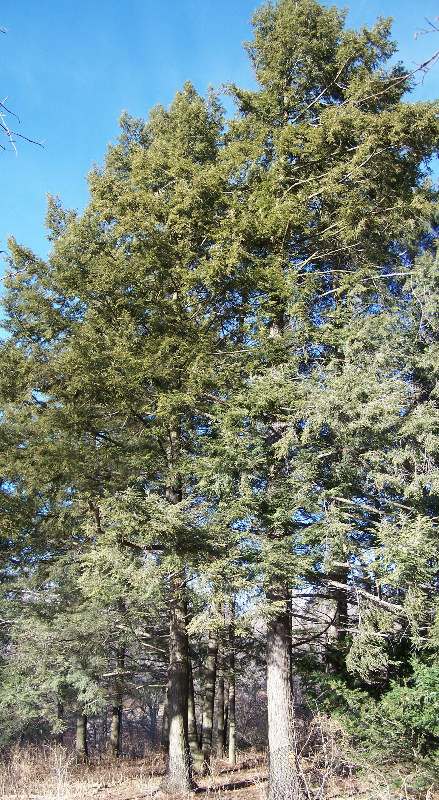
Himalayan Hemlock

Himalayan Hemlock

Tsuga dumosa

wonderlane on Flickr, CC BY 2.0, via Wikimedia Commons

Eastern Hemlock

Eastern Hemlock

Tsuga canadensis

Bruce Marlin, CC BY-SA 3.0, via Wikimedia Commons

Side by side

Himalayan HemlockEastern Hemlock
Scientific nameTsuga dumosa (D.Don) EichlerTsuga canadensis (L.) Carrière
English nameHimalayan HemlockEastern Hemlock
GroupConifers and alliesConifers and allies
ClassPinopsida ConiferPinopsida Conifer
OrderPinalesPinales
FamilyPinaceae Pine FamilyPinaceae Pine Family
GenusTsuga HemlockTsuga Hemlock
Red List categoryLeast ConcernNear Threatened
Countries on record6 countries4 countries
GBIF occurrence records1,726 records68,238 records

Rows where the two agree are shown in grey.

Where each is found

Only Himalayan Hemlock (6)

Only Eastern Hemlock (4)

From Catalogue of Life checklists and GBIF occurrence records. A country missing from a list means no record is held, which is not proof of absence.

Checked facts

Himalayan HemlockEastern Hemlock
Appearance
  • The species has a broad, irregular-pyramidal and open crown when mature. English Wikipedia
  • Its bark is pinkish to grey-brown and has prominent ridges and broad, shallow, flaky fissures. English Wikipedia
  • Its leaves are green and shiny on their upper surfaces, with two wide silvery stomatal bands underneath. English Wikipedia
  • Its male cones are globose and grow singly in axillary positions. English Wikipedia
  • Its female cones are round-ovate, grow singly at branch tips and curve slightly downward. English Wikipedia
  • Its seeds are brown, ovate and equipped with thin wings on their upper parts. English Wikipedia
  • Its bark is brown, scaly, and deeply fissured, particularly on older trees. English Wikipedia
  • Its flattened needles are typically arranged in two rows along the twigs. English Wikipedia
  • The upper surfaces of its needles are shiny green to yellow-green. English Wikipedia
  • The undersides of its needles have two broad, clearly visible stomatal bands. English Wikipedia
  • Its outer bark has dull reddish-purple layers. tidcf.nrcan.gc.ca
Size
  • The species typically grows to a height of 20–25 metres, although exceptional individuals reach 40 metres. English Wikipedia
  • Its typical diameter at breast height is 40–50 centimetres, but some trees exceed 100 centimetres. English Wikipedia
  • Its leaves measure 10–25 millimetres long and 2–2.5 millimetres wide. English Wikipedia
  • Its seeds are approximately 9 millimetres long. English Wikipedia
No checked fact yet
Habitat
  • In Vietnam, the species occurs at elevations above 1,500 metres on Hoang Lien Son Mountain. English Wikipedia
  • In Vietnam, it commonly grows in mixed stands with Rhododendron species and Abies pindrow. English Wikipedia
  • The species can also form pure forest stands in Vietnam. English Wikipedia
  • The species is adapted to cold climates with high rainfall and humidity. English Wikipedia
  • The species occurs in hemlock-dominated coniferous forests in Thrumshingla, Bhutan. pmc.ncbi.nlm.nih.gov
  • The species was recorded among tree species in forest plots containing evidence of red panda presence. kar.kent.ac.uk
  • Eastern hemlock can grow along swamp margins where peat and muck soils are shallow. research.fs.usda.gov
  • It favors moist to very moist sites with good drainage. research.fs.usda.gov
  • The species grows in acidic soils including sandy loams, loamy sands, and silty loams. research.fs.usda.gov
  • In the northeastern United States, the species occurs from sea level to approximately 730 metres elevation. research.fs.usda.gov
  • In the southern Appalachian Mountains, it grows at elevations of approximately 610–1,520 metres. research.fs.usda.gov
DietNo checked fact yet
Reproduction
Distribution
  • The species is native to the eastern Himalayas. English Wikipedia
  • Its native range includes Nepal, India, Bhutan, Myanmar, Vietnam and Tibet. English Wikipedia
  • In India, its range extends from Uttarakhand in the west to Arunachal Pradesh in the east. English Wikipedia
  • Its range extends southeastward to northern Myanmar and Vietnam. English Wikipedia
  • Its northeastern range includes southeastern Tibet, northwestern Yunnan and southwestern Sichuan. English Wikipedia
  • Eastern hemlock is native to eastern North America. English Wikipedia
  • Its native range extends from northeastern Minnesota eastward through southern Quebec to Nova Scotia. English Wikipedia
  • Its southern distribution extends through the Appalachian Mountains to northern Georgia and Alabama. English Wikipedia
ConservationNo checked fact yet
  • Hemlock woolly adelgid was first detected within Kejimkujik National Park in Nova Scotia in 2018. English Wikipedia
Uses
  • The species is used for construction within its native range. English Wikipedia
  • Its wood is used to make furniture within its native range. English Wikipedia
  • The species is occasionally cultivated as an ornamental tree in Europe and North America. English Wikipedia
  • Eastern hemlock timber is used for general construction and manufacturing crates. English Wikipedia
  • Its wood is used to manufacture railroad ties. English Wikipedia
  • Eastern hemlock wood is used as a source of pulp for paper manufacturing. English Wikipedia
  • Its bark was historically used as a tannin source by the leather tanning industry. English Wikipedia
  • Eastern hemlock is cultivated as an ornamental tree. English Wikipedia
  • Its branches were historically used as brooms by American pioneers. English Wikipedia
  • The inner bark can be eaten raw or boiled and can also be made into flour. English Wikipedia
OtherNo checked fact yet

In brief

Himalayan Hemlock

Tsuga dumosa is native to the eastern Himalayas, with a range that includes Nepal, India, Bhutan, Myanmar, Vietnam and Tibet. It has a broad, irregular-pyramidal crown when mature and leaves with two wide silvery stomatal bands underneath. Full profile

Eastern Hemlock

Tsuga canadensis is native to eastern North America, with a range extending from northeastern Minnesota through southern Quebec to Nova Scotia and south through the Appalachian Mountains to northern Georgia and Alabama. It has flattened needles typically arranged in two rows, with shiny green to yellow-green upper surfaces and two broad stomatal bands underneath. Full profile

Compare something else

Page built on 28 November 2026 from the data on the two species pages, where every source is listed.

Cite this page

ScientificNames.org. (2026). Himalayan Hemlock vs Eastern Hemlock. Retrieved November 28, 2026, from https://scientificnames.org/compare/himalayan-hemlock-vs-eastern-hemlock