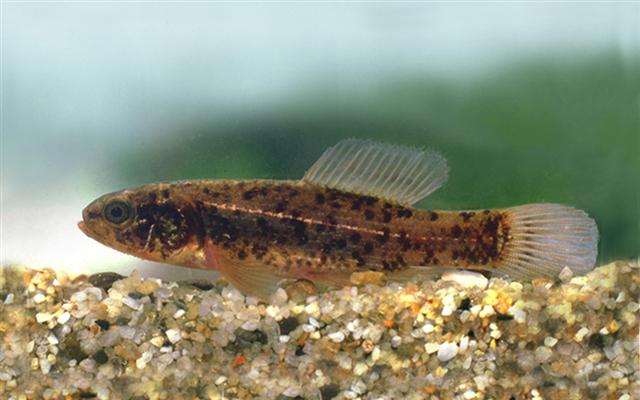
| Appearance | | - The European mudminnow has a long, cylindrical body. English Wikipedia
- Its coloration ranges from green to brown, with lighter undersides and grey to dark brown mottled spots. English Wikipedia
- The species has distinct dark lateral stripes that are particularly noticeable in juveniles. English Wikipedia
- The European mudminnow has a flat head and a small mouth. English Wikipedia
|
|---|
| Size | | |
|---|
| Habitat | - Central mudminnows inhabit still or slow-moving freshwater environments with dense vegetation and cover. animaldiversity.org
- Central mudminnows are most commonly encountered at depths of less than five meters. animaldiversity.org
- In Wisconsin, central mudminnows commonly occur among cattails, waterweed, eel grass, bulrush, yellow water lilies, water buttercup, and filamentous algae. animaldiversity.org
- Central mudminnows thrive in habitats with low dissolved oxygen, minimal water flow, dense vegetation, and thick organic substrates. animaldiversity.org
- Central mudminnows prefer flooded stream margins and pools with slow or no water flow for spawning. animaldiversity.org
- The Missouri species profile identifies aquatic river and stream habitats as the central mudminnow's primary habitat. mdc12.mdc.mo.gov
| |
|---|
| Diet | - Central mudminnows are predominantly benthic carnivores. English Wikipedia
- Central mudminnows prefer amphipods, beetles, and dragonflies while avoiding planktonic organisms. English Wikipedia
- Chironomids and gastropods together account for approximately 60% of the dissected stomach contents by volume. English Wikipedia
- Central mudminnow juveniles feed on small crustaceans and crustacean and insect larvae during their first winter. biokids.umich.edu
- Young central mudminnows measuring 19 mm have been observed eating newly hatched snails, fly larvae, and fish. biokids.umich.edu
| No checked fact yet |
|---|
| Behaviour | - Central mudminnows move into flooded bank areas during high-flow periods to avoid strong currents. animaldiversity.org
- Central mudminnows prefer shoaling with other individuals rather than remaining solitary. animaldiversity.org
- Central mudminnows have been observed congregating in groups of twelve or more in laboratory experiments. animaldiversity.org
- When threatened, central mudminnows escape into soft sediment and ooze. animaldiversity.org
| - The species exhibits limited dispersal, as described in the study's discussion of aquatic species with restricted movement. pmc.ncbi.nlm.nih.gov
|
|---|
| Reproduction | - Central mudminnow spawning is stimulated by warming water temperatures and spring flooding. animaldiversity.org
- The preferred spawning temperature for central mudminnows is 12.8°C, although spawning can occur at temperatures up to 15.3°C. animaldiversity.org
- Central mudminnow eggs are demersal and adhesive. animaldiversity.org
- Female central mudminnows attach individual eggs directly to vegetation. animaldiversity.org
- Female central mudminnows produce an average of 425 to 450 eggs per spawning season. animaldiversity.org
- Central mudminnow eggs are yellow or orange and approximately 1.6 mm in diameter. animaldiversity.org
- Female central mudminnows exhibit some egg-guarding behaviour. animaldiversity.org
- Central mudminnow eggs hatch approximately six days after being laid. biokids.umich.edu
- Central mudminnows are thought to reproduce once annually. biokids.umich.edu
| No checked fact yet |
|---|
| Distribution | No checked fact yet | - The European mudminnow occurs in Austria, Bosnia and Herzegovina, Bulgaria, Croatia, Hungary, Moldova, Romania, Serbia, Slovakia, Slovenia, and Ukraine. English Wikipedia
- An introduced population of the European mudminnow occurs in northern Germany. English Wikipedia
|
|---|
| Conservation | - The central mudminnow is classified as state endangered in Missouri, with a state rank of S1 and global rank of G5. mdc12.mdc.mo.gov
| - The IUCN classifies the European mudminnow as vulnerable to extinction within its indigenous range. English Wikipedia
- Only a few scattered populations of the European mudminnow have survived habitat loss and fragmentation. pmc.ncbi.nlm.nih.gov
- The invasive Amur sleeper (Perccottus glenii) has further worsened the conservation situation of the European mudminnow, particularly in the Tisza region. pmc.ncbi.nlm.nih.gov
- The European mudminnow has been extirpated from numerous locations. pmc.ncbi.nlm.nih.gov
- The species has been extirpated particularly from backwaters connected to the upper and middle sections of the Hungarian Tisza River. pmc.ncbi.nlm.nih.gov
- The area of wetlands and river-connected backwaters in the Carpathian Basin was reduced to 700 km2. pmc.ncbi.nlm.nih.gov
- The study detected strictly limited gene flow between the investigated regions of the species. pmc.ncbi.nlm.nih.gov
- The study proposed two evolutionary significant units for the European mudminnow in the Carpathian Basin, corresponding to the Danube and Tisza catchments. pmc.ncbi.nlm.nih.gov
- The study recommended conservation-unit boundaries spanning approximately 80–90 km. pmc.ncbi.nlm.nih.gov
- The study recommended establishing 16 management units for the 33 investigated populations. pmc.ncbi.nlm.nih.gov
- The genetic study examined 404 European mudminnow specimens from eight regions. pmc.ncbi.nlm.nih.gov
- The genetic analysis of the European mudminnow used eight microsatellite loci. pmc.ncbi.nlm.nih.gov
- River regulation in the Carpathian Basin included the construction of more than 4,200 km of levees. pmc.ncbi.nlm.nih.gov
- The Tisza River was shortened from 1,419 km to 966 km following river regulation. pmc.ncbi.nlm.nih.gov
|
|---|
| Uses | No checked fact yet | - In the Carpathian Basin, the European mudminnow was historically used as food for domestic animals, including pigs. pmc.ncbi.nlm.nih.gov
|
|---|
| Similar species | - The central mudminnow can be confused with the banded killifish, but the latter has a supraterminal mouth whereas the central mudminnow has a terminal mouth. animaldiversity.org
| No checked fact yet |
|---|