Comparison
Upland Chorus Frog vs Boreal Chorus Frog
Upland Chorus Frog (Pseudacris feriarum) and Boreal Chorus Frog (Pseudacris maculata) both belong to the genus Pseudacris (chorus frog) and part ways below it. Both are recorded in 2 countries.
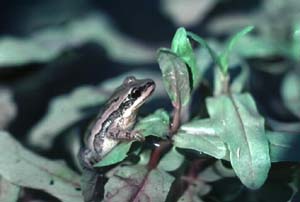


Side by side
| Upland Chorus Frog | Boreal Chorus Frog | |
|---|---|---|
| Scientific name | Pseudacris feriarum (Baird, 1854) | Pseudacris maculata (Agassiz, 1850) |
| English name | Upland Chorus Frog | Boreal Chorus Frog |
| Group | Amphibians | Amphibians |
| Class | Amphibia Amphibians | Amphibia Amphibians |
| Order | Anura Frogs | Anura Frogs |
| Family | Hylidae Hylids | Hylidae Hylids |
| Genus | Pseudacris Chorus Frog | Pseudacris Chorus Frog |
| Named in | 1854 | 1850 |
| Red List category | Least Concern | Least Concern |
| Countries on record | 2 countries | 2 countries |
| GBIF occurrence records | 8,228 records | 16,663 records |
Rows where the two agree are shown in grey.
Where each is found
Both recorded in 2 countries
From Catalogue of Life checklists and GBIF occurrence records. A country missing from a list means no record is held, which is not proof of absence.
Checked facts
| Upland Chorus Frog | Boreal Chorus Frog | |
|---|---|---|
| Appearance |
|
|
| Size |
|
|
| Habitat |
|
|
| Diet |
|
|
| Behaviour |
|
|
| Reproduction |
|
|
| Distribution |
|
|
| Conservation |
|
|
In brief
Upland Chorus Frog
Pseudacris feriarum occurs in the southeastern and eastern United States, from New Jersey to the Florida panhandle and west to eastern Texas and southeastern Oklahoma. Adults are typically brown, tan, or gray, with three dark dorsal stripes that may be broken into spots. Full profile
Boreal Chorus Frog
Pseudacris maculata occurs in Canada from central Quebec to eastern British Columbia, extending north to the Northwest Territories and southern Yukon, and in the United States in Montana, Minnesota, northwestern Wisconsin, northeastern Arizona, northern New Mexico, and southwestern Utah. It is normally brown, with three broken dorsal stripes and a dark band extending from its snout across its eye and down its side. Full profile
Compare something else
Page built on 29 November 2026 from the data on the two species pages, where every source is listed.
Cite this page
ScientificNames.org. (2026). Upland Chorus Frog vs Boreal Chorus Frog. Retrieved November 29, 2026, from https://scientificnames.org/compare/upland-chorus-frog-vs-boreal-chorus-frog
“Upland Chorus Frog vs Boreal Chorus Frog.” ScientificNames.org, 2026, scientificnames.org/compare/upland-chorus-frog-vs-boreal-chorus-frog. Accessed 29 Nov. 2026.
ScientificNames.org. “Upland Chorus Frog vs Boreal Chorus Frog.” Accessed November 29, 2026. https://scientificnames.org/compare/upland-chorus-frog-vs-boreal-chorus-frog.
@misc{scientificnames_upland_chorus_frog_vs_boreal_chorus_frog,
  author = {{ScientificNames.org}},
  title = {Upland Chorus Frog vs Boreal Chorus Frog},
  year = {2026},
  url = {https://scientificnames.org/compare/upland-chorus-frog-vs-boreal-chorus-frog},
  note = {Accessed 2026-11-29}
}