Comparison
Upland Chorus Frog vs Pacific Tree Frog
Upland Chorus Frog (Pseudacris feriarum) and Pacific Tree Frog (Pseudacris regilla) both belong to the genus Pseudacris (chorus frog) and part ways below it. Both are recorded in 2 countries.
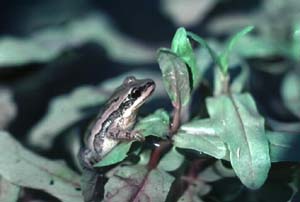


Side by side
| Upland Chorus Frog | Pacific Tree Frog | |
|---|---|---|
| Scientific name | Pseudacris feriarum (Baird, 1854) | Pseudacris regilla (Baird & Girard, 1852) |
| English name | Upland Chorus Frog | Pacific Tree Frog |
| Group | Amphibians | Amphibians |
| Class | Amphibia Amphibians | Amphibia Amphibians |
| Order | Anura Frogs | Anura Frogs |
| Family | Hylidae Hylids | Hylidae Hylids |
| Genus | Pseudacris Chorus Frog | Pseudacris Chorus Frog |
| Named in | 1854 | 1852 |
| Red List category | Least Concern | Least Concern |
| Environment | Not recorded | freshwater |
| Countries on record | 2 countries | 3 countries |
| GBIF occurrence records | 8,228 records | 91,962 records |
Rows where the two agree are shown in grey.
Where each is found
Both recorded in 2 countries
Only Pacific Tree Frog (1)
From Catalogue of Life checklists and GBIF occurrence records. A country missing from a list means no record is held, which is not proof of absence.
Checked facts
| Upland Chorus Frog | Pacific Tree Frog | |
|---|---|---|
| Appearance |
|
|
| Size |
|
|
| Habitat |
|
|
| Diet |
|
|
| Behaviour |
|
|
| Reproduction |
|
|
| Distribution |
|
|
| Conservation |
|
|
In brief
Upland Chorus Frog
Pseudacris feriarum occurs in the southeastern and eastern United States, from New Jersey to the Florida panhandle and west to eastern Texas and southeastern Oklahoma. Adults are typically brown, tan, or gray, with three dark dorsal stripes that may be broken into spots. Full profile
Pacific Tree Frog
Pseudacris regilla occurs from southern British Columbia through Washington, Oregon, and California to Baja California, Mexico, with populations also occurring in southeastern Alaska, Nevada, Idaho, and Montana. It has smooth, color-changing skin, commonly dark body markings, and large padded toe surfaces. Full profile
Compare something else
Page built on 26 November 2026 from the data on the two species pages, where every source is listed.
Cite this page
ScientificNames.org. (2026). Upland Chorus Frog vs Pacific Tree Frog. Retrieved November 26, 2026, from https://scientificnames.org/compare/upland-chorus-frog-vs-pacific-tree-frog
“Upland Chorus Frog vs Pacific Tree Frog.” ScientificNames.org, 2026, scientificnames.org/compare/upland-chorus-frog-vs-pacific-tree-frog. Accessed 26 Nov. 2026.
ScientificNames.org. “Upland Chorus Frog vs Pacific Tree Frog.” Accessed November 26, 2026. https://scientificnames.org/compare/upland-chorus-frog-vs-pacific-tree-frog.
@misc{scientificnames_upland_chorus_frog_vs_pacific_tree_frog,
  author = {{ScientificNames.org}},
  title = {Upland Chorus Frog vs Pacific Tree Frog},
  year = {2026},
  url = {https://scientificnames.org/compare/upland-chorus-frog-vs-pacific-tree-frog},
  note = {Accessed 2026-11-26}
}