Comparison
Vietnam Mouse-deer vs Lesser Mouse-deer
Vietnam Mouse-deer (Tragulus versicolor) and Lesser Mouse-deer (Tragulus kanchil) both belong to the genus Tragulus and part ways below it. Both are recorded in 1 country.
Vietnam Mouse-deer
Tragulus versicolor
(c) User:מנחם.אל, some rights reserved (CC BY), CC BY 4.0, via iNaturalist

Lesser Mouse-deer
Tragulus kanchil
Linda Kenney from United Kingdom, CC BY-SA 2.0, via Wikimedia Commons

Side by side
| Vietnam Mouse-deer | Lesser Mouse-deer | |
|---|---|---|
| Scientific name | Tragulus versicolor Thomas, 1910 | Tragulus kanchil (Raffles, 1821) |
| English name | Vietnam Mouse-deer | Lesser Mouse-deer |
| Group | Mammals | Mammals |
| Class | Mammalia Mammal | Mammalia Mammal |
| Order | Artiodactyla Artiodactyls | Artiodactyla Artiodactyls |
| Family | Tragulidae Chevrotain | Tragulidae Chevrotain |
| Genus | Tragulus | Tragulus |
| Named in | 1910 | 1821 |
| Red List category | Data Deficient | Least Concern |
| Countries on record | 1 country | 10 countries |
| GBIF occurrence records | 6 records | 2,211 records |
Rows where the two agree are shown in grey.
Where each is found
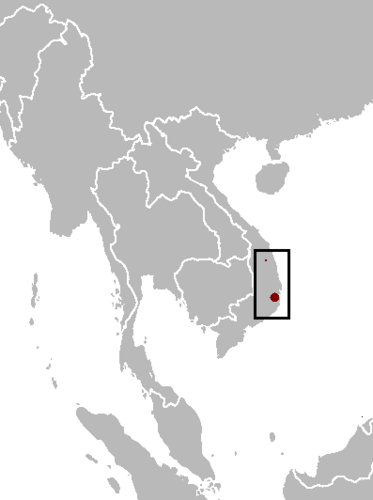
Both recorded in 1 country
Only Lesser Mouse-deer (9)
From Catalogue of Life checklists and GBIF occurrence records. A country missing from a list means no record is held, which is not proof of absence.
Checked facts
| Vietnam Mouse-deer | Lesser Mouse-deer | |
|---|---|---|
| Appearance |
|
|
| Size |
|
|
| Habitat |
|
|
| Diet |
| No checked fact yet |
| Behaviour |
|
|
| Reproduction | No checked fact yet |
|
| Distribution |
|
|
| Conservation |
|
|
| Similar species |
| No checked fact yet |
In brief
Vietnam Mouse-deer
The species is endemic to Vietnam and has been recorded in dry lowland forests near the southern coast. It is distinguished by a prominent silver line along its back and a silver sheen on its rump. Full profile
Lesser Mouse-deer
Tragulus kanchil occurs across Southeast Asia, including Indochina, Myanmar, Brunei, Cambodia, southern Yunnan in China, Indonesia, Laos, Malaysia, Singapore, Thailand, and Vietnam. It is among the smallest known hoofed mammals, with mature individuals measuring as little as 45 cm in length and weighing 2 kg. Full profile
Compare something else
Page built on 28 November 2026 from the data on the two species pages, where every source is listed.
Cite this page
ScientificNames.org. (2026). Vietnam Mouse-deer vs Lesser Mouse-deer. Retrieved November 28, 2026, from https://scientificnames.org/compare/vietnam-mouse-deer-vs-lesser-mouse-deer
“Vietnam Mouse-deer vs Lesser Mouse-deer.” ScientificNames.org, 2026, scientificnames.org/compare/vietnam-mouse-deer-vs-lesser-mouse-deer. Accessed 28 Nov. 2026.
ScientificNames.org. “Vietnam Mouse-deer vs Lesser Mouse-deer.” Accessed November 28, 2026. https://scientificnames.org/compare/vietnam-mouse-deer-vs-lesser-mouse-deer.
@misc{scientificnames_vietnam_mouse_deer_vs_lesser_mouse_deer,
  author = {{ScientificNames.org}},
  title = {Vietnam Mouse-deer vs Lesser Mouse-deer},
  year = {2026},
  url = {https://scientificnames.org/compare/vietnam-mouse-deer-vs-lesser-mouse-deer},
  note = {Accessed 2026-11-28}
}