Comparison

Black Gram vs Bambara Groundnut

Black Gram (Vigna mungo) and Bambara Groundnut (Vigna subterranea) both belong to the genus Vigna (cowpea) and part ways below it. Both are recorded in 9 countries.

Black Gram

Black Gram

Vigna mungo

Sanjay Acharya, CC BY-SA 3.0, via Wikimedia Commons

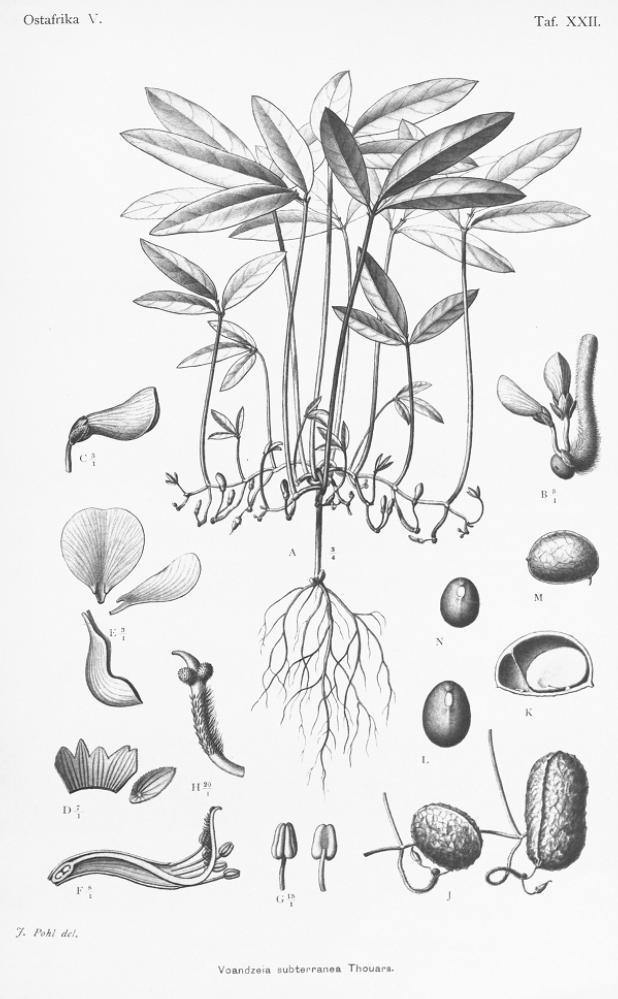
Bambara Groundnut

Bambara Groundnut

Vigna subterranea

Joseph Pohl, Public domain, via Wikimedia Commons

Side by side

Black GramBambara Groundnut
Scientific nameVigna mungo (L.) HepperVigna subterranea (L.) Verdc.
English nameBlack GramBambara Groundnut
GroupFlowering plantsFlowering plants
ClassMagnoliopsidaMagnoliopsida
OrderFabalesFabales
FamilyFabaceae BeanFabaceae Bean
GenusVigna CowpeaVigna Cowpea
Red List categoryNot recordedLeast Concern
Countries on record32 countries41 countries
GBIF occurrence records2,470 records5,135 records

Rows where the two agree are shown in grey.

Where each is found

Both recorded in 9 countries

Only Black Gram (23)

Only Bambara Groundnut (32)

From Catalogue of Life checklists and GBIF occurrence records. A country missing from a list means no record is held, which is not proof of absence.

Checked facts

Black GramBambara Groundnut
Appearance
Size
Habitat
  • The species is cultivated in tropical and subtropical dry climate zones. English Wikipedia
  • It grows well in sandy, well-drained soils that reduce waterlogging and pod rotting. English Wikipedia
  • The species is suited to relatively poor soils with a pH between 5 and 6.5. English Wikipedia
  • It tolerates saline soils, although high sodium chloride concentrations reduce its yield. English Wikipedia
  • The species is highly drought-resistant. English Wikipedia
  • Its minimum annual rainfall requirement is approximately 300 mm. English Wikipedia
  • Its optimal annual rainfall range is 750–1,400 mm. English Wikipedia
  • Its optimal growing temperature ranges from 19 °C to 30 °C. English Wikipedia
Diet
  • Black gram seeds contain 25 grams of protein per 100 grams of dry weight. English Wikipedia
  • Black gram seeds contain 983 milligrams of potassium per 100 grams. English Wikipedia
  • Black gram seeds contain 138 milligrams of calcium per 100 grams. English Wikipedia
  • Raw black gram contains 628 micrograms of folate per 100 grams. English Wikipedia
  • Cooked black gram contains 216 micrograms of folate per 100 grams. English Wikipedia
  • Black gram complements the essential amino acids supplied by most cereals. English Wikipedia
No checked fact yet
BehaviourNo checked fact yet
  • The plant is resistant to high temperatures and can grow in marginal soils unsuitable for some other legumes. English Wikipedia
Reproduction
  • The species reproduces through geocarpy, with its pods ripening underground. English Wikipedia
  • Its generative reproduction is autogamous and involves self-fertilization and self-pollination. English Wikipedia
  • Its flowers generally appear 40–60 days after planting. English Wikipedia
  • Its growth cycle generally lasts 90–170 days. English Wikipedia
  • Under optimal conditions, its pods mature approximately 120–150 days after planting. English Wikipedia
  • After pollination, the seeds fully develop over approximately 55 additional days. English Wikipedia
Distribution
  • Black gram originated in South Asia. English Wikipedia
  • The crop is extensively cultivated in southern India and northern Bangladesh and Nepal. English Wikipedia
  • The species has been introduced to the Caribbean, Fiji, Mauritius, Myanmar, and Africa. English Wikipedia
  • The introduction of black gram into several tropical regions was mainly associated with Indian immigrants. English Wikipedia
No checked fact yet
Uses
  • Black gram seeds are consumed whole or split and dehusked to prepare dal. English Wikipedia
  • Boiled whole or split black gram is consumed as food. English Wikipedia
  • Black gram is a key ingredient in the preparation of idli and dosa batter. English Wikipedia
  • Black gram is used to prepare vada, which is made from soaked batter and deep-fried in cooking oil. English Wikipedia
  • Black gram dough is used in the preparation of papadum. English Wikipedia
  • Black gram is used to prepare the traditional Nepali dish maas ko dal. English Wikipedia
  • Black gram is an ingredient in the North Indian dish dal makhani. English Wikipedia
  • Black gram is used to prepare the Uttarakhandi dish Chainsu or Chaisu. English Wikipedia
  • Black gram is used in the preparation of Dogra-style khichdi during Panj Bhikham and Makar Sankranti. English Wikipedia
  • Fermented black gram paste is used to prepare Lakhnapuri Bhalle and Lakhanpuri Laddu. English Wikipedia
  • Black gram is used as an ingredient in the Bengali foods kalai ruti and biulir dal. English Wikipedia
  • Black gram is one of the ingredients of the Rajasthani dish Panchmel dal. English Wikipedia
  • Black gram is consumed as a sweet in the Telugu states in the form of laddoos called Sunnundallu or Minapa. English Wikipedia
  • Black gram was historically used in medieval India to make crucibles impermeable. English Wikipedia
  • Black gram is traditionally used in South Asian cuisine. English Wikipedia
  • Black gram is traditionally used medicinally for conditions including dyspepsia, constipation, gastritis, and rheumatism. pmc.ncbi.nlm.nih.gov
  • Black gram contains phytochemicals belonging to several groups, including alkaloids, flavonoids, saponins, steroids, and tannins. pmc.ncbi.nlm.nih.gov
  • Black gram contains carbohydrates, amino acids, vitamins, and carotenoids. pmc.ncbi.nlm.nih.gov
  • Its cultivation is an important source of household income for women in Côte d’Ivoire. pmc.ncbi.nlm.nih.gov
  • Its flour is used in food preparation and can improve food digestibility. pmc.ncbi.nlm.nih.gov
  • The species is cultivated as both an intercrop and a sole crop alongside crops such as maize, cowpeas and melon. pmc.ncbi.nlm.nih.gov
  • Its cultivation can improve soil fertility through biological nitrogen fixation. English Wikipedia
Similar species
  • Black gram was formerly classified in the genus Phaseolus before being transferred to Vigna. English Wikipedia
  • Black gram is related to the mung bean. English Wikipedia
  • Black gram should not be confused with the smaller true black lentil, Lens culinaris. English Wikipedia
No checked fact yet
Other
  • Reported pharmacological activities of black gram include antioxidant, antidiabetic, and anti-inflammatory activities. pmc.ncbi.nlm.nih.gov
  • Scientific evidence supporting the biological activities attributed to black gram is currently scarce. pmc.ncbi.nlm.nih.gov
  • Black gram belongs to the subfamily Faboideae, also known as Papilionaceae, within Fabaceae. pmc.ncbi.nlm.nih.gov
  • Black gram is commonly known by the names urd, urid, Māsh, and black gram. pmc.ncbi.nlm.nih.gov
  • Black gram is recognized as a cultivated species of the genus Vigna. pmc.ncbi.nlm.nih.gov

In brief

Black Gram

The species originated in South Asia and is cultivated in South Asia. Black Gram is an annual plant with dense hairs, large hairy leaves, and narrow cylindrical pods. Full profile

Bambara Groundnut

Vigna subterranea is a herbaceous annual with creeping stems and pods that ripen underground. Full profile

Compare something else

Page built on 27 November 2026 from the data on the two species pages, where every source is listed.

Cite this page

ScientificNames.org. (2026). Black Gram vs Bambara Groundnut. Retrieved November 27, 2026, from https://scientificnames.org/compare/black-gram-vs-bambara-groundnut