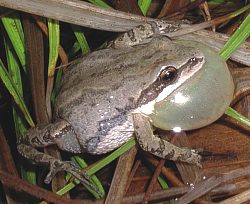
| Appearance | - Adults have smooth skin and coloration ranging from greenish-grey, reddish, olive, to brown. English Wikipedia
- Adults typically have three dark longitudinal stripes running down their backs. English Wikipedia
- The dorsal stripes may be broken, reduced, or absent in some individuals. English Wikipedia
- The underside is generally white or cream-colored with scattered dark flecks. English Wikipedia
- A white stripe runs along the upper lip, while a dark stripe extends from the snout across the eye and along each side. English Wikipedia
- Some individuals have a dark triangular marking on the head. English Wikipedia
- Tadpoles have rounded gray or brown bodies, transparent tail fins, and dark flecks. English Wikipedia
| - Adults have gray or light brown dorsal skin with small dark brown spots and a white abdomen. animaldiversity.org
- The species has yellowish limbs and groins, while males have dusky-yellow necks. animaldiversity.org
- Adults have rough skin, shortened broad toe pads, and webbing between their toes. animaldiversity.org
- The species lacks the dark eye stripe characteristic of the Baja California Treefrog. nps.gov
|
|---|
| Size | | |
|---|
| Habitat | - Adults inhabit open, damp environments including marshes, meadows, forest edges, fallow fields, bottomland swamps, and floodplains. animaldiversity.org
- The species can occupy rural, urban, and agricultural environments. macalester.edu
- Tadpoles and froglets occur in shallow ponds, temporary pools, ditches, marshes, swamps, river backwaters, and lake edges. macalester.edu
| - The species commonly inhabits streams with abundant boulders and cobbles in their channels. English Wikipedia
- Adults occupy canyon, desert, coastal, and mountain stream habitats. animaldiversity.org
- The species occurs in coastal sage habitats and streams at elevations from 0 to 2,290 m. animaldiversity.org
- In the Santa Monica Mountains and Simi Hills, the species occurs around coastal and canyon streams and rocky washes with permanent quiet pools. nps.gov
- During daylight, frogs shelter in small openings among boulders near the waterline. animaldiversity.org
- During fall and winter, frogs move to higher rock crevices to avoid drainage from heavy rainfall. animaldiversity.org
|
|---|
| Diet | - Adults consume small invertebrates including flies, mosquitoes, ants, beetles, moths, caterpillars, grasshoppers, and spiders. English Wikipedia
- Young froglets feed on small prey including mites, midges, and springtails. English Wikipedia
- Tadpoles feed on periphyton, filamentous algae, diatoms, and pollen. English Wikipedia
- Tadpoles can scavenge when food is available. English Wikipedia
| - Adult frogs eat insects, spiders, centipedes, and other invertebrates. nps.gov
- Tadpoles consume plant material, periphyton from algal mats, and organic detritus. animaldiversity.org
- Tadpoles feed on organic detritus and plant material. nps.gov
|
|---|
| Behaviour | - Males and occasionally females produce calls in large choruses. English Wikipedia
- Male calls attract potential mates to breeding sites. English Wikipedia
- The call can be heard from approximately half a mile away. English Wikipedia
- Individual calling bouts typically last 0.5 to 2 seconds. English Wikipedia
- When disturbed, individuals stop calling and retreat underwater or into nearby terrestrial cover. English Wikipedia
- Individuals use leaf litter, logs, rocks, and loose soil as winter hibernation shelters. English Wikipedia
- The species rarely climbs despite belonging to the treefrog family. animaldiversity.org
- Individuals are largely solitary outside breeding gatherings. animaldiversity.org
- Individuals can tolerate partial freezing of their body water during winter. animaldiversity.org
- The species has an average home range of approximately 2,116 square metres, including its breeding pond. animaldiversity.org
| - The species is predominantly nocturnal. animaldiversity.org
- Frogs undergo aestivation during periods of extreme heat or cold. animaldiversity.org
- Adults rarely remain in water outside breeding or predator-avoidance situations. animaldiversity.org
- The species undergoes torpor from December through March. animaldiversity.org
- Males use repeated, loud, low-pitched quacking calls to attract females during breeding. animaldiversity.org
- Males produce warning calls to intimidate competing males and defend their territories. animaldiversity.org
- Males display aggression and territoriality toward other males through combat and threatening vocalizations. animaldiversity.org
- The species has been observed cohabiting streams with fish that consume invertebrates. animaldiversity.org
|
|---|
| Reproduction | - The breeding season generally extends from March through May, depending on geographic location. macalester.edu
- Females produce approximately 500 to 1,500 eggs per breeding season. English Wikipedia
- Individual egg clusters generally contain between 20 and 300 eggs. English Wikipedia
- Females attach gelatinous egg clusters to submerged weeds or grasses near the edges of shallow water bodies. English Wikipedia
- Eggs generally hatch within 3 to 14 days after being laid. animaldiversity.org
- Tadpoles generally metamorphose within 40 to 90 days after hatching. animaldiversity.org
- Males fertilize eggs externally while females lay them. animaldiversity.org
- There is no known parental involvement after females have deposited their eggs. animaldiversity.org
- Females generally reach sexual maturity during their second or third year. macalester.edu
| - The breeding season generally extends from February to early October. nps.gov
- Breeding begins in early February after winter rainfall declines. animaldiversity.org
- Males attract females to breeding ponds and aquatic areas using mating calls. animaldiversity.org
- Mating occurs through inguinal amplexus, with males gripping females around their hips. animaldiversity.org
- Tadpoles undergo metamorphosis approximately 40–75 days after hatching. nps.gov
- Juveniles generally reach sexual maturity at approximately two years of age. animaldiversity.org
- Both parents leave the breeding ponds after spawning, indicating little or no parental care. animaldiversity.org
|
|---|
| Distribution | - The species occurs in Canada and the United States. English Wikipedia
- The documented range extends from Canada to the Gulf of Mexico and from New Jersey to central Arizona. English Wikipedia
| - The species occurs in coastal southern California and northern Baja California, Mexico. amphibiaweb.org
|
|---|
| Conservation | - The species is classified as Least Concern on the IUCN list. English Wikipedia
- The species is listed as threatened in the Great Lakes/St. Lawrence–Canadian Shield region under Canada's Species at Risk Act. English Wikipedia
- Populations are declining in certain areas despite the species' adaptability to human activity. English Wikipedia
| - The species is not considered threatened by the IUCN. English Wikipedia
- Habitat fragmentation may reduce genetic diversity among populations. English Wikipedia
- Tadpoles are sensitive to elevated nitrite concentrations associated with agricultural and urban runoff. nps.gov
- Exposure to ultraviolet radiation may reduce embryonic survival. English Wikipedia
- Rainbow trout and two-striped garter snakes prey on the species in stream ponds. English Wikipedia
- Invasive green sunfish prey on adult California tree frogs. English Wikipedia
|
|---|
| Uses | - The species serves as an indicator of environmental pollution and ecosystem health. English Wikipedia
- Changes in morphology or reproductive success can indicate environmental pollution or toxic substances. English Wikipedia
- The species helps control populations of small insects and other prey organisms. animaldiversity.org
| No checked fact yet |
|---|