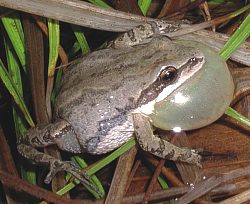
| Appearance | - Adults have smooth skin and coloration ranging from greenish-grey, reddish, olive, to brown. English Wikipedia
- Adults typically have three dark longitudinal stripes running down their backs. English Wikipedia
- The dorsal stripes may be broken, reduced, or absent in some individuals. English Wikipedia
- The underside is generally white or cream-colored with scattered dark flecks. English Wikipedia
- A white stripe runs along the upper lip, while a dark stripe extends from the snout across the eye and along each side. English Wikipedia
- Some individuals have a dark triangular marking on the head. English Wikipedia
- Tadpoles have rounded gray or brown bodies, transparent tail fins, and dark flecks. English Wikipedia
| - The species is normally pale brown, although individuals may have green or pink tinges. English Wikipedia
- The species has variable dark stripes extending through its eyes and along the sides of its body. English Wikipedia
- The species has a relatively slender body, long legs, small toe pads, and a pointed head. ncwildlife.gov
- Its coloration can be tan, reddish, greenish, or pinkish. ncwildlife.gov
|
|---|
| Size | | |
|---|
| Habitat | - Adults inhabit open, damp environments including marshes, meadows, forest edges, fallow fields, bottomland swamps, and floodplains. animaldiversity.org
- The species can occupy rural, urban, and agricultural environments. macalester.edu
- Tadpoles and froglets occur in shallow ponds, temporary pools, ditches, marshes, swamps, river backwaters, and lake edges. macalester.edu
| - The species inhabits a variety of ephemeral and semi-permanent wetlands in the southeastern Coastal Plain. English Wikipedia
- The species favors grassy areas in and around cypress ponds. English Wikipedia
- The species seldom inhabits permanent ponds, although it can occur there. English Wikipedia
- The species commonly occurs on lower tree trunks and foliage at heights of one metre or more. English Wikipedia
- The species uses grass, sedge, and sphagnum habitats in or near wetlands. amphibiaweb.org
- The species inhabits moist, grassy environments, particularly near temporary ponds and other Coastal Plain wetlands. ncwildlife.gov
|
|---|
| Diet | - Adults consume small invertebrates including flies, mosquitoes, ants, beetles, moths, caterpillars, grasshoppers, and spiders. English Wikipedia
- Young froglets feed on small prey including mites, midges, and springtails. English Wikipedia
- Tadpoles feed on periphyton, filamentous algae, diatoms, and pollen. English Wikipedia
- Tadpoles can scavenge when food is available. English Wikipedia
| - The species primarily feeds on arthropods associated with leaf litter and soil, including springtails, ants, thrips, and palpigrades. English Wikipedia
- Adult individuals have been recorded eating large cockroaches, walking sticks, and mites. English Wikipedia
|
|---|
| Behaviour | - Males and occasionally females produce calls in large choruses. English Wikipedia
- Male calls attract potential mates to breeding sites. English Wikipedia
- The call can be heard from approximately half a mile away. English Wikipedia
- Individual calling bouts typically last 0.5 to 2 seconds. English Wikipedia
- When disturbed, individuals stop calling and retreat underwater or into nearby terrestrial cover. English Wikipedia
- Individuals use leaf litter, logs, rocks, and loose soil as winter hibernation shelters. English Wikipedia
- The species rarely climbs despite belonging to the treefrog family. animaldiversity.org
- Individuals are largely solitary outside breeding gatherings. animaldiversity.org
- Individuals can tolerate partial freezing of their body water during winter. animaldiversity.org
- The species has an average home range of approximately 2,116 square metres, including its breeding pond. animaldiversity.org
| - The species spends considerable time foraging on the ground. English Wikipedia
- The species can rotate its head and neck more extensively than other frog species because of unusual vertebral flexibility. English Wikipedia
- The species is often active during both daytime and nighttime and can remain active throughout the year in some parts of its range. English Wikipedia
- The species can jump approximately 20 times its own body length. English Wikipedia
- The species uses coloration resembling surrounding vegetation as camouflage against predators. English Wikipedia
- Its dark eye and body stripes are thought to disrupt its outline against visually hunting predators. English Wikipedia
- The species produces a call consisting of a pure tone followed by a train of pulses, a combination described as unique within Hylidae. English Wikipedia
- Its call is a high-pitched, insect-like tinkling sound that can be heard throughout the year. ncwildlife.gov
- Some people cannot hear the species' call because of its high pitch. ncwildlife.gov
|
|---|
| Reproduction | - The breeding season generally extends from March through May, depending on geographic location. macalester.edu
- Females produce approximately 500 to 1,500 eggs per breeding season. English Wikipedia
- Individual egg clusters generally contain between 20 and 300 eggs. English Wikipedia
- Females attach gelatinous egg clusters to submerged weeds or grasses near the edges of shallow water bodies. English Wikipedia
- Eggs generally hatch within 3 to 14 days after being laid. animaldiversity.org
- Tadpoles generally metamorphose within 40 to 90 days after hatching. animaldiversity.org
- Males fertilize eggs externally while females lay them. animaldiversity.org
- There is no known parental involvement after females have deposited their eggs. animaldiversity.org
- Females generally reach sexual maturity during their second or third year. macalester.edu
| - Males attract females by calling while perched on grass stems or tree trunks. English Wikipedia
- The species breeds in shallow, fish-free wetlands, including cypress domes, marshes, bogs, wet prairies, wet flatwoods, and floodplain forests. English Wikipedia
- Females can reproduce more than once during an annual reproductive cycle. English Wikipedia
- Females usually deposit eggs on the bottom of ponds or on vegetation in shallow water. English Wikipedia
- Females lay an average of 100 eggs per clutch and can produce as many as 200. English Wikipedia
- Eggs are deposited in clusters containing one to five eggs. English Wikipedia
- The eggs hatch within one to two days. English Wikipedia
- Larvae take between seven and 70 days to undergo metamorphosis. English Wikipedia
- The species' tadpoles complete metamorphosis six to ten weeks after hatching. ncwildlife.gov
|
|---|
| Distribution | - The species occurs in Canada and the United States. English Wikipedia
- The documented range extends from Canada to the Gulf of Mexico and from New Jersey to central Arizona. English Wikipedia
| - The species is endemic to the southeastern United States. English Wikipedia
- Its documented range extends from southern Florida and Alabama northward to Virginia. English Wikipedia
- The species occurs in the Coastal Plain of North Carolina. ncwildlife.gov
- The species occurs in the southeastern regions of Virginia. dwr.virginia.gov
|
|---|
| Conservation | - The species is classified as Least Concern on the IUCN list. English Wikipedia
- The species is listed as threatened in the Great Lakes/St. Lawrence–Canadian Shield region under Canada's Species at Risk Act. English Wikipedia
- Populations are declining in certain areas despite the species' adaptability to human activity. English Wikipedia
| - The species can serve as an indicator of healthy wetlands. English Wikipedia
- The species is noticeably absent from urbanized wetlands. English Wikipedia
- The species is classified as a nongame species in North Carolina and has no open season. ncwildlife.gov
- No problems have been reported for this species in the North Carolina Wildlife Diversity Program quarterly reports. ncwildlife.gov
|
|---|
| Uses | - The species serves as an indicator of environmental pollution and ecosystem health. English Wikipedia
- Changes in morphology or reproductive success can indicate environmental pollution or toxic substances. English Wikipedia
- The species helps control populations of small insects and other prey organisms. animaldiversity.org
| No checked fact yet |
|---|
| Other | No checked fact yet | |
|---|