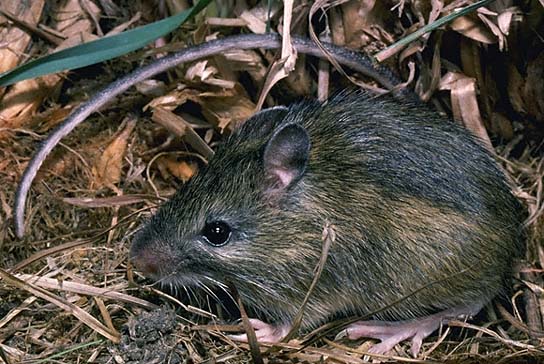
| Appearance | - The western jumping mouse has coarse, dark-greyish-brown fur on its upper body, a broad yellow-to-red band along its flanks, and pale yellowish-white underparts. English Wikipedia
- The species has elongated hind feet and reduced forelimbs. English Wikipedia
- Some individuals have white spots on their upper body or tail tip. English Wikipedia
- Males and females are similar in appearance and size. English Wikipedia
- The species has a dark dorsal band, yellow sides, and a usually white belly that may have a yellow tinge. animaldiversity.org
| - The lesser Egyptian jerboa has three toes on each hind foot. English Wikipedia
- The species has a very long tail that helps it maintain balance when jumping. English Wikipedia
- The species has large eyes, large ears, and a relatively short snout. English Wikipedia
- Its coat ranges from pale to dark sandy in colour and has a lighter underside. English Wikipedia
|
|---|
| Size | | No checked fact yet |
|---|
| Habitat | - The species inhabits mountainous terrain with moderately damp climates. English Wikipedia
- The species occurs in meadows and forests dominated by alder, aspen, or willow. English Wikipedia
- Individuals are commonly found in dense vegetation near fresh water. English Wikipedia
- The species inhabits moist fields, thickets, and woodlands with dense grass, sedge, or other green plant cover. animaldiversity.org
- Individuals are usually found within 50 metres of streams, ponds, or lakes. animaldiversity.org
- Individuals live in self-dug burrows or burrows made by other animals. animaldiversity.org
| - The species inhabits desert environments that may be sandy or rocky. English Wikipedia
- The lesser Egyptian jerboa lives in desert and semi-desert areas with sandy or stony substrates. animaldiversity.org
|
|---|
| Diet | - The species is omnivorous, with grass and herb seeds forming the largest part of its diet. English Wikipedia
- Other food items include fruits, fungi, and insects. English Wikipedia
- The main foods consumed include arthropods, seeds, and leaves. animaldiversity.org
- Arthropods may replace seeds as an important food source when seeds are unavailable. animaldiversity.org
- The species is mostly herbivorous and eats seeds, fruit, and occasionally insects. swap.dgf.nm.gov
| |
|---|
| Behaviour | - The species is primarily nocturnal but may also forage during daylight. animaldiversity.org
- Individuals are active during summer and hibernate during the remainder of the year. English Wikipedia
- In some locations, individuals spend eight to ten months annually in hibernation. English Wikipedia
- During hibernation, individuals rely entirely on stored body fat rather than cached food. English Wikipedia
- During hibernation, individuals wake on average once every 38 days. English Wikipedia
- Individuals generally enter their dens after the first snowfall if they have not entered earlier. English Wikipedia
- Individuals emerge from hibernation when ground temperatures reach approximately 8–9.5 °C. English Wikipedia
- When alarmed, individuals drum their tails against the ground. animaldiversity.org
- When startled, individuals can escape through a series of jumps measuring 90–150 cm. animaldiversity.org
- Individuals can swim and climb. animaldiversity.org
- Individuals tend to use existing runways made by other animals. animaldiversity.org
- Fat deposition begins approximately one month before hibernation. animaldiversity.org
| - The lesser Egyptian jerboa is strictly nocturnal. English Wikipedia
- The lesser Egyptian jerboa uses its acute sense of smell to detect food. English Wikipedia
- The species can survive without drinking water by obtaining its water requirements from food. English Wikipedia
- The species can travel up to ten kilometres in a day while searching for food. English Wikipedia
- The lesser Egyptian jerboa can leap up to three metres in a single jump. English Wikipedia
- The species lives in burrows that it excavates using its forelimbs and teeth. English Wikipedia
- Its permanent burrows can contain storage chambers, hibernation chambers, and a nesting chamber. English Wikipedia
- The species seals its burrows with sand plugs during late spring and summer. English Wikipedia
- The species uses its burrows to rest, avoid predators, and escape daytime heat. English Wikipedia
- The lesser Egyptian jerboa has also been observed sheltering beneath desert truffles. English Wikipedia
- The species may enter aestivation in its burrow during particularly hot or dry periods. English Wikipedia
- Winter hibernation has been suggested for the species but has only been reported in a few individuals. English Wikipedia
- The lesser Egyptian jerboa is generally silent but may grunt or shriek when disturbed or handled. English Wikipedia
|
|---|
| Reproduction | | - Breeding has been recorded at least twice annually, during June–July and October–December. English Wikipedia
- Males attract females through a ritual display performed while standing on their hind legs. English Wikipedia
- During courtship, males slap approaching females at regular intervals using their short forelimbs. English Wikipedia
- A successful mating usually results in a litter of four to five offspring. English Wikipedia
- Young become independent at approximately eight to ten weeks of age. English Wikipedia
- The species reaches sexual maturity at approximately eight to twelve months of age. English Wikipedia
|
|---|
| Distribution | - The species occurs in western North America from Yukon to New Mexico. English Wikipedia
- The species occurs throughout western Canada and much of the western United States. animaldiversity.org
| - The species occurs throughout the Sahara Desert, in scattered parts of the Sahel, and in the Middle East. English Wikipedia
|
|---|
| Conservation | - The species is classified as less vulnerable to climate change under both RCP 4.5 and RCP 8.5 scenarios in the New Mexico assessment. swap.dgf.nm.gov
| No checked fact yet |
|---|
| Uses | - The species is an important component of healthy grass-dominated habitats throughout its range. animaldiversity.org
| No checked fact yet |
|---|