Comparison
White-dotted Cattleheart vs Burchell's Cattleheart
White-dotted Cattleheart (Parides alopius) and Burchell's Cattleheart (Parides burchellanus) both belong to the genus Parides (cattlehearts) and part ways below it.
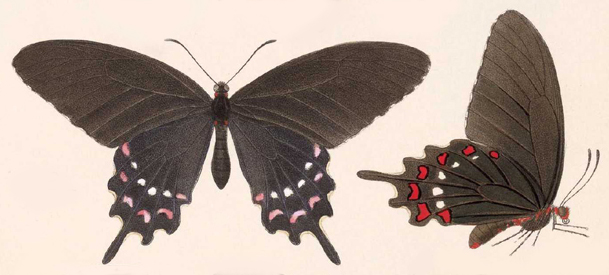
White-dotted Cattleheart
Parides alopius
Frederick DuCane Godman and Osbert Salvin, Public domain, via Wikimedia Commons


Side by side
| White-dotted Cattleheart | Burchell's Cattleheart | |
|---|---|---|
| Scientific name | Parides alopius (Godman & Salvin, 1890) | Parides burchellanus (Westwood, 1872) |
| English name | White-dotted Cattleheart | Burchell's Cattleheart |
| Group | Insects | Insects |
| Class | Insecta Insect | Insecta Insect |
| Order | Lepidoptera | Lepidoptera |
| Family | Papilionidae Swallowtail Butterfly | Papilionidae Swallowtail Butterfly |
| Genus | Parides Cattlehearts | Parides Cattlehearts |
| Named in | 1890 | 1872 |
| Red List category | Not recorded | Endangered |
| Countries on record | 1 country | 1 country |
| GBIF occurrence records | 343 records | 13 records |
Rows where the two agree are shown in grey.
Where each is found
Only White-dotted Cattleheart (1)
Only Burchell's Cattleheart (1)
From Catalogue of Life checklists and GBIF occurrence records. A country missing from a list means no record is held, which is not proof of absence.
Checked facts
| White-dotted Cattleheart | Burchell's Cattleheart | |
|---|---|---|
| Appearance |
|
|
| Size |
| No checked fact yet |
| Habitat |
|
|
| Diet |
|
|
| Behaviour |
| No checked fact yet |
| Reproduction |
| No checked fact yet |
| Distribution | No checked fact yet |
|
| Conservation |
|
|
| Similar species |
|
|
In brief
White-dotted Cattleheart
Parides alopius has black upper wing surfaces and two rows of submarginal hindwing spots, with white spots in the first row and pink spots in the second. Full profile
Burchell's Cattleheart
Burchell's Cattleheart belongs to the Parides aeneas species group. It occurs in only a few locations in central Brazil, inhabiting gallery or riparian forests along rivers crossing the Brazilian cerrado landscape. It has velvet-black wings, small white marginal spots on the forewings, and red spots on the underside of the hindwings. Full profile
Compare something else
Page built on 29 November 2026 from the data on the two species pages, where every source is listed.
Cite this page
ScientificNames.org. (2026). White-dotted Cattleheart vs Burchell's Cattleheart. Retrieved November 29, 2026, from https://scientificnames.org/compare/white-dotted-cattleheart-vs-burchells-cattleheart
“White-dotted Cattleheart vs Burchell's Cattleheart.” ScientificNames.org, 2026, scientificnames.org/compare/white-dotted-cattleheart-vs-burchells-cattleheart. Accessed 29 Nov. 2026.
ScientificNames.org. “White-dotted Cattleheart vs Burchell's Cattleheart.” Accessed November 29, 2026. https://scientificnames.org/compare/white-dotted-cattleheart-vs-burchells-cattleheart.
@misc{scientificnames_white_dotted_cattleheart_vs_burchells_cattleheart,
  author = {{ScientificNames.org}},
  title = {White-dotted Cattleheart vs Burchell's Cattleheart},
  year = {2026},
  url = {https://scientificnames.org/compare/white-dotted-cattleheart-vs-burchells-cattleheart},
  note = {Accessed 2026-11-29}
}