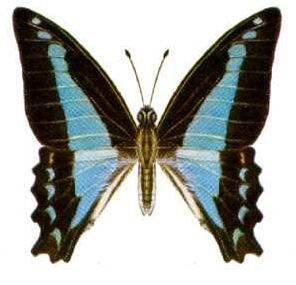
Comparison

White Lady vs Common Bluebottle

White Lady (Graphium morania) and Common Bluebottle (Graphium sarpedon) both belong to the genus Graphium (swordtail butterfly) and part ways below it.

White Lady

White Lady

Graphium morania

Roland Trimen, Public domain, via Wikimedia Commons

Common Bluebottle

Common Bluebottle

Graphium sarpedon

Commonwealth Scientific and Industrial Research Organisation (CSIRO), Public domain, via Wikimedia Commons

Side by side

White LadyCommon Bluebottle
Scientific nameGraphium morania (Angas, 1849)Graphium sarpedon (Linnaeus, 1758)
English nameWhite LadyCommon Bluebottle
GroupInsectsInsects
ClassInsecta InsectInsecta Insect
OrderLepidopteraLepidoptera
FamilyPapilionidae Swallowtail ButterflyPapilionidae Swallowtail Butterfly
GenusGraphium Swordtail ButterflyGraphium Swordtail Butterfly
Named in18491758
Red List categoryLeast ConcernLeast Concern
Countries on record5 countries22 countries
GBIF occurrence records360 records19,260 records

Rows where the two agree are shown in grey.

Where each is found

Only White Lady (5)

Only Common Bluebottle (22)

From Catalogue of Life checklists and GBIF occurrence records. A country missing from a list means no record is held, which is not proof of absence.

Checked facts

White LadyCommon Bluebottle
Appearance
  • The hindwing underside lacks red spots in the marginal band. English Wikipedia
  • Both upper wings have white spots in the marginal band. English Wikipedia
  • The abdomen lacks a continuous yellow lateral stripe and may have up to three yellow lateral spots on segments 2–4, alongside triangular black lateral spots. English Wikipedia
  • The forewing cell apex has either one white spot or two narrowly or incompletely separated white spots. English Wikipedia
  • The discal spot in forewing cellule 2 is large enough to fill its base completely. English Wikipedia
  • The upper hindwing's white subdiscal spots in cellules 2–5 lie closer to the inner margin than to the outer margin of the black marginal band. English Wikipedia
  • The wing markings are yellowish or greenish white. English Wikipedia
  • The upper wings are opaque black and crossed by a broad, pale blue medial band. English Wikipedia
  • The medial wing band is broadest in the middle and becomes greenish and spotted toward the front. English Wikipedia
  • The portion of the blue band crossing hindwing interspaces 6, 7 and 8 is white. English Wikipedia
  • The hindwings have a sub-terminal line of slender blue crescent-shaped markings. English Wikipedia
  • The underside has a dark brown ground colour. English Wikipedia
  • The hindwing underside has narrow crimson lines crossing its velvety black postdiscal area. English Wikipedia
  • A crimson spot near the hindwing's tornal angle is accompanied by an admarginal yellowish-white spot below it. English Wikipedia
  • The head and thorax are brown with a greenish-grey suffusion. English Wikipedia
Size
HabitatNo checked fact yet
  • The species primarily inhabits moist, low-level rain forests below 1,600 m elevation. English Wikipedia
  • The butterfly is usually observed flying just above the tree canopy in its low-elevation habitat. English Wikipedia
  • The larvae have expanded their habitat to include cinnamon tree plantations. English Wikipedia
Diet
  • Adult butterflies feed on nectar from various flowering herbs. English Wikipedia
  • The larvae primarily eat leaves of plants belonging to the Lauraceae, Myrtaceae, Sapotaceae and Rutaceae families. English Wikipedia
  • The subspecies G. s. sarpedon and G. s. teredon frequently feed on cinnamon bark tree and Indian laurel leaves. English Wikipedia
  • Camphor tree leaves are eaten by virtually all subspecies. English Wikipedia
Behaviour
  • The species flies throughout the year, with activity peaking in November and February. English Wikipedia
  • Male butterflies commonly feed at the edges of roadside puddles. English Wikipedia
  • Groups of as many as eight males have been observed at one puddle. English Wikipedia
  • The species has also been observed visiting animal droppings, carcasses and rotting insects. English Wikipedia
  • The species has been recorded migrating in southern India. English Wikipedia
  • The species engages in mud-puddling during migration. English Wikipedia
  • The species has accounted for as much as five percent of migrating butterflies observed over a 72-hour period in the Nilgiri hills. English Wikipedia
  • The butterfly has rapid flight and quick reactions, making it difficult to catch. English Wikipedia
ReproductionNo checked fact yet
  • Females lay yellowish eggs individually on host plant leaves. English Wikipedia
  • Young larvae are black or dark green and bear numerous spines. English Wikipedia
  • Mature larvae are green and have short spines on each thoracic segment and the anal segment. English Wikipedia
  • Mature larvae have a transverse yellow band on the fourth body segment and a lateral body band. English Wikipedia
  • Larvae generally rest on the upper surface near the centre of a leaf. English Wikipedia
  • Larvae are sluggish and pupate near their feeding location. English Wikipedia
  • The pupa is green and has a slender, pointed projection on the thorax. English Wikipedia
  • The pupa has yellowish wing cases and lateral bands. English Wikipedia
Distribution
  • The species occurs in KwaZulu-Natal, Zululand, Eswatini, Transvaal, southern Mozambique, southeastern Zimbabwe, and eastern Botswana. English Wikipedia
  • The species' stated geographical range extends from Ovambo Land to Delagoa Bay. English Wikipedia
Similar species
  • Graphium morania belongs to a six-member clade whose members have similar genitalia. English Wikipedia
  • Graphium angolanus is listed as a member of the same clade as Graphium morania. English Wikipedia
  • Graphium endochus is listed as a member of the same clade as Graphium morania. English Wikipedia
  • Graphium taboranus is listed as a member of the same clade as Graphium morania. English Wikipedia
  • Graphium schaffgotschi is listed as a member of the same clade as Graphium morania. English Wikipedia
  • Graphium ridleyanus is listed as a member of the same clade as Graphium morania. English Wikipedia
No checked fact yet

In brief

White Lady

The species occurs in KwaZulu-Natal, Zululand, Eswatini, Transvaal, southern Mozambique, southeastern Zimbabwe, and eastern Botswana. Its wing markings are yellowish or greenish white, and both upper wings have white spots in the marginal band. Full profile

Common Bluebottle

The species occurs in East, South and Southeast Asia. Full profile

Compare something else

Page built on 27 November 2026 from the data on the two species pages, where every source is listed.

Cite this page

ScientificNames.org. (2026). White Lady vs Common Bluebottle. Retrieved November 27, 2026, from https://scientificnames.org/compare/white-lady-vs-common-bluebottle