Comparison
Woodwards' Batis vs Cape Batis
Woodwards' Batis (Batis fratrum) and Cape Batis (Batis capensis) both belong to the genus Batis (batises) and part ways below it. Both are recorded in 4 countries.
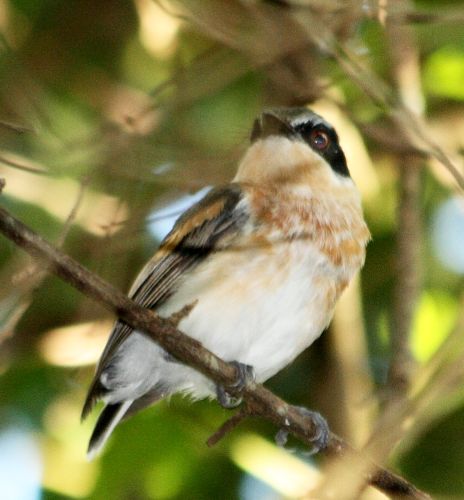


Side by side
| Woodwards' Batis | Cape Batis | |
|---|---|---|
| Scientific name | Batis fratrum (Shelley in Woodward & Woodward, 1900) | Batis capensis (Linnaeus, 1766) |
| English name | Woodwards' Batis | Cape Batis |
| Group | Birds | Birds |
| Class | Aves Bird | Aves Bird |
| Order | Passeriformes Passerine | Passeriformes Passerine |
| Family | Platysteiridae Wattle-eye | Platysteiridae Wattle-eye |
| Genus | Batis Batises | Batis Batises |
| Named in | 1900 | 1766 |
| Red List category | Least Concern | Least Concern |
| Environment | terrestrial | Not recorded |
| Countries on record | 4 countries | 9 countries |
| GBIF occurrence records | 3,205 records | 65,411 records |
Rows where the two agree are shown in grey.
Where each is found
Both recorded in 4 countries
Only Cape Batis (5)
From Catalogue of Life checklists and GBIF occurrence records. A country missing from a list means no record is held, which is not proof of absence.
Checked facts
| Woodwards' Batis | Cape Batis | |
|---|---|---|
| Appearance |
|
|
| Size |
|
|
| Habitat |
|
|
| Diet |
|
|
| Behaviour | No checked fact yet |
|
| Reproduction |
|
|
| Distribution |
|
|
| Conservation |
| No checked fact yet |
| Similar species | No checked fact yet |
|
| Name origin |
|
|
| Other |
|
|
In brief
Woodwards' Batis
Woodwards' Batis is a bird in the family Platysteiridae, order Passeriformes, class Aves, currently placed in the genus Batis. It is endemic to southeastern Africa, occurring from northeastern KwaZulu-Natal in South Africa along coastal northern Mozambique and southern Malawi to remnant forests in southeastern Zimbabwe. It has blue-grey upperparts, a black facial mask, orange-red eyes and a black tail with white markings. Full profile
Cape Batis
The Cape Batis (Batis capensis) is a small, stout passerine bird in the family Platysteiridae, order Passeriformes and class Aves. It inhabits cool coastal forests and moist evergreen mountain forests. Adult males have a broad black breast band, while females and juveniles have a narrower rufous breast band and a small rufous throat patch. Full profile
Compare something else
Page built on 28 November 2026 from the data on the two species pages, where every source is listed.
Cite this page
ScientificNames.org. (2026). Woodwards' Batis vs Cape Batis. Retrieved November 28, 2026, from https://scientificnames.org/compare/woodwards-batis-vs-cape-batis
“Woodwards' Batis vs Cape Batis.” ScientificNames.org, 2026, scientificnames.org/compare/woodwards-batis-vs-cape-batis. Accessed 28 Nov. 2026.
ScientificNames.org. “Woodwards' Batis vs Cape Batis.” Accessed November 28, 2026. https://scientificnames.org/compare/woodwards-batis-vs-cape-batis.
@misc{scientificnames_woodwards_batis_vs_cape_batis,
  author = {{ScientificNames.org}},
  title = {Woodwards' Batis vs Cape Batis},
  year = {2026},
  url = {https://scientificnames.org/compare/woodwards-batis-vs-cape-batis},
  note = {Accessed 2026-11-28}
}