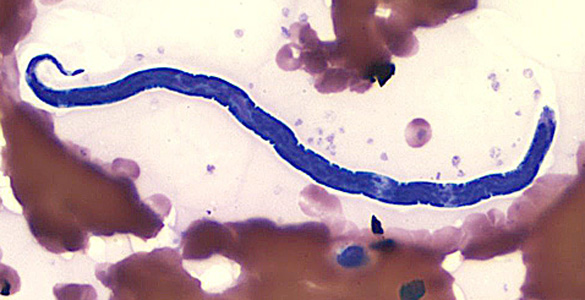
| Appearance | - Adult worms are translucent white, slender, cylindrical, and smooth-bodied, with rounded ends. English Wikipedia
- The head is rounded and separated from the main body by a neck-like constriction. animaldiversity.org
- Adult males have a ventrally curved tail, whereas females have a gradually tapering tail with a rounded tip. English Wikipedia
- The female's tail gradually tapers and ends in a rounded tip. animaldiversity.org
- The microfilariae have a sheath surrounding their bodies. cdc.gov
- The microfilariae have a gently curved body and a pointed, tapered tail. cdc.gov
- The nuclei in the microfilarial nuclear column do not extend to the tip of the tail. cdc.gov
| |
|---|
| Size | - Adult females measure approximately 80–100 mm in length and 0.24–0.30 mm in diameter. cdc.gov
- Adult males measure approximately 40 mm in length. cdc.gov
- Microfilariae measure approximately 240–300 μm in stained blood smears. cdc.gov
- Microfilariae measure approximately 275–320 μm in 2% formalin. cdc.gov
- The eggs average 40 μm by 25 μm. animaldiversity.org
- The microfilarial embryo averages 290 μm by 6–7 μm. animaldiversity.org
| - Adult female worms measure approximately 20–70 mm in length and about 425 micrometers in width. English Wikipedia
- Adult male worms measure approximately 20–34 mm long and 350–430 micrometers wide. English Wikipedia
- Female adult worms are typically larger than males. animaldiversity.org
- Microfilariae measure approximately 250–300 micrometers long and 6–8 micrometers wide. English Wikipedia
|
|---|
| Habitat | - Adult worms primarily inhabit human lymphatic vessels and occur less commonly in blood vessels. cdc.gov
- Adult worms are particularly common in lymphatic vessels in the groin region. animaldiversity.org
- Adult parasites are frequently located in afferent lymphatic channels of lymph glands in the lower body. English Wikipedia
- The species occurs in environments where mosquitoes are found, including areas around temporary pools and standing water. animaldiversity.org
| |
|---|
| Diet | | |
|---|
| Behaviour | - Microfilariae exhibit nocturnal periodicity in their circulation in most regions. cdc.gov
- Microfilariae are most abundant in peripheral blood between approximately 10 pm and 4 am. English Wikipedia
- Microfilariae migrate into deep veins during the day and peripheral circulation during the night. English Wikipedia
- The species moves in a serpentine pattern by contracting its longitudinal muscles. animaldiversity.org
- The species relies on chemosensation rather than vision to detect environmental chemicals and mating pheromones. animaldiversity.org
- Adult males and females commonly remain coiled together. English Wikipedia
| - Adult worms migrate through the subcutaneous tissues of their hosts throughout the day. animaldiversity.org
- Microfilariae circulate in the bloodstream during daylight hours and migrate into the lungs at night. English Wikipedia
- Microfilariae retreat into the lungs during nighttime. animaldiversity.org
- Microfilariae can be ingested by deerflies when the flies feed on infected human hosts. animaldiversity.org
- In their fly intermediate hosts, microfilariae develop in the fat body. animaldiversity.org
- Infective juvenile worms migrate to the mouthparts of their fly hosts. animaldiversity.org
- The species is an obligate endoparasite of humans. animaldiversity.org
|
|---|
| Reproduction | - The species has separate male and female individuals. animaldiversity.org
- Reproduction requires copulation between individuals of opposite sexes. animaldiversity.org
- Female worms produce thousands of microfilariae after mating. English Wikipedia
- Male worms use their coiled tail regions to grasp females during copulation. animaldiversity.org
- Male copulatory spicules help hold open the female reproductive opening during sperm transfer. animaldiversity.org
- The species completes its lifecycle using humans as definitive hosts and mosquitoes as intermediate hosts. English Wikipedia
- Larvae develop into sexually mature adult worms in human lymphatic vessels over approximately one year. English Wikipedia
- The parasite does not multiply inside its mosquito intermediate host. English Wikipedia
| - Loa loa reproduces sexually within its definitive human host. English Wikipedia
- Female worms produce microfilariae after mating. animaldiversity.org
- Female worms continuously produce large numbers of microfilariae throughout their lifetimes. English Wikipedia
- Female worms may produce pheromones that attract males. animaldiversity.org
- During copulation, the male coils around the female with its curved region positioned over her genital pore. animaldiversity.org
- Male worms use spicules to hold females during copulation. animaldiversity.org
- The species has amoeboid-like sperm that lack flagella. animaldiversity.org
- After approximately one year of development in the definitive host, worms reach adulthood and may begin the reproductive cycle again. animaldiversity.org
|
|---|
| Distribution | - The species is endemic throughout most of Sub-Saharan Africa, Madagascar, several Western Pacific island nations and territories, and parts of the Caribbean. cdc.gov
- The species also occurs sporadically in South America, India, and Southeast Asia. cdc.gov
| - Loa loa occurs in rainforests of West Africa and equatorial Sudan. animaldiversity.org
- The species is associated with Central Africa and parts of West Africa. pmc.ncbi.nlm.nih.gov
- The species is transmitted by the deerfly species Chrysops dimidiata and Chrysops silacea. pmc.ncbi.nlm.nih.gov
- The parasite is transmitted to humans through repeated bites from infected deerflies. cdc.gov
|
|---|
| Conservation | No checked fact yet | - Larval mortality is high because most parasites fail to reach suitable hosts. animaldiversity.org
|
|---|
| Other | - The species is a major causative agent of lymphatic filariasis in humans. English Wikipedia
| - Loa loa causes the disease known as loiasis. English Wikipedia
- The species is classified as a filarial nematode. English Wikipedia
- Adult worms migrating beneath the conjunctiva of the eye account for the common name eye worm. cdc.gov
- Adult worms can cause localized swellings known as Calabar swellings. English Wikipedia
- Infections with Loa loa are frequently asymptomatic. cdc.gov
- Loa loa does not spread directly from one person to another. cdc.gov
|
|---|