Comparison

Pygmy Slow Loris vs Bangka Slow Loris

Pygmy Slow Loris (Xanthonycticebus pygmaeus) and Bangka Slow Loris (Nycticebus bancanus) both belong to the subfamily Lorisinae and part ways below it.

Pygmy Slow Loris

Pygmy Slow Loris

Xanthonycticebus pygmaeus

David Haring / Duke Lemur Center, CC BY-SA 3.0, via Wikimedia Commons
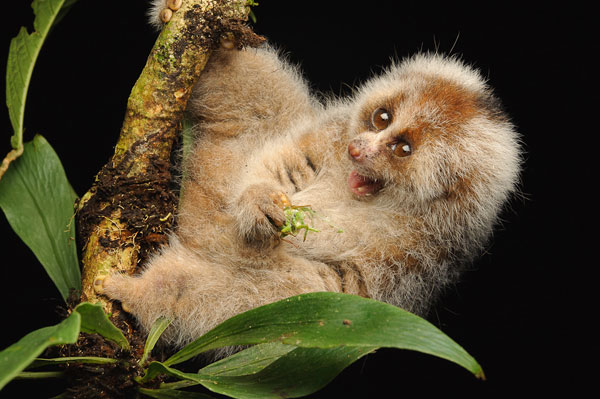
Bangka Slow Loris

Bangka Slow Loris

Nycticebus bancanus

Gunay M.E., CC BY-SA 4.0, via Wikimedia Commons

Side by side

Pygmy Slow LorisBangka Slow Loris
Scientific nameXanthonycticebus pygmaeus (Bonhote, 1907)Nycticebus bancanus Lyon, 1906
English namePygmy Slow LorisBangka Slow Loris
GroupMammalsMammals
ClassMammalia MammalMammalia Mammal
OrderPrimates PrimatePrimates Primate
FamilyLorisidae PottosLorisidae Pottos
GenusXanthonycticebus Pygmy LorisesNycticebus Slow Loris
Named in19071906
Red List categoryEndangeredCritically Endangered
Countries on record5 countriesNot recorded
GBIF occurrence records151 recordsNot recorded

Rows where the two agree are shown in grey.

Where each is found

Only Pygmy Slow Loris (5)

From Catalogue of Life checklists and GBIF occurrence records. A country missing from a list means no record is held, which is not proof of absence.

Checked facts

Pygmy Slow LorisBangka Slow Loris
Appearance
  • The species has a white stripe running from its nose to its forehead. English Wikipedia
  • The sides of the head and upper lip are silvery gray, while the rest of the face and crown are rufous. English Wikipedia
  • The species has small black ears measuring approximately 23 mm. English Wikipedia
  • A rufous to brownish-black stripe extends along the dorsal surface from the nape to the middle of the lower back. English Wikipedia
  • The species has russet, reddish-buff, or brownish upper body coloration. English Wikipedia
  • The species has buff-colored flanks that are paler than its back. English Wikipedia
  • The species has silvery-white hands and feet with yellowish-white nails. English Wikipedia
  • The species has a round face and an intermediate interorbital distance. pmc.ncbi.nlm.nih.gov
  • The species has a reduced index digit and a very large third hand pad. pmc.ncbi.nlm.nih.gov
  • The species undergoes a seasonal change in its coat. pmc.ncbi.nlm.nih.gov
  • The species has a diploid chromosome number of 50. English Wikipedia
SizeNo checked fact yet
  • The average body length of the Bangka slow loris is 258.05 mm (10.159 inches). English Wikipedia
Habitat
  • The species inhabits tropical dry, semi-evergreen, and evergreen forests. English Wikipedia
  • The species inhabits semi-evergreen, secondary, and temperate broadleaf and mixed forests. English Wikipedia
  • The species inhabits primary evergreen forests, semi-evergreen forests, limestone forests, degraded habitats, and bamboo thickets. pmc.ncbi.nlm.nih.gov
Diet
  • The species consumes termites, ants, other insects, and fruit. English Wikipedia
  • Tree gum accounts for approximately 63% of the diet in a Vietnamese dietary study. English Wikipedia
  • The species obtains tree exudates from trees belonging to the Sapindaceae, Euphorbiaceae, Fabaceae, Anacardiaceae, and Burseraceae families. English Wikipedia
Behaviour
  • The species is nocturnal and arboreal. English Wikipedia
  • The species moves slowly along branches while searching for prey and does not leap. English Wikipedia
  • The species is generally encountered alone or in groups of two to four individuals in the wild. English Wikipedia
  • The species is least active on cold, moonlit nights. English Wikipedia
  • The species uses scent marking to defend territories and mark territorial boundaries. English Wikipedia
  • The species produces a toxic secretion from its brachial glands that becomes noxious when mixed with saliva. English Wikipedia
  • The species has a diverse locomotor repertoire that includes clambering, quadrupedalism, and vertical climbing. pmc.ncbi.nlm.nih.gov
  • The species primarily uses small and large substrates, with small substrates accounting for 57.91% of recorded use. pmc.ncbi.nlm.nih.gov
  • Horizontal and oblique substrates account for most recorded substrate use. pmc.ncbi.nlm.nih.gov
  • Standing is the most frequently recorded posture, accounting for 47.23% of observations. pmc.ncbi.nlm.nih.gov
  • The species spends most of its recorded activity on multiple substrates. pmc.ncbi.nlm.nih.gov
  • The Bangka slow loris is nocturnal. English Wikipedia
  • The species uses its curved second hind-toe claw for scratching and grooming. English Wikipedia
  • The species uses its toothcomb for grooming. English Wikipedia
  • The Bangka slow loris uses secretions from its brachial gland defensively by wiping them onto its toothcomb. English Wikipedia
  • The species has a toxic bite, a distinctive characteristic among primates. English Wikipedia
  • The species activates its brachial gland toxin by mixing the secretion with saliva. English Wikipedia
  • The species applies toxin to its fur during grooming to protect its infants. English Wikipedia
ReproductionNo checked fact yet
DistributionNo checked fact yet
  • The Bangka slow loris occurs in southwestern Borneo and on Bangka Island. English Wikipedia
Conservation
  • The species is classified as Endangered on the IUCN Red List. English Wikipedia
  • The species is threatened by hunting, trade, and habitat destruction. English Wikipedia
  • Illegal hunting, pet trade, habitat degradation, and traditional medicine use are identified as major threats to the species. pmc.ncbi.nlm.nih.gov
  • Conservation of forest habitats and ex situ reintroduction programs are identified as measures that can support the species' populations. pmc.ncbi.nlm.nih.gov
  • The Bangka slow loris was assessed by the IUCN in 2015 as Critically Endangered. iucnredlist.org
  • Habitat loss is one of the greatest threats to the survival of the Bangka slow loris. English Wikipedia
  • Illegal wildlife trade is a major threat to the species. English Wikipedia
  • The species is protected from commercial trade under Appendix I of CITES. English Wikipedia
  • Tin mining and oil palm plantations have caused extensive habitat destruction on Bangka Island. English Wikipedia
Similar speciesNo checked fact yet
  • The Bangka slow loris was formerly classified as a subspecies or synonym of the Bornean slow loris, Nycticebus menagensis. English Wikipedia
  • Nycticebus bancanus was elevated to full species status in 2013 following examination of museum specimens and photographs. English Wikipedia
Name originNo checked fact yet
OtherNo checked fact yet

In brief

Pygmy Slow Loris

Xanthonycticebus pygmaeus inhabits tropical dry, semi-evergreen, evergreen, secondary, and temperate broadleaf and mixed forests, as well as limestone forests, degraded habitats, and bamboo thickets. It has a white stripe running from its nose to its forehead. Full profile

Bangka Slow Loris

The Bangka Slow Loris belongs to the family Lorisidae. It occurs in southwestern Borneo and on Bangka Island. It has a toxic bite, a distinctive characteristic among primates. Full profile

Compare something else

Page built on 29 November 2026 from the data on the two species pages, where every source is listed.

Cite this page

ScientificNames.org. (2026). Pygmy Slow Loris vs Bangka Slow Loris. Retrieved November 29, 2026, from https://scientificnames.org/compare/pygmy-slow-loris-vs-bangka-slow-loris