Comparison
Banana Yucca vs Big Bend Yucca
Banana Yucca (Yucca baccata) and Big Bend Yucca (Yucca rostrata) both belong to the genus Yucca (spanish-bayonet) and part ways below it. Both are recorded in 2 countries.
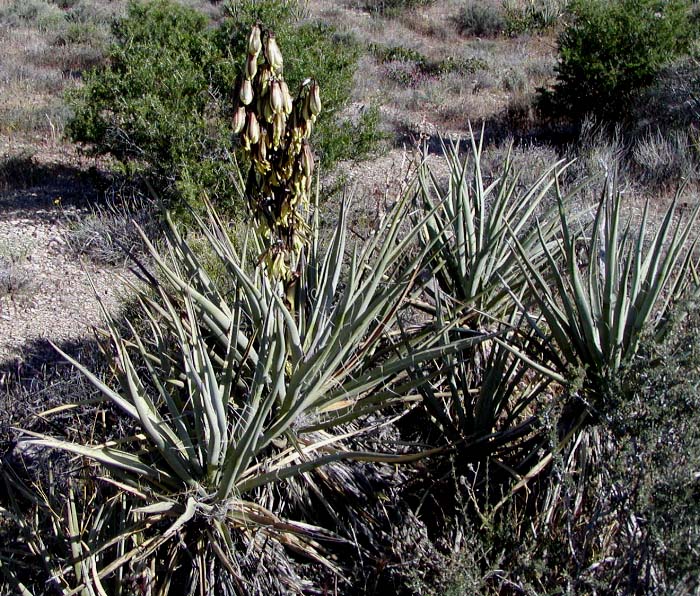


Side by side
| Banana Yucca | Big Bend Yucca | |
|---|---|---|
| Scientific name | Yucca baccata Torr. | Yucca rostrata Engelm. ex Trel. |
| English name | Banana Yucca | Big Bend Yucca |
| Group | Flowering plants | Flowering plants |
| Class | Liliopsida | Liliopsida |
| Order | Asparagales | Asparagales |
| Family | Asparagaceae Asparagus Family | Asparagaceae Asparagus Family |
| Genus | Yucca Spanish-bayonet | Yucca Spanish-bayonet |
| Red List category | Least Concern | Least Concern |
| Countries on record | 2 countries | 2 countries |
| GBIF occurrence records | 12,431 records | 411 records |
Rows where the two agree are shown in grey.
Where each is found
Both recorded in 2 countries
From Catalogue of Life checklists and GBIF occurrence records. A country missing from a list means no record is held, which is not proof of absence.
Checked facts
| Banana Yucca | Big Bend Yucca | |
|---|---|---|
| Appearance |
|
|
| Size |
|
|
| Habitat |
|
|
| Behaviour |
|
|
| Reproduction |
|
|
| Distribution |
|
|
| Conservation |
|
|
| Uses |
|
|
| Similar species |
|
|
| Other |
| No checked fact yet |
In brief
Banana Yucca
Yucca baccata is native to the southwestern United States and northern Mexico. It is distinguished by its fleshy, cylindrical fruit, which measures 8–18 cm long and approximately 6 cm across. Full profile
Big Bend Yucca
Yucca rostrata is native to Brewster County in western Texas and the Mexican states of Chihuahua and Coahuila. It is distinguished by rosettes of more than 100 bluish-green leaves and large inflorescences bearing pendent white flowers. Full profile
Compare something else
Page built on 28 November 2026 from the data on the two species pages, where every source is listed.
Cite this page
ScientificNames.org. (2026). Banana Yucca vs Big Bend Yucca. Retrieved November 28, 2026, from https://scientificnames.org/compare/banana-yucca-vs-big-bend-yucca
“Banana Yucca vs Big Bend Yucca.” ScientificNames.org, 2026, scientificnames.org/compare/banana-yucca-vs-big-bend-yucca. Accessed 28 Nov. 2026.
ScientificNames.org. “Banana Yucca vs Big Bend Yucca.” Accessed November 28, 2026. https://scientificnames.org/compare/banana-yucca-vs-big-bend-yucca.
@misc{scientificnames_banana_yucca_vs_big_bend_yucca,
  author = {{ScientificNames.org}},
  title = {Banana Yucca vs Big Bend Yucca},
  year = {2026},
  url = {https://scientificnames.org/compare/banana-yucca-vs-big-bend-yucca},
  note = {Accessed 2026-11-28}
}