Comparison

Redspot vs Xerces Blue

Redspot (Zesius chrysomallus) and Xerces Blue (Glaucopsyche xerces) both belong to the family Lycaenidae (blues) and part ways below it.

Redspot

Redspot

Zesius chrysomallus

Butterflyrajib, CC BY-SA 4.0, via Wikimedia Commons

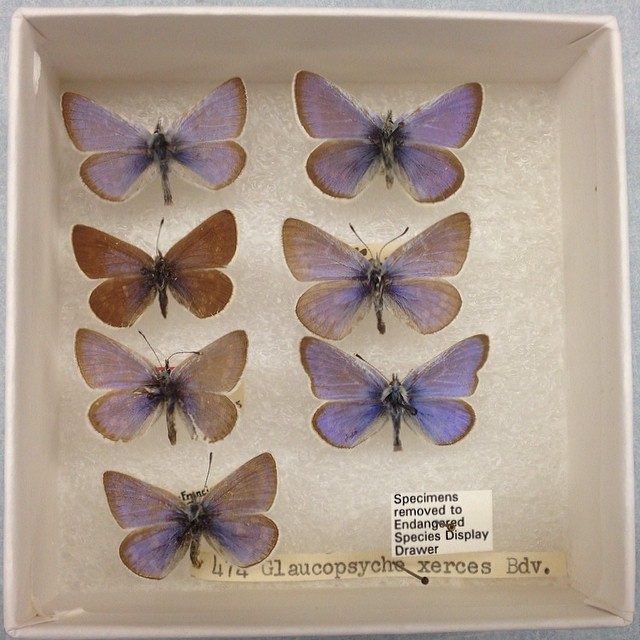
Xerces Blue

Xerces Blue

Glaucopsyche xerces

Brianwray26, CC BY-SA 4.0, via Wikimedia Commons

Side by side

RedspotXerces Blue
Scientific nameZesius chrysomallus Hübner, 1823Glaucopsyche xerces (Boisduval, 1852)
English nameRedspotXerces Blue
GroupInsectsInsects
ClassInsecta InsectInsecta Insect
OrderLepidopteraLepidoptera
FamilyLycaenidae BluesLycaenidae Blues
GenusZesiusGlaucopsyche
Named in18231852
Red List categoryNot recordedExtinct
Countries on record3 countries3 countries
GBIF occurrence records289 records886 records

Rows where the two agree are shown in grey.

Where each is found

Only Redspot (3)

Only Xerces Blue (3)

From Catalogue of Life checklists and GBIF occurrence records. A country missing from a list means no record is held, which is not proof of absence.

Checked facts

RedspotXerces Blue
Appearance
  • The male has a pale copper-red upper wing surface with finely blackish-brown veins. English Wikipedia
  • The male has narrow brown bands along the forewing costa and outer margin. English Wikipedia
  • The male hindwing has three sub-terminal brown spots in the anal interspaces, bordered by slender greyish-blue lines. English Wikipedia
  • The male has brown tails with white tips. English Wikipedia
  • The male underside is pale grey with pale reddish-brown markings edged by dark brown and white lines. English Wikipedia
  • The male has black antennae with whitish undersides and orange-red tips on the clubs. English Wikipedia
  • The female forewing has a pale blue upper surface with blackish-brown marginal borders carrying a violet tint. English Wikipedia
  • The female hindwing has a blue ground colour variably suffused with blackish-brown. English Wikipedia
  • The female hindwing has a large sub-terminal black spot in each of the next two interspaces, with the first spot crowned with orange. English Wikipedia
  • The female hindwing has blackish tails tipped with white, with an additional tail at vein 3 approximately half the length of the others. English Wikipedia
  • The female underside has the same pattern as the male underside but a paler ground colour. English Wikipedia
  • Males have iridescent blue coloration on the upper surfaces of their wings and pale spots on the undersides. floridamuseum.ufl.edu
  • The species exhibited extensive variation in wing patterns, with several named forms. floridamuseum.ufl.edu
  • The species was characterized by blue wings with white spots. English Wikipedia
SizeNo checked fact yet
HabitatNo checked fact yet
  • The species inhabited coastal sand dunes on the San Francisco Peninsula in California. English Wikipedia
  • The species preferred stabilized sandy sites where its low-growing larval host plant grew. floridamuseum.ufl.edu
  • The species occupied coastal sand dunes in the upper San Francisco Peninsula, including areas now within the Golden Gate National Recreation Area. floridamuseum.ufl.edu
Diet
  • The caterpillars used Lotus scoparius (Deerweed) as their preferred larval host plant. pmc.ncbi.nlm.nih.gov
  • The butterflies fed on plants belonging to the genera Lotus and Lupinus. English Wikipedia
  • Lupinus was another recorded vegetative food source, but it was unsuitable for the larval stages. English Wikipedia
BehaviourNo checked fact yet
  • The species had a major flight period documented in historical biological studies. pmc.ncbi.nlm.nih.gov
ReproductionNo checked fact yet
Distribution
  • Zesius chrysomallus occurs in Sri Lanka and India. English Wikipedia
  • The species' distribution extends more than 250 km into central Gujarat from previously known southern locations. academia.edu
  • Recent sightings of the species were reported in Anand district, Gujarat. academia.edu
  • The species was endemic to the coastal sand dunes of the upper San Francisco Peninsula in California. floridamuseum.ufl.edu
ConservationNo checked fact yet
  • The Xerces blue is extinct, with its extinction associated with habitat loss caused by urban development. English Wikipedia
  • The last known living individuals were observed in the early 1940s. pmc.ncbi.nlm.nih.gov
  • Urban development and disturbance of sandy soils caused the local loss of important host plants, contributing to the species' extinction. pmc.ncbi.nlm.nih.gov
  • The loss of Lotus plants used by the larvae is considered a contributing factor in the species' extinction. English Wikipedia
  • The introduction of the Argentine ant coincided with the species' decline and has been proposed as a possible contributing factor. pmc.ncbi.nlm.nih.gov
  • The invasive Argentine ant was proposed as a possible threat because it may have outcompeted native ants that tend and protect the caterpillars. pmc.ncbi.nlm.nih.gov
  • The species' extinction inspired the establishment of the Xerces Society for Invertebrate Conservation in 1971. floridamuseum.ufl.edu
  • The species is recognized as an important symbol of insect conservation in North America. pmc.ncbi.nlm.nih.gov
Similar speciesNo checked fact yet
  • The closest relatives of the Xerces blue are Glaucopsyche australis and Glaucopsyche pseudoxerces. English Wikipedia
  • The Xerces blue's closest relative group is most closely related to Glaucopsyche lygdamus, commonly called the silvery blue. English Wikipedia
  • Historical researchers considered the Xerces blue and Glaucopsyche lygdamus closely related but separate species. pmc.ncbi.nlm.nih.gov
OtherNo checked fact yet
  • Genetic analyses of museum specimens confirmed that the Xerces blue was a distinct species. pmc.ncbi.nlm.nih.gov
  • DNA analysis was conducted using a museum specimen collected in 1928. pmc.ncbi.nlm.nih.gov
  • The DNA analysis recovered 210,182,214 nucleotides from the museum specimen. pmc.ncbi.nlm.nih.gov
  • Preserved specimens of the species are held by the California Academy of Sciences, Bohart Museum, and Harvard Museum of Natural History. English Wikipedia
  • The Florida Museum of Natural History's McGuire Center holds specimens of the species. floridamuseum.ufl.edu

In brief

Redspot

Redspot occurs in Sri Lanka and India, with its distribution extending more than 250 km into central Gujarat from previously known southern locations. Full profile

Xerces Blue

Glaucopsyche xerces inhabited coastal sand dunes on the upper San Francisco Peninsula in California. It was a small butterfly characterized by blue wings with white spots. Full profile

Compare something else

Page built on 28 November 2026 from the data on the two species pages, where every source is listed.

Cite this page

ScientificNames.org. (2026). Redspot vs Xerces Blue. Retrieved November 28, 2026, from https://scientificnames.org/compare/redspot-vs-xerces-blue